50 Years of Fire Service Technology
Key Takeaways
- The passing of the Federal Fire Prevention and Control Act of 1974 was a major point of interest in the development of firefighter safety, communications, capabilities and standardization.
- The year that Firehouse Magazine launched (1976) corresponded with wide acceptance on the part of fire departments of the use of hydraulic rescue tools. The publication has reported on technological advancements in regard to firefighter safety and effectiveness at every turn since then.
- Despite myriad instances of innovation that have made the fire service more effective for its members and the people who it serves, Firehouse’s main subject matter experts believe that the future will deliver improvements that will be leaps and bounds ahead of what already has come to pass.
Note: Full converage of Firehouse's 50th Anniversary
When we were asked to collaborate on the 50th anniversary of Firehouse, particularly within the technology sphere, it instantly took us back to thinking about what technology was like back in 1976 and at the beginning of our respective careers—and not just fire service technology but also as a society.
Paper maps & handwritten logbooks
Rotary phones still were common—although some people had push-button models—but all of them were all hard-lined and still had shared party lines. Typewriters (manual or electric) were found throughout the various administrative offices, and at a local firehouse, you likely still had every record in a handwritten logbook. Cameras still were film, and special training was required to properly develop images. Paper maps, map books and even large hand-drawn maps were found in fire stations and glove boxes of most vehicles.
If you were fortunate enough to have a TV, it most likely was small and had a rabbit ear antenna sticking up for reception. Vinyl records, 8-track tapes and cassette tapes were the primary source of recorded music, and none of these devices could fit in your pocket. Libraries full of encyclopedias and other printed materials were the primary source for researching something that you didn’t know, and you had better know the Dewey Decimal System to find what you wanted. People had fax machines for quick file transfer, but most correspondence still went through the postal service, given that email and other electronic mediums weren’t widely used. Training was mostly hands on unless you were lucky enough to have a slide projector, and all purchasing transactions were conducted in person or through mail in catalogs.
Start of an evolution
Looking particularly at the fire service, the passing of the Federal Fire Prevention and Control Act of 1974 was a major point of interest in the development of firefighter safety, communications, capabilities and standardization.
When the inaugural issue of Firehouse was published, SCBAs were beginning to be commonplace for interior structural firefighting but included heavy steel cylinders. Multilayered protective clothing was replacing the traditional rubber coats and long boots. Kevlar, Nomex and fiberglass also were gaining popularity for protective equipment use, but leather still was the go-to material for fire helmets.
Although UHF and VHF radios were common, they were shared between staff and apparatus, mainly carried by the officer. Hydraulic rescue tools also were being used more as agencies began transitioning to take on more medical and rescue roles.
Fire pumps, both positive displacement and centrifugal, matured, and with the addition of more-powerful diesel engines in apparatus, they became the new standard. Foam proportioning systems were in regular use at airports, refineries and even some forward-thinking municipal departments. Aluminum ladders were in widespread use, although some departments held onto wooden ladders for the rest of the decade. Elevated aerial platforms and snorkels were increasingly more common, as modern hydraulics improved capabilities.
Gasoline-powered saws replaced axes for vertical ventilation, but the saws were extremely heavy and didn’t have the safety features nor the battery-powered operation that today’s models have.
Although there was no standardized incident command system, wildfires in California were influencing organization and accountability practices.
Reflections from Werner
I started my fire service career in 1974. My earliest recollections take me back to duck turnout coats, pull-up boots, extremely limited and heavy “walking talkies,” a much more mechanical environment, SCBA with steel tanks and open-cab apparatus. Everything was handwritten. Seat belts rarely were used when responding to calls. Acceptance of the use of SCBA was limited.
I was blessed to have a great interest in and understanding of the development of technology and began a career of challenging the status quo from the perspective of safety and effectiveness. As innovative technologies evolved, I explored how they could enhance safety and effectiveness in the fire service. I was fortunate to be in the Charlottesville, VA, Fire Department and with my supportive chief, Julian Taliaferro, who encouraged innovation.
Through an invite from Harvey Eisner, Firehouse allowed me a forum by which to share these new technologies and advancements with a larger audience. The first article that I wrote for Firehouse was “The Internet: A Global Fire Service,” and the first fire service internet phone call was made to the London Fire Brigade from Firehouse Expo in Baltimore.
The technological advances to follow were influenced mostly by the electronic/computer/digital era. When I first started authoring articles for Firehouse, they were typed and sent via snail mail. Around 1998, I had the opportunity to work with Jeff Barrington at Firehouse to implement its first email, first file transfer process and the launch of Firehouse.com, with the help of Christopher Hebert and Dave Iannone. The website became widely recognized as the website that was dedicated exclusively to the fire service.
I was able to experiment with many technologies within my department and then share those concepts in Firehouse and on Firehouse.com.
Some of the other technology milestones that I had an opportunity to work on and share were through the International Association of Fire Chiefs (IAFC). I helped to create the IAFC Technology Council, with then-IAFC President Jeff Johnson. I served as the group’s first chair (still serve today), which provided opportunities to work on numerous technology projects to enhance safety and effectiveness, which included addressing the digital radio interference issue, geographic information systems (GIS), TICs, communications interoperability, website development, smartphones/tablets/apps, Bluetooth, new cutting tools, fire apparatus hearing protection systems, internet as a new means of automatic vehicle location (AVL) and the development of what would become FirstNet, which gave the first and only true priority and preemption to public safety.
What I have seen over 50 years in public safety has been amazing, but it will be dwarfed by what is to come. AI, robotics, self-driving vehicles and the continued development of new electronic technologies are moving faster than many can comprehend. This is evolving into smart interconnected cities, a new Intelligent Emergency Response System, and an entirely new set of challenges and opportunities. Technology will advance community risk reduction (CRR) by providing real-time analysis, to enable more innovative ways to address community risk.
I believe that 3D firefighter location soon will be achieved, with full firefighter biometric monitoring 24/7/365, to help to improve firefighter health and reduce cancer and mortality rates.
The future of innovation in the fire service and emergency services is great and moving at light speed.
Reflections from Moore
I started my career in 2000. When I look back on the technological advancements throughout my career, it seems as though things have quickened.
I can remember the salty firefighters of the past telling stories of the times before SCBAs but never going into a fire without one after the equipment entered the marketplace. I had the pleasure of wearing steel, aluminum and carbon-fiber SCBAs, with and without integrated PASS devices.
I never wore anything other than a multilayered turnout coat and pants, with a mix of leather and composite helmets and boots.
I remember holding one of the first commercially available TICs but also saw the evolution that resulted in one on every firefighter in my department.
I just missed the days of physically riding on the tailboard, but I still can remember the “fun” of responding in the rain or snow in open-cab apparatus.
I remember the days of only the officer having a radio but also enjoyed the era of Bluetooth connections and nationwide improvements to public safety communications, including FirstNet.
I witnessed drones moving from a novelty purchase to an operational necessity and actively participated in the evolution of the fire service mission from just responders to CRR professionals.
At the end of my career—and in my next job in fire service technology—I was able to experience cloud solutions, Internet of Things integrations, advanced analytics and GIS-based technology that enhances every decision that’s made.
The quickening of technology intrigues me, and as the next generations of firefighters step up, I look forward to seeing how the fire service evolves to face the new and currently imperceivable threats to our communities.
Although I only have been writing for Firehouse for a short time compared with Chief Werner, it has been an awesome experience to share tech trends, emerging tech and best practices to avoid tech problems. Thanks to everyone who has supported my journey and allowed me to contribute to the learning and knowledge of the fire service.
Important Technological Milestones
Looking forward from the time that Firehouse began to serve firefighters everywhere, there are several major technological milestones to celebrate.
- 1976: Fire departments’ wide acceptance of the HURST Jaws of Life.
- 1978–1980: Incident Command System spreads nationally, standardizing command structures at emergency incidents.
- 1980: First 800 MHz public safety trunked radio system established.
- 1981: NFPA SCBA standard establishes national performance requirements, which greatly improves reliability, performance and standardization.
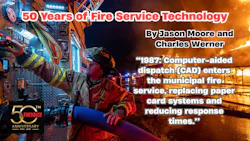
- 1987: Computer-aided dispatch (CAD) enters the municipal fire service, replacing paper card systems and reducing response times.
- 1990s: Automated voice dispatch and linked station-alerting technology become widely used.
- 1990s: Significant advancements in hazmat-detection devices.
- 1990–1992: Personal alert safety system (PASS) devices introduced and improve the survivability of an incapacitated firefighter.
- 1993–1995: Mobile Data Terminals hit mainstream use to provide instant access to dispatch information, maps, hydrant locations and preplans.
- 1995–2005: Hearing protection systems introduced into fire apparatus.
- 1996–1999: Portable thermal imaging cameras (TICs) become practical, although they still were large, bulky and extremely expensive.
- 2001: TICs come down enough in price so that they begin to go into widespread use.
- 2002: FDNY is the first municipal fire agency to implement full-scale, motion-based driving simulators for fire apparatus and ambulances.
- 2003: Rapid intervention crews/teams (RIC/RIT) become a standard practice following national attention on firefighter fatality investigations.
- 2005: Carbon-fiber SCBA cylinders revolutionize SCBA by reducing weight but also allowing the increase of air capacity.
- 2007: Improved PASS standards add high-temperature testing requirements to solve fireground failures.
- 2010: NFPA passes a TIC standard, which aids in ruggedizing the equipment to withstand fireground conditions.
- 2011–2013: SCBAs begin to incorporate electronic air management, wireless PASS, buddy breathing and digital displays.
- 2014–2016: Battery-powered rescue tools eliminate heavy power units and hoses, to reshape extrication and rescue operations.
- 2016–2018: Drone technology enters regular use for wildfire mapping, search and rescue, hazmat incidents and post-fire assessment.
- 2019: COVID-19 pushes everyone to virtual meetings and training.
- 2020–2022: Expanded use of battery-powered equipment now includes saws, ventilation fans and additional rescue tools.
- 2022–2024: Smart PPE accelerates, including the addition of biometric monitoring of firefighters, telemetry pertaining to air consumption, environmental sensors and enhanced communication systems.
- 2024: Multiple NFPA PPE standards are consolidated and emphasize the reduction of per- and polyfluoroalkyl substances (PFAS).
- 2025–Present: AI-assisted intelligence, automated and semi-automated drones, the drone swarm concept, dedicated satellites for wildfire detection, edge detection augmented reality and 3D tracking of firefighters gain national adoption.
About the Author
 Jason Moore
Jason Moore
Jason Moore is a 23-year veteran of the fire service who began his career with the U.S. Air Force as a fire protection specialist. Moore is involved with the International Association of Fire Chiefs’ Technology Council and is a founding member/associate director of the Indiana University Crisis Technologies Innovation Lab (IU Red Lab). He delivered presentations on implementing technology, using technology for community risk reduction and best practices to justify funding for innovative programs. Moore was the keynote speaker at FireFusion 2024 and is a member of the Firehouse Editorial Advisory Board.
 Charles Werner
Charles Werner
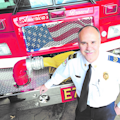
CHARLES WERNER is a 45-year veteran of public safety. He served with the Charlottesville, VA, Fire Department for 37 years, serving the last 10 years of his tenure as chief. Following retirement, Werner served for two years as senior adviser and acting deputy state coordinator for the Virginia Department of Emergency Management. He has chaired: DHS SAFECOM Executive Committee; IAFC Technology Council; National Information Sharing Consortium; and DHS/White House Incident Management Information Sharing SubCommittee. Werner currently serves as the director of DroneResponders Public Safety Alliance, chair of the National Council on Public Safety UAS and chair of the Virginia Secure Commonwealth UAS Sub Panel.