New 'Zone Zero' Wildfire Prevention Measures Draw Ire in San Diego County
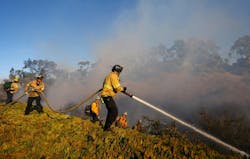
The San Diego City Council ended 2025 — a year that brought wildfires to the forefront of people’s minds — by enacting a controversial new set of fire prevention rules.
So far, local reaction to the new regulations is mixed, with some saying they make “good sense” and others questioning whether there can be exceptions to the rules.
The regulations, dubbed “Zone Zero,” were approved by the council’s Public Safety Committee on Dec. 12 and by the full council four days later — both times with no discussion. They were then discussed by the Planning Commission during a December workshop where the commission did not vote on the rules.
Zone Zero goes beyond rules for Zone 1, which refers to the area within a 5- to 35-foot radius of a home, and for Zone 2, the area between 35 and 100 feet, to address the five feet of space directly next to a home.
The new rules essentially say nothing flammable can be in that zone. While plants and other landscaping are the chief focus, the law also applies to fencing, patios and decks made of wood or other flammable materials.
Zone Zero will take effect in February, applying only to new construction at first. Most existing homes that don’t already conform with the regulations will have until February 2027 to comply.
The rules apply only in “very high” fire hazard severity zones, but the vast majority of San Diego — about two-thirds — is in such a zone, including some of La Jolla.
Several areas of La Jolla — including Soledad Natural Park, La Jolla Heights Natural Park, Torrey Pines State Natural Reserve and UC San Diego — were identified as having very high fire hazards in a 2025 assessment by Cal Fire, the first new map since 2011 laying out fire hazard zones across the state.
Critics of Zone Zero say it will cost homeowners thousands of dollars to comply, while supporters say the rules are expected to dramatically boost wildfire prevention.
Planning Commissioner Daniel Reeves said last month that Zone Zero is likely to be particularly impactful because San Diego has so many homes beside canyons.
“There are thousands of homeowners on canyons that are probably not compliant even with the Zone 1 and 2 requirements, let alone Zone Zero,” Reeves said. “So it will be interesting how enforcement is done there.”
City officials said they plan to focus on education over enforcement, acknowledging they don’t have the resources for aggressive enforcement.
“There are so many parcels that we just don’t have enough staff to really enforce,” said Daniel Hypes, the city’s assistant fire marshal. “When we get complaints, we will go and investigate.”
The San Diego Fire-Rescue Department does educational home risk assessments on request, and Hypes said they are expected to become more crucial with the Zone Zero rules in effect.
Even without enforcement, most homeowners likely will have to comply with the rules or risk losing fire insurance, said Deputy Fire Chief Tony Tosca.
“If we don’t do it, then the insurance is going to impose it anyway,” he said.
Tosca said city officials plan to be flexible in some situations — for instance, allowing a 100-year-old tree within five feet of a home.
“We’re not going to expect them to cut it down,” he said. “We’ll give them options. We’re going to do a lot of education and outreach.”
At the Jan. 8 La Jolla Town Council meeting, firefighters advocated compliance with Zone Zero and discussed its role in statewide efforts to prevent wildfires.
Fire prevention inspector Jordan Harrer said Zone Zero is “an extension of the home hardening that many of us are already doing to extend outward from the home.” It was implemented because the area within five feet of a house is “where embers most commonly land and ignite materials,” he said.
It’s not about “cosmetic changes” but rather “reducing wildfire risk at the home itself,” he added.
Though the new regulations initially apply to new construction, Harrer said owners of existing houses can meet the terms of Zone Zero if they “keep the area around your home clear of combustible debris, avoid storing … combustible items against walls or under windows [and] clear the leaves and needles from roofs and gutters.”
La Jolla landscape architect Jim Neri said that although bringing properties into compliance might be expensive for homeowners who have flammable vegetation or fixtures in the 5-foot space, Zone Zero is a good idea.
“From the recent fires we can see that La Jolla is no more protected than Pacific Palisades, so implementing these preventive standards now makes good sense,” Neri said, referring to the devastating wildfire in Los Angeles a year ago and to fires in San Diego County, including La Jolla, last year. “It also provides a good maintenance path around homes for window washing, painting, repairs and termite tenting and is considered in property insurance as well. From a landscape architecture standpoint, it becomes another aspect of any design program.”
However, he added, it “should be tempered with common sense to allow for fire-retardant landscape such as succulents and living walls in limited amounts so Municipal Code landscape requirements may be met.”
Hoping for such flexibility, La Jolla Shores resident Richard Stennes questioned whether his property would be exempt, given that efforts already have been taken in his neighborhood to reduce fire risk, such as spraying the citrus-based flame retardant Citrotech on the landscaping near his property.
“I certainly do have a concern about [Zone Zero] because it would require me to cut down the tree in front of the house and a lot of bushes and I have no risk of fire as I have installed the Citrotech system, which prevents anything burning,” he wrote in correspondence shared with the La Jolla Light. “In the absence of such fire prevention, the fire mitigation would include removing plants within five feet of your house. I’m sure that many [in the neighborhood] are going to be impacted by that.”
At the Town Council meeting, Stennes asked whether any exceptions may allow vegetation if other mitigation measures are taken. Harrer said the answer is “potentially” but that the city is waiting for guidance from the state on that.
“We are not going door to door to issue fines to people that either don’t or can’t comply with Zone Zero,” Harrer said. “What we want to work toward is a … change to the community.” ♦
©2026 The San Diego Union-Tribune. Visit sandiegouniontribune.com. Distributed by Tribune Content Agency, LLC.