NIOSH: Failure to Recognize Basement Fire Dangers a Factor in Chicago LODD Blaze
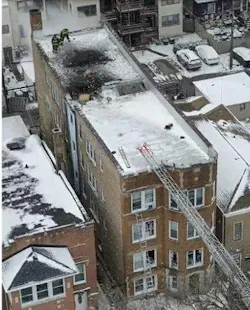
Failure to recognize dangers associated with below grade fires, uncoordinated ventilation and fire control, communications issues and lack of thermal imaging were among issues NIOSH investigators listed as factors at a March fire that claimed Chicago Firefighter/EMT Michael Altman.
"Recognizing a below grade fire is essential to developing proper strategy and tactical objectives. Below grade fires can be one of the most dangerous and challenging fires. Operating over a below grade fire exposes firefighters to intense heat and no visibility."
Altman, who fell through the floor into basement, died of burns the day after the arson fire.
"Early identification of basements and their access points are critical during the initial on-scene size-up and a component of the 360 size-up. If the use of basements is a common component of building design within a particular community, then a basement should be considered as part of the scene size-up. The presence or lack of a basement must be communicated to everyone involved in the incident to minimize or eliminate the opportunity for fire crews to end up working above a basement fire without their
knowledge," according to the report.
Among the dangers below grade fires include limited entry and egress into a basement, unusual and/or unanticipated void spaces, working above the fire on potentially weakened floor joists and flooring materials, being caught in the fire’s exhaust portion of the flow path, unknown and frequently excessive fire loading, restricted ventilation options Utility panels and meters plus connections, separate areas connected by non-fire stopped utility penetrations, hanging wires and ductwork and distribution of contents (e.g., furniture, appliances).
After interviewing firefighters and incident commanders, the following were listed as contributing factors in the fatal blaze:
- Uncoordinated ventilation and fire control
- Basement/below grade fire
- Thermal imager use and firefighter survival
- Personnel accountability system
- Structured communications protocols
- Arson and delayed activation of fire department response
- Building and property inspections
The investigators also recommended fire departments provide firefighters with training and operational support to coordinate ventilation and fire control tactics considering how ventilation affects fire behavior.
"During interviews with NIOSH, many firefighters described notable wind on the day of this incident. It was also noted that initially there was almost no sign that a fire was burning in the building from the Side Alpha perspective and smoke was only visible on Sides Bravo and Charlie. This could have been an indicator of the fire being ventilation-limited and compartmentalized. The wind was blowing from the north-northwest directly toward the Side Alpha entrance of the building."
Also, while a thermal imaging camera had been purchased for each seat position on trucks, they had not been placed in service "due to administrative uncertainty about the recording ability...and lack
of departmental policies around them."
As of the report date, they had still not been placed on the rigs, investigators noted.
"Equipping personnel with technology to allow them to perceive
the environment in which they are operating allows them to make decisions based on the conditions they can observe through the TI. The use of a TI may allow personnel to see breaches in the floor, temperature differentials by use of the color palettes...and could better equip them to
determine if a room can be entered safely."
About the Author
 Susan Nicol
News Editor
Susan Nicol is the news editor for Firehouse.com. She is a life member and active with the Brunswick Volunteer Ambulance & Rescue Company, Oxford Fire Company and Brunswick Vol. Fire Co. Susie has been an EMT in Maryland since 1976. Susie is vice-president of the Frederick County Fire/Rescue Museum. She is on the executive committee of Frederick County Volunteer Fire and Rescue Association. She also is part of the Maryland Institute for Emergency Medical Services Systems (MIEMSS) Region II EMS Council. Susie is a board member of the American Trauma Society, Maryland Division. Prior to joining the Firehouse team, she was a staff writer for The Frederick News-Post, covering fire, law enforcement, court and legislative issues.
Related
 St. Louis firefighter Benjamin Polson.
 godfreyfiredeptlogo1