Public Policy Implications of the Fentanyl Epidemic for Urban Fire Departments
Key Takeaways
- The "Philadelphia Kensington Experiment" serves as a lesson for fire departments for breaking out of their traditional silo to become a force multiplier in a greater social effort.
- Combining the use of a Philadelphia Fire Department brush truck, police to accompany firefighters who staff the rig, EMS and mental health outreach workers is stemming the tide of rubbish fires that are set by the Kensington neighborhood's homeless population.
- Getting the task force off the ground required a sea change in the Philadelphia Fire Department's way of thinking: It would be proactive and patrol for rubbish fires rather than wait to react.
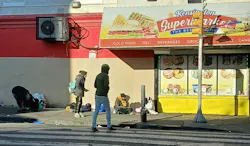
The Kensington neighborhood is ground zero for Philadelphia’s fentanyl crisis. However, fentanyl is only the tip of the iceberg when it comes to the social afflictions that plague this once-thriving, solidly middle-class neighborhood.
In the past century, Kensington was much more like a factory town than a neighborhood. Located near the Delaware River ports, it was home to hundreds of factories that powered America through two World Wars and provided good-paying jobs for generations of working Philadelphians. Kensington also once boasted a robust commercial district, with Kensington Avenue lined with storefronts of many types. It was a family shopping destination for generations of working-class Philadelphians. As the global economy shifted and American manufacturing declined, the factories—many of them massive mill-type buildings that covered multiple city blocks—closed. Often, the owners simply walked away, leaving the city to deal with deteriorating structures that were too expensive to clean up or tear down. Massive mill building fires became a staple of the 1960s and 1970s as unscrupulous owners turned to arson for profit.
As the old factories rotted away or burned, Kensington’s decline accelerated. The neighborhood, which was stable for generations of factory workers, police officers and firefighters, underwent rapid demographic, social and economic changes. Over time, it became home to large numbers of the city’s homeless population, who were drawn by vacant properties and the easy availability of drugs.
People from surrounding cities and states journeyed to Kensington in search of drugs and prostitution and to commit other crimes. The intersection of Kensington and Allegheny Avenues (K&A) is notorious, literally the crossroads of every social problem you can think of—mental illness, substance abuse, prostitution, chronic homelessness, wanton violence, rampant crime, human deprivation—all framed by some of the most desperate poverty in the nation. Eventually, Kensington became an unmanageable “no-go” zone and open-air drug market. That’s where we were two years ago.
From containment to action
I grew up two neighborhoods over from Kensington, in Wissinoming, so Kensington always was part of my life in some way. My parents were raised there in the 1950s. I spent three years as the captain of Ladder Company 10, which is located on the north side of the area. While I was there, two firefighters from my company, Lt. Robert Neary and Firefighter Daniel Sweeney, were killed in a massive mill building fire, and two other firefighters were injured, one critically. Most likely, the fire was started by unknown vagrants who were trying to stay warm. Devastating doesn’t begin to cover it.
As Kensington’s agony dragged on, successive city administrations failed to make progress. With no real solutions, they more or less applied a strategy of containment. All but the most serious crime went unpunished, given that police resources were stretched thin. The fire department fought fires and EMS transported overdose victims, making liberal use of Narcan along the way.
Then something remarkable happened when Philadelphia elected a new mayor, Cherelle Parker, in 2023. She pledged to make Philadelphia the cleanest, greenest and safest city in the country—a tall order, indeed. Simultaneously, Kensington got a new city council representative, Quetcy Lozada, who is a fiery woman who grew up in the neighborhood and is intimately familiar with its trials and tribulations. Together, Parker and Lozada began a full frontal assault on Kensington’s woes.
Policy changes
At a meeting with Kensington’s new city council representative, department heads faced blistering demands for action. When the fire department’s turn came, “nuisance” fires immediately were raised as a priority. Engine 25, which is located on the south side of Kensington, is one of the busiest fire stations in the United States. In a city of 120 square miles that recorded approximately 5,000 rubbish fires per year, Engine 25’s two-square-mile area accounted for nearly 3,000 of them. These fires—set by homeless individuals in vacant buildings or on sidewalks to keep warm or cook food—led to multiple deadly incidents over the years. Something had to be done.
The proactive side of the fire service usually is contained in fire prevention and community risk reduction education and training to help targeted populations to prevent fires. Of course, fires can’t be extinguished until the fire department is notified and capable of responding. The problem in Kensington was staggering: At any given time, dozens of fires burned. Police extinguished them with fire extinguishers without even calling the fire department, using dozens of extinguishers per week at significant cost.
Engine 25 continually ran from one small fire to another. This took the company away from other duties and its primary mission—fighting serious structure fires and responding to medical emergencies that are a constant feature of busy urban fire companies. The situation also took a mental/physical toll on the personnel and put excessive and costly wear and tear on the apparatus.
Analysis
There is an insidious, complex scheme underlying the situation. The first task was to identify the source of material that’s used in these rubbish fires. The answer was so-called short dumpers, which are contractors that look to avoid dump fees and drop debris in back alleys and vacant lots and on dark streets. The homeless then cart the debris away to use in their fires. Much like the drug problem, there are suppliers and consumers. The answer was to cut off the supply of debris that was being brought into Kensington by the dumpers.
Stopping the dumpers is the mission of the Department of Licenses and Inspections, which issues permits for construction debris disposal and levies substantial fines for violations. The Department of Streets hauls away the resulting trash. However, these agencies were stretched thin, and the police were overwhelmed with more serious calls. Nevertheless, you must start somewhere.
During the meeting with Lozada, I made a suggestion. Years before, I broached the idea of using one of the Philadelphia Fire Department’s (PFD) smaller brush trucks—pickup-size vehicles that are equipped with hose, pump and water tank—to help Engine 25 with the rubbish fires. Two firefighters could operate one of the vehicles, which made them perfect for knocking down small fires more efficiently.
At the time that I originally offered my suggestion, the idea went nowhere. However, 10 years and a fentanyl epidemic later, it gained traction. Lozada demanded action and was willing to try any viable idea, and she made clear that funding wasn’t an obstacle; she had the backing of the mayor. Political will was being exerted to actually address a social problem as opposed to ignoring it.
Getting the program off the ground required a sea change in fire department thinking: We now would be proactive, patrolling for incipient fires rather than waiting to react. I had no idea whether the department or our union would be receptive.
Immediately, the same questions as before surfaced. The first, as always, was money, but shockingly, it was brushed aside; the mayor was committed to funding the effort. The next concern was security: How could we guarantee the safety of firefighters who would put out fires that were set by drug-addled, mentally ill people who might attack them? There also was the public relations risk of someone freezing to death after firefighters extinguished their only source of warmth.
Solution
The solution was a task force pilot program. It had been staring us in the face the entire time. Instead of siloed city agencies that operated independently, Philadelphia combined them in a full-out assault on Kensington’s multiple problems. The task force includes the fire department’s brush truck, which is staffed by two firefighters (on overtime, to the union’s satisfaction), patrolling a defined high-need area. Police accompany them for safety. PFD EMS and mental health outreach workers help to connect people who are in need with treatment, shelters or other city social services.
Early in 2024, the city conducted a major sweep of Kensington’s commercial district, breaking up homeless camps that stretched for blocks while sanitation crews disposed of the debris. Streets were cleaned, sidewalks were power-washed, and the police department began to assign entire classes of new officers to Kensington as their first post-academy assignment.
At the time of this writing, Kensington is far from an urban utopia. It still suffers from high rates of homelessness, drug abuse and violence. However, the progress is undeniable. Entire blocks that once were impassable because of homeless camps now are cleared. New apartment buildings are taking shape throughout the area. Time will tell whether this rebirth takes hold, but the sustained focus on rehabilitating Kensington gives reason for optimism.
The “Philadelphia Kensington Experiment” shows what government can do when it focuses on a complex problem and combines resources, funding and the necessary political will. It also is a lesson for fire departments for breaking out of their traditional silo to become a force multiplier in a greater social effort. It clearly is a model for other jurisdictions that face the same type of social problems.
About the Author
 Dennis Merrigan
Dennis Merrigan
Before he retired in 2026, Division Chief Dennis Merrigan PhD. was a 34-year veteran of the Philadelphia Fire Department. His most recent assignment was chief fire marshal. Merrigan completed his PhD. in fire and emergency management and a post-graduate certificate in international emergency management from Oklahoma State University. He also completed a post-graduate certificate in terrorism studies from John Jay College of Criminal Justice.