Firefighting: It’s All About the Math
Key Takeaways
- It's imperative that fire departments characterize the data that they use as a basis for enhancing performance and the quality of operations transparently and clearly, rather than manipulating them to present a particular narrative.
- A mindset that defaults to the absolute validity of metrics risks assumptions that put fire department members at greater risk rather than reducing it.
- Of course, every member of a fire department should focus on process improvements to shorten incident-mitigation timelines, but use of data for this must align with incident priorities.
2+2 always equals 4 but so does (28 + 43) / 4) - 4) x 8) / 10) - 15) + 8). Many people often wonder how the fundamental principles of mathematics can be utilized in their chosen profession. In the fire service, these concepts play a crucial role for everyone, from new recruits to seasoned veterans, company officers and even chiefs of departments.
Numbers and metrics are essential tools that help us to perform our duties effectively. Whether it involves managing budgets, handling staffing requirements, making purchasing decisions, or analyzing department standards to boost efficiency and effectiveness, these quantitative elements guide us in improving our service delivery models. By relying on accurate data and metrics, we unlock methods that enhance the performance and quality of department operations.
That said, it’s essential to approach numerical data with caution, because sometimes, figures can lead us in directions that don’t align with the mission. Transparency and clarity must be prioritized. Statistics can be manipulated to present a certain narrative, but when numbers are characterized honestly and ethically, responsible decisions can be made that benefit everyone who’s involved.
Rookies, senior members, company officers & chiefs
Within the fire service, numbers often are used to communicate our story and to persuade the public or officials for increased staffing, pay, equipment, etc. However, it’s vital to use these figures with integrity rather than distorting them to serve a cause. Allowing the numbers to speak for themselves helps to foster trust among labor and management, departments and municipalities, and the public. Developing a narrative first and then manipulating the numbers to fit the narrative can breed mistrust.
In the fire service, much like in mathematics, following the correct order of operations is crucial for achieving success on the fireground. Every task has a specific sequence that must be followed to ensure that everything runs smoothly. For example, starting a chainsaw involves a series of steps; missing one can waste valuable time. Placing an apparatus in pump mode or engaging the aerial device requires a precise process; neglecting this order can damage equipment and add critical seconds to the response. In a profession in which every second matters in saving lives and property, adhering to the proper order of operations is essential.
From the very first day at the recruit academy, recruits are presented with a range of metrics and expectations that are rooted in numbers. This continues throughout their career. They are instructed to arrive 10 minutes early, run an eight-minute mile, score at least 70 percent on written exams and understand that certain nozzles require 100 psi at the tip, factoring in friction loss.
The emphasis on time—such as the importance of rapid response within four minutes and 100–120 compressions per minute during CPR—reinforces the critical nature of numbers in the profession. This constant exposure to numerical standards can feel overwhelming at first, but it forms the basis for how recruits learn to analyze and approach their responsibilities throughout their career.
The cycle continues for seasoned veterans. Years of service x pension service increment, number of jobs made, years until retirement and seniority number are some of the elements that seasoned veterans are concerned about as they enter the “golden parachute” stage of their career. Financial calculations must be evaluated to determine whether they have the necessary means to retire.
Seasoned veterans also hone their skill set to a level of mastery, which reduces operational timelines. They become more immersed in the metrics and look for opportunities to save time and improve effectiveness, which often is accomplished through process improvements.
Company officers routinely assess response metrics, such as response times during emergency calls, and monitor training exercises by tracking sets and repetitions, often recording firefighter proficiency in simulated drills to gauge progress. Officers actively seek opportunities to enhance operations by evaluating resource allocation, such as personnel assignments and equipment allocations that are available for routine shifts and surge-style events. They track burn rates and rest/rehabilitation cycles to maintain optimal performance and safety.
On the administrative side, company officers might monitor unit utilization hours, manage personnel counts, monitor overtime usage and keep a watchful eye on budget thresholds.
Chief officers concentrate on broader departmental strategies. Typically, they are involved deeply in analyzing numerical data, particularly when preparing and executing the department’s budget. They must balance department needs with the funding that’s provided by the municipality to ensure organizational success. From a strategic perspective, these leaders engage in planning for long-term capital expenditures, such as acquiring new fire apparatus and coordinating delivery timelines, which are critical metrics for the department.
Data can mislead
Although numerical data help us to appreciate the significance of mathematics in our profession, it’s important to recognize that certain calculations might mislead us (e.g., using excessive speed to respond to incidents). Our focus should be on leveraging metrics to reinforce our reasoning for saving time and minimizing risk.
Recently, as an instructor in a training class, I observed several opportunities to enhance efficiency during simulated situations where every second was critical. These improvements, which involve process improvements, could result in considerable time savings with virtually no added risk. By emphasizing proficiency training and multitasking, individual firefighters can make significant strides to cut the timeline between incident occurrence and mitigation.
Identifying ways to reduce the time between the onset of an incident and its final mitigation has long been a central priority in the fire service. Developing NFPA 1710: Standard for the Organization and Deployment of Fire Suppression Operations, Emergency Medical Operations, and Special Operations to the Public by Career Fire Departments and NFPA 1720: Standard for the Organization and Deployment of Fire Suppression Operations, Emergency Medical Operations, and Special Operations to the Public by Volunteer Fire Departments—and now NFPA 1750: Standard for the Organization and Deployment of Fire Suppression Operations, Emergency Medical Services, Special Operations and Fire Prevention Activities—implementing aspects of the NFPA 1901: Standard for Automotive Fire Apparatus, improving call processing times and using priority control systems at intersections all aim to minimize this interval.
We all either witnessed firsthand emergency vehicle responses that likely violated safety regulations or state vehicle codes or came across reports on social media that detail accidents that were caused by unsafe speeds.
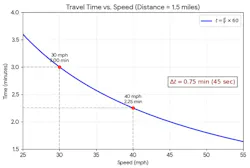
Driving too quickly might shave off only a small amount of time but greatly increases the risk of not reaching the scene safely. For instance, increasing average speed to 40 mph from 30 mph on a 1½-mile response only saves 45 seconds. At the same time, proficiency in critical skills, such as swiftly deploying a handline or donning an SCBA mask and preparing to enter an immediately dangerous to life and health atmosphere in 10 seconds, can save far more time with almost no increase in risk.
Balance = greater success
The math is straightforward: Saving time leads to reduced property damage, fewer injuries and fewer fatalities, as long as risk calculations are included in the equation. By identifying the right formula that balances risk and efficiency, organizations can achieve greater success.
Every member of an organization should focus on process improvements and mastering essential skills to safely shorten incident-mitigation timelines. Simply driving faster isn’t a risk-conscious solution. More-effective strategies align with our incident priorities and promote better outcomes. All members in the organization are integral to the final equation.
About the Author
 John Judge IV
John J. Judge IV has served as the fire chief of the Scranton, PA, Fire Department since July 2020. He has been with the department for 24 years and has been involved in the fire service since 1989. As a member of FEMA Urban Search and Rescue Pennsylvania Task Force 1 since 2015, Judge deployed to numerous national disasters. He also currently serves as an adjunct instructor for the Pennsylvania State Fire Academy. Judge holds a bachelor’s degree in criminal justice from the University of Scranton, a bachelor’s degree in fire science from University of Maryland University College and a Master of Professional Studies in emergency and disaster management from Georgetown University.