Changes to Firefighting Strategy & Tactics Over the Past 50 Years
Key Takeaways
- Since its launch in 1976, Firehouse has informed readers of research that revealed the fireground dangers of high heat-release rates, premature ventilation and lightweight construction that firefighters might face. Education on these major influential concepts provided for safer fire suppression operations and improved decision-making.
- Active participation in preconstruction meetings that are related to podium-style residential structures and preplanning by fire departments whose response district includes these buildings help firefighters to conduct hose stretches, apparatus placement, laddering, search and water application in ways that are unique to fires at these properties.
- Although the offensive and defensive strategic modes that served firefighters well over the past decades remain, greater emphasis now is placed on merging these approaches to create transitional fire attacks. These are designed to make the interior environment more tenable for occupants and firefighters.
Note: Full coverage of Firehouse's 50th Anniversary
As we celebrate the 50th anniversary of Firehouse, it’s imperative to look at the multitude of changes that occurred in our profession during this period.
Although the foundation of fire suppression didn’t change, we morphed into full-service, all-hazard organizations that respond to emergency medical, technical rescue, hazmat and wildland interface incidents as well as fires. As a result, we must adapt to and embrace this continued evolution. If we don’t, we’ll fail to keep ourselves safe and to meet our primary mission of providing exceptional life-safety services.
What follows are major catalysts to the way that we operate both on and off of the fireground.
PPE
Fifty years ago, the term “smoke eaters” was used to pay reverence to firefighters. SCBA might have been worn, but it rarely was used as designed. Not enough was known about the deadly toxic chemicals that made up the smoke that we inhaled, and many members paid the price for what was thought to be the standard of how we should operate. The longer that you could remain in a smoke-and-fire-filled environment, the more you proved your worth.
Turnout gear consisted of three-quarter-length rubber boots, a heavy rubber coat, a helmet and rubber gloves that provided limited thermal protection. Fortunately, opinions began to change in the late 1970s when PPE manufacturers began to use materials that were lighter in weight and provided higher thermal-resistance ratings. Turnout coats and pants became popular. A new level of safety was born.
The 1980s brought us personal alert safety systems (PASS), advanced helmet protection and protective hoods. Design and safety enhancements to SCBA were developed and implemented, and NFPA standards began to mandate the use of this equipment in fire suppression operations.
Based on further improvements to PPE that occurred since then, our fireground safety, health and wellness, and ability to operate in immediately dangerous to life and health atmospheres notably improved.
Individual radios now are a component of our PPE. Ergonomically designed SCBA that weighs less and include a heads-up display, integrated PASS alarms, universal emergency breathing systems, individual thermal imaging cameras (TICs) and personal facepieces are the norm.
Helmets that consist of lightweight composite shells, integrated eye protection, suspension systems and impact caps provide improved protection. Custom-fit turnout gear ensembles that consist of lightweight thermal-reducing materials and leather boots, integrated drag rescue devices and personal escape systems are standard. Gloves offer improved fit and increased thermal resistance, and protective hoods supply both enhanced thermal protection and a barrier to cancer-causing substances.
Now that this foundation is established, it’s important for the fire service to continue to research and investigate new advancements in the equipment that we wear.
Building construction
Over the past 50 years, major transformations in the methods, materials and systems that are used to construct buildings occurred. Look no further than the history of Frank Brannigan’s “Building Construction for the Fire Service.” This renowned manuscript, which was published in 1971, focused on Brannigan’s personal experiences with wood-frame, ordinary, heavy timber and fire-resistive construction techniques. The book quickly became the foundation upon which firefighters accepted the critical importance of building construction and its effect on fireground operations. Glenn Corbett skillfully took on the task of modernizing and adding current material.
During the major housing boom that occurred from 1970–1980, baby boomers were drawn to larger multistory residences. Platform frame construction that used dimensional lumber became the optimal choice in private dwelling construction. Flooring consisted of multiple layers. Drywall became a popular interior wall covering.
Commercial building construction turned its attention to the use of noncombustible materials, such as steel, concrete masonry and precast concrete, to keep up with the demand. New, more modern techniques and materials began to take the place of traditional methods, such as post-and-beam, balloon-frame and ordinary construction.
The 1980s brought lightweight floor and roof trusses, gusset plates, preengineered floor joists and oriented-strand-board coverings, which resulted in additional void spaces and a much higher potential for structural collapse. The use of these premanufactured building elements allowed dwellings to be built with vaulted ceilings, large open spaces and higher square footage.
Energy efficiency developed into a major element of construction, and the use of hydrocarbon-based furnishings, synthetic foams and faux finish materials became the standard.
The trend continued to grow during the 1990s. Faster, cheaper and bigger was the desired outcome. Flooring and roof components that experienced even further weight reduction added to an already significant collapse potential. Operating on fire-weakened floors became a critical safety issue.
This era also brought modular houses, prefabricated interior and exterior wall panels, and high-strength, load-bearing, adhesive-based lumber. Unprotected Type II noncombustible buildings that include large open areas and lightweight steel-bar truss roofs continued to dominate the commercial building landscape as large distribution warehouses and big box retailers became popular.
Fire departments began to recognize a significant change in fire dynamics and smoke movement during interior operations. Underwriters Laboratories (UL) and the National Institute of Standards and Technology (NIST) began to conduct landmark scientific-based studies in the mid-2000s that changed the way that we operate on the fireground and how we view fire behavior, ventilation and flow path.
We now know more about the dangers that we face from high heat-release rates, premature ventilation, lightweight construction, flow path and reduced water application. All of these are major influential concepts that steered us to safer fire suppression operations and improved decision-making.
It also was during this era that we witnessed the increased use of hybrid construction, composite materials and cold-formed steel in both residential and commercial settings.
Where we are today
Today, construction processes have embraced the use of technology-based systems to design and build structures. Architects use computer-aided design software to generate intricate blueprints, 3D models and virtual walkthroughs. Sustainability, green buildings and reduced carbon footprints are high-priority issues. Technology that uses 3D printing and high-performance concrete allows for the construction of entire structures on site. Solar arrays and energy storage systems have become popular. High- and mid-rise buildings now are built using mass timber structural components. The use of hydrocarbon, humanmade and composite materials for interior and exterior finishings and furniture dominate the market.
A new challenge
An upsurge in the housing market and the desire for convenience and urban-style living brought large, multi-unit, podium-style residential structures to many communities. These buildings are vertical lumber yards on steroids. High-rise expert Jack Murphy uses the term “groundscraper” to describe these
massive structures.
The immense size and area of these buildings create response and operational issues that many departments aren’t prepared for. Hose stretches, apparatus placement, ladder access, search priorities and water supply are new operational challenges that these complexes bring to our doorstep.
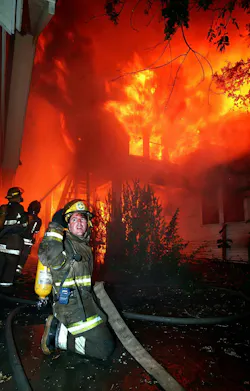
Active participation in preconstruction meetings and effective preplanning are the best ways to meet these adversities and to ensure an adequate response to these buildings.
Building construction underwent major changes during the past 50 years, and each transformation brought new operational and safety-related challenges to our mission. Forest Gump’s mother said it best: “Life is like a box of chocolates; you never know what you’re gonna get.” As Brannigan stated, “The building is your enemy. Know your enemy.”
Strategy & tactics
Today’s modern fire environment is responsible for modifying many of the fire suppression strategies and tactics that our academies taught us 50 years ago.
Although incident priorities of life safety, incident stabilization and property conservation remain unaffected, modern research that was conducted by UL’s Fire Safety Research Institute and NIST transformed the way that we think and operate. Years ago, we were taught never to flow water into smoke. Venting every window was a custom, and prompt laddering of the building occurred at every fire. Currently, we know that smoke is fuel and that water application during hoseline advancement reduces the potential for flashover and increases victim survivability. Gone are the days of aggressive interior operations where “get on your belly and get in there” showed your adeptness and courage.
Operations now focus on time-to-water application, coordinated ventilation, and searching occupiable or survivable spaces inside of buildings. Fortunately, this modern-day aggressive yet smart attitude continues to follow the basic tenets that we were taught years ago of prioritizing the search and applying water to the fire. However, as we look back, several noticeable changes adjusted the fireground strategy and tactics that we choose.
To enhance command and control of the fireground, reduce freelancing, improve decision-making, strengthen communications and facilitate operational efficiency, incident commanders moved from pen and paper to using command software, mobile tablets, tactical worksheets, drones and unified command posts. Situational awareness was enriched through an improved recognition of hazards, the reinforced use of 360-degree size-ups and the communication of this critical information to arriving units. Discipline, preparation, standard operating guidelines, riding assignments and moving with purpose reduced indecision and increased effectiveness.
Experience tells us that the extent and location of the fire on arrival typically drives the strategic mode of choice and the tactical assignments that are ordered. Although getting a hoseline placed between fire and life and aggressively searching for trapped occupants still are priorities, we had to adapt our operation to match challenges that result from reduced staffing and a rapidly changing interior fire environment.
Offensive and defensive strategic modes remain with us; however, a greater emphasis now is placed on merging these approaches to create transitional fire attacks. These are designed to make the interior environment more tenable for both occupants and firefighters who enter the structure. Big fire, big water still exists, exposure protection is a valid choice, and a three-pronged approach to attack line placement at most fires remains constant. True to old-school thinking, truck company work remains focused on forcible entry and searching for occupants; laddering, ventilation and other essential fireground tactics, such as overhaul, have become priority-based, staffing-related assignments.
Science and fireground experience proved lightweight construction, preengineered lumber and synthetic materials increase the potential for collapse. Coordinated ventilation with water application is essential to controlling the fire. Reducing heat release rates is imperative. Controlling the door is mandatory, and limiting flow path is vital to our survival.
Remember: Risk a lot to save a lot, risk a little to save a little, risk nothing to save nothing.
Staffing
Staffing today can’t be understood through simple comparisons to the past. It must be viewed through the lens of demographics, economics and the changing landscape of American communities. In the post‑war era, small towns thrived, cities were rebuilt, and suburbs expanded. Volunteer departments were sustained by homegrown members who lived, worked and stayed in their community. Career departments in many cities were staffed at levels that would surprise firefighters today: In some places, departments had double the career staffing in 1976 compared with what those same cities operate with in 2026.
Some jurisdictions planned early and built hybrid systems around dense urban centers and universities. Prince George’s County, MD, pioneered the career/volunteer model, and Alpha Fire Company in State College, PA, launched the live‑in program at Penn State.
Modern staffing challenges are shaped by forces that didn’t exist 50 years ago. The rising cost of living pushed many volunteer members out of the town that they grew up in. They still want to serve, but longer commutes mean slower response times or eventual attrition. Losing homegrown members—people who know the streets, buildings and families—creates gaps that are difficult to fill.
Career departments face their own pressures. Across the country, firefighters are advocating for the 24/72 schedule for improved rest and retention. Some communities have pulled away from larger, county-based systems for their own agency. The staffing story of 2026 isn’t one of decline but of transition, as the fire service adapts.
Technology
Technology represents the most visible and dramatic change. Fire apparatus have become engineering achievements with the integration of safety systems, data analytics and operational enhancements that firefighters in 1976 couldn’t imagine.
TICs, which once were the size of a Hollywood broadcast camera, now clip onto a facepiece or fit in a pocket. A handheld model costs less than a dinner out yet provides capabilities that once were reserved for specialized units.
Communications have advanced at a pace that feels almost unreal. Portable radios can transmit clearly across states and regions, to enable interoperability that once was a distant aspiration.
Even bailout equipment reflects technological evolution. Engineered ropes, compact descent devices and pocket‑size escape kits give firefighters options that didn’t exist decades ago.
Technical rescue
The evolution of technical rescue might be the most profound transformation of all. What began as Boy Scouts, tradespeople, service members and civil defense auxiliaries in the Cold War era grew into organized rescue squads.
As cities expanded upward and outward, the complexity of emergencies increased. Rescue teams adapted, training expanded and equipment evolved. The growth of mass transit introduced new rescue challenges, and the fire service responded accordingly.
The 1993 World Trade Center bombing and the 1995 Oklahoma City attack accelerated the development of urban search and rescue at regional and national levels. FEMA teams grew, regional task forces formed, and technical rescue became a discipline that required immense specialization.
Today, funding challenges have pushed many areas toward regional rescue models that are leaner and designed to support local jurisdictions. Rope rescue, confined space, trench, collapse, swiftwater and machinery entrapment now are standard capabilities, not niche specialties.
Adapt and overcome
Fifty years after Firehouse began to chronicle the profession, the fire service is more complex, technical and capable than ever. Staffing models are changing, technology is accelerating, and technical rescue continues to expand.
Through all of this, firefighters, both career and volunteer, remain committed to adapting, overcoming and serving their community. As we look ahead to the next 50 years, one truth remains clear: The fire service will continue to rise to every challenge, just as it always has.
About the Author
 John J. Lewis
John J. Lewis
John J. Lewis is a retired lieutenant from the Passaic, NJ, Fire Department, formerly assigned as the training and safety officer. He remains active in fire service as a 20-plus-year instructor at the Bergen County, NJ, Fire Academy and as an adjunct instructor for Kean University/New Jersey Division of Fire Safety. Along with his partner, Robert Moran, Lewis has written and presented training programs throughout the country and co-authored many articles for fire service publications.
 Robert Moran
Robert Moran
Robert Moran served as fire chief of the Brewster, MA, Fire Rescue Department from 2010–2024. Prior to that, he served 26 years with the Englewood, NJ, Fire Department, retiring in 2010 after 12 years as chief of department. Moran holds a master’s degree from Fairleigh Dickinson University, is a certified public manager, and has a Chief Fire Officer (CFO) designation from the Center for Public Safety Excellence. He serves as an adjunct instructor for Kean University and the New Jersey Division of Fire Safety and lectures at numerous regional and national fire service conferences. Along with his training partner, John Lewis, Moran writes the back page of the New York State Association of Fire Chiefs' Size-Up magazine and operates Jersey Guys Fire Service Training.
 Robert Policht
Robert Policht
Robert Policht, who is a Firehouse contributing editor, is lieutenant of Ladder Co. 2 of the Passaic, NJ, Fire Department. He assisted with developing and establishing the department’s response to human vs. machine incidents and is attached to the Fire Investigation Unit. Policht started his career as a volunteer and has served as a chief of department. He taught at the Bergen County, NJ, Fire Academy and is a member of the NJ Division of Fire Safety's Fire Threat Task Force. Policht has a master’s degree in emergency management and homeland security from Arizona State University and has been published in several trade publications. He is a founder of and contributor to Flow and Vent, which is a website that's dedicated to fire and rescue training.