The Myth of White-Out in Fire Service Thermal Imaging Cameras
Key Takeaways
- Newer technology that’s incorporated into thermal imaging cameras (TICs) for the fire service prevents what occurred in previous versions of the devices when they were exposed to temperatures that were beyond their limited sensor dynamic range, aka white-out.
- The newest models of TICs are susceptible to a circumstance when they can’t produce a usable image when moisture, soot or debris accumulates on the devices’ lens.
- Loss of a usable image on TICs that incorporate newer technology that results from the accumulation of moisture, soot or debris usually is remedied by wiping the TIC’s lens. As environmental moisture increases, the frequency of lens cleaning must increase accordingly.
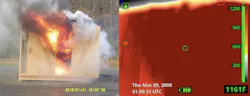
Misunderstandings about thermal imaging camera (TIC) performance and limitations have contributed directly to firefighter disorientation, mayday events and line-of-duty deaths (LODDs). These misunderstandings and lack of standardized concepts, training and education also have contributed to misinterpretation of thermal data prior to rapid fire development. One of the most cited and misunderstood issues that are associated with TIC use is the phenomenon that often is referred to as white-out.
No heat-induced white-out
Firefighters frequently report that their TIC “whited out” after they entered a fire environment. In prior models of TICs, this might have been an accurate description, but newer technology prevents this phenomenon from occurring.
Early fire service TICs lacked colorization and operated with limited sensor dynamic range. Operational modes have changed to dual-gain, tri-gain and mixed-gain technology to manage these larger spans of dynamic range. When older TICs were exposed to temperatures that were beyond their limited sensor dynamic range, the display would saturate and present a completely white image. Modern fire service TICs use improved sensor technologies and colorized displays. Therefore, effectively, heat-induced white-out is eliminated.
When a TIC that’s based on newer technology encounters an environment that’s beyond its dynamic range, the entire displayed image will display red. This isn’t a heat failure but a misinterpreted image degradation because of environmental and operational factors, aka saturation.
Why, then, are firefighters continually reporting that they witnessed “white-out” on their TIC. The most common cause of a white or gray display is the build-up of moisture and particulate on the TIC lens.

Moisture, soot & debris
Fire service TICs typically use a germanium lens, which allows infrared (IR) energy to pass through to the detector. When moisture, soot or debris accumulates on the lens, IR energy is blocked, and the detector can’t produce a usable image.
Moisture is the No. 1 enemy of a TIC. Because a natural by-product of smoke is moisture, environments in which TICs might encounter difficulties include:
- Active fire sprinkler discharge (cold smoke environment).
- Operating above the fire prior to ventilation.
- Steam production from hoseline application during fire attack.
- Smoke-filled structures with high humidity.
Further, firefighters who stand up in the heat and moisture-laden environment instead of placing themselves below the smoke layer (where cooler air and less moisture are present to view the environment) will find that the image degrades.
As firefighters enter a fire environment, their facepiece often fogs up. Each time firefighters wipe their facepiece, the TIC lens also must be wiped. When the lens is cleared, image detail typically returns but only briefly. As environmental moisture increases, the frequency of lens cleaning must increase accordingly.
If the lens continues to fog immediately after wiping, the firefighter often is standing up, is too high in the environment, or is operating in a full-exhaust or high-flow path. In these cases, lowering position and improving hoseline placement are critical.
Image clarity degradation
In 2023, Insight Fire Training reviewed nine confidential mayday reports from departments nationwide. Two common themes were identified in every incident: Firefighters were operating upright in the standing position, and firefighters wiped their facepiece and TIC display but didn’t wipe the TIC lens. These contributing factors often aren’t recognized in the reports in which the term “white-out” is mentioned. Several near-miss incidents and LODD reports mention “white-out.”
Gain change
Dual-gain and tri-gain operational modes manage larger spans of temperature ranges and allow for better image clarity in each span, or gain.
NFPA designates these spans as high sensitivity and low sensitivity. High sensitivity often is designated as the lower temperature range (typically from zero–300 degrees Fahrenheit in many devices) in which image clarity is much sharper. Low sensitivity engages when devices detect a certain percentage of these pixels of heat. Many of the devices that include dual-gain and tri-gain technology briefly pause during the transition between high sensitivity and low sensitivity, so the image might appear white during this transition.
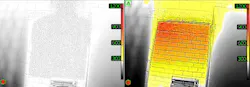
If firefighters who are using dual-gain and tri-gain devices pause during this transition, they will notice a green triangle appear in the upper left-hand corner of the display. Many TICs then begin to display colorization. However, these color temperature associations are manufacturer-specific based on programming and aren’t standardized. Therefore, firefighters who scan too quickly and fail to pause during the transition will miss critical information, such as the location of the fire room, egress points and hazards.
Uniform temperature
Another area in which a TIC produces a white/gray screen by which little discernible detail is visible is known as a uniform temperature environment.
In thermography, an environment that lacks sufficient temperature differential to provide a discernible image is known as a “bland scene.” In short, if there isn’t enough temperature difference, the scene lacks sufficient detail to provide information about the environment.
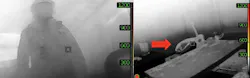
In addition, if the device is of lower-resolution quality with poor thermal sensitivity rating (>80mK), image quality degrades even more in a uniform temperature environment. NFPA 1801: Standard for Thermal Imagers for the Fire Service recommends that a fire service TIC have a minimum 320 x 240 resolution, a 25 Hz refresh rate and a thermal sensitivity that isn’t greater than 80mK. When a device lacks sufficient image quality and performance specifications, the end user will struggle to identify objects and hazards that are in these environments.
Uniform temperature environments include:
- Ambient or low-temperature spaces.
- Post-suppression environments, including high-moisture environments prior to ventilation.
- Areas that are above the fire, because moisture and heat migrate to these areas.
- Cold smoke environments with sprinkler activation. (This is an often-overlooked danger in large commercial spaces.)
Electronic failure
One additional reason for “white-out” to occur in a modern TIC is an actual failure in the device. In rare cases, a TIC might display a white screen because of electronic failure or radio-frequency interference.
Although modern TICs incorporate electromagnetic interference shielding, these electronic failures still can occur because of manufacturing defects or internal electronic damage.
Firefighters should conduct daily functional checks, including operating a portable radio near the TIC, and a lens inspection to ensure that the lens isn’t cracked or scratched.
When wiping isn’t enough
In certain environmental conditions (e.g., the presence of a full-exhaust or a unidirectional flow path, such as advancing down basement stairs with fire below or operating above a fire), TICs can become blinded despite proper scanning techniques. In these incidents, firefighters will note that the image won’t improve and overall noticeable heat will increase. This is cited in many LODD reports as a failure to adequately size-up and locate the fire.
Firefighters must recognize that the TIC is a secondary means of orientation and shouldn’t be used as the primary means/sole source of orientation. Firefighters must conduct a thorough size-up, to develop a mental map of the structure, prior to entry as well as understand first-due response areas through preplanning. These practices are nonnegotiable in zero-visibility environments.
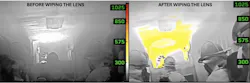
Misinterpreting a degraded image as device failure, rather than environmental or operational influence, has contributed to firefighter injuries and fatalities. It will continue to do so until the fire service realizes that TIC training should be prioritized. This training must emphasize how to use the devices properly and contraindications. If these trainings aren’t accompanied with hands-on training with live fire, a department is noncompliant with existing recognized training standards.
About the Author
 Andrew Starnes
Andrew Starnes
Andrew Starnes has been involved with the fire service as a volunteer since 1991 and as a career firefighter since 1998. He retired as a battalion chief after 25 years of service. Starnes graduated from Fayetteville State University with a Bachelor of Fire Science Administration. He currently serves as the owner/operator/instructor of Insight Training LLC and is Level II Thermography Certified. Starnes' work has assisted in developing numerous fire service products, including several thermal imaging cameras from various manufacturers. Insight Training's Thermal Imaging Curriculum is in use in Canada, Germany, Poland, Spain, Taiwan and across South America. Starnes serves as a board member for 5-Alarm Task Force and is a Master Craftsman with Project Kill the Flashover.