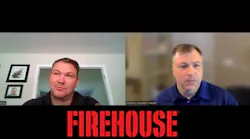
Video: ‘Tones Go Off, We Get on a Rig, We Go’: How the FDNY Rebuilt After 9/11
Looking back on the Sept. 11 terrorist attacks, FDNY Firefighter Rod Ford remembers a department that suffered unimaginable losses but never stopped answering calls.
Ford, now assigned to Rescue 4 in Queens, was still on his probationary period with only nine months out of the academy as an FDNY firefighter when the World Trade Center was attacked. He started witht he department in the EMS Bureau in 1997. After graduating from the academy in October 2000, he was assigned to Tower Ladder 138 in Corona, Queens.
Ford was off-duty at home on Long Island the morning of Sept. 11, 2021, and preparing to go for a run when a firefighter from his company called his home.
“They just blew up the Trade Center again. You gotta get in now," his colleague told him.
Ford drove toward the firehouse and, as he listened to the radio, reports changed from a plane striking the World Trade Center to a second aircraft crashing into the second tower. To the U.S. Navy veteran, he knew the country was under attack.
They arrived to devastation
Ford arrived at his firehouse where he and other off-duty firefighters gathered any available tools and their bunker gear and went to a staging area where Shea Stadium once stood. They were organized into groups and boarded city buses toward Manhattan. They arrived without radios or respiratory protection and carried whatever tools they could find.
The North Tower collapses shortly before he arrived.
Once at the collapsed remains of the World Trade Center, Ford remembers being struck by the scale of the destruction and the absence of something firefighters normally expect at an emergency scene with: a command presence.
“We literally had no clue what was going on," he recalled to Firehouse.com.
The devastation was so extensive that even veteran firefighters were confronting something for which there was no previous experience.
“The probie with nine months on had just as much experience with this as the 30-year guy from a busy company. We were all just kind of figuring it out as we went.”
Finding his best friend's rig
"One of the first things I see is Ladder Company 132....my best friend, Mike Kiefer, worked in Ladder 132, and I didn't know if he was working," Ford recalled.
While they spoke two days earlier, Ford could not recall if Kiefer was scheduled to work that day but was pretty sure he was on-duty.
"So I hopped up in the rig," he said, looking for the riding list that had the on-duty members' assignments."All that stuff had gotten blown out. The rig was covered in dust and all the paper and everything from the buildings was in there. I didn't find it. You know, what are you going to do? You've got just got to keep moving on."
Later, he ran into a classmate who told Ford that he Kiefer was working that day.
When he returned to the firehouse early the next morning, he learned that FDNY had established a number to check on the status of firefighters.
"I called right away, and the guy answered the phone and I asked about Mike Kiefer from Ladder 132 and he says, 'All the members of Ladder 132 are still unaccounted for.' I'm just thinking, that poor guy — like some of the conversations he must've with family and friends.
Kiefer did perish, along with the rest of Ladder 132's crew.
Working at the World Trade Center site
Ford and his colleagues spent the day moving through the site, searching for survivors and trying to determine where firefighters and workers might be trapped.
“It was just this overwhelming feeling of just helplessness," he said as they moved from area to area.
They were pulled off the collapsed buildings and moved away as concern rose over the collapse of the 47-story World Trade Center Building 7. He said several floors of the office building were engulfed in flames and firefighters were unable to get a lot of water on the fire.
"When we walked down and we took a look at Building 7, what we saw any, any other time, minus the World Trade Center, that would be the job of your career."
Later that afternoon, the high-rise building collapsed, creating a whole new level of destruction with nearly 270 stories of Manhattan office buildings laying in a ruins.
They remained on scene until the early morning hours and were sent back to their station for a brief break before regrouping in the morning.
The first days and weeks after
That first day turned into weeks and then months of work at the World Trade Center for Ford. He was immediately assigned to a detail at the site, where firefighters worked alongside ironworkers, engineers and other tradespeople as heavy equipment slowly dismantled the pile.
Firefighters watched as grapplers lifted debris, checking underneath for human remains, firefighting equipment or anything that could help identify the missing.
For nearly three months, Ford was at "the pile" helping search for the missing and recover what they could.
The city that never sleeps and the funerals
At the same time, the FDNY still had to protect New York City.
“The FDNY is open for business 24/7, and the guys just kept charging on and getting the job done.”
The recovery effort wasn't confined to Ground Zero. Firefighters returned to their companies trying to put rigs back together, and covering for firehouses that lost entire crews all while they continued answering alarms and attending an almost continuous succession of funerals and memorial services.
“You were also going to funerals. There were 343 funerals to go to," he said.
Ford remembers firefighters attending services for friends and coworkers they knew personally while also trying to attend funerals simply because they were nearby or along their route to or from work. Volunteer fire departments on Long Island helped provide apparatus, firehouses and caissons for the services and their members filled the lineups while FDNY firefighters were recovering.
Beginning to Rebuild the FDNY
Rebuilding the FDNY meant replacing apparatus and equipment, restoring staffing and, most difficult of all, rebuilding companies that had lost multiple members.
“You lose six guys or a double house, you lose 12 guys — you can't replace that. It just rips apart the culture of that firehouse," he explained. “It just takes time to heal up.”
Yet the largest fire department in the U.S. continued operating.
“The department survived. We never closed. They stayed open for business.”
The logistical rebuilding happened remarkably quickly, from what he recalled.
The FDNY drew from its spare apparatus fleet, manufacturers accelerated production, and some departments allowed apparatus that had been intended for them to instead go to New York directly from the production lines.. Departments donated rigs as well as children and communities.
The FDNY’s warehouse also allowed lost tools and equipment to be replaced.
“The rigs were kind of back in action and going on runs like nothing had ever happened. It's a big organization and there's a lot of good people really, really working the problems, and they were getting things done.”
Rebuilding the department's ranks required large classes of new firefighters. Ford remembers classes of hundreds entering the fire academy back-to-back.
Those firefighters faced a difficult assignment: entering companies that had recently buried members whose experience and influence could never truly be replaced.
“Those guys really stepped up and kind of energized us with some new blood, so to speak, and got things going. Having new guys come in, it's like a breath of fresh air," he explained.
A new assignment
Ford eventually joined Rescue 4 in 2013. By then, he said, the rescue company had been rebuilt by firefighters who arrived in the years immediately following the attacks.
“By the time I got there, it was rebuilt. It wasn't a work in progress. Guys that came in '02, '03 — they rebuilt it. They put it back together.”
Ford has since worked alongside firefighters whose fathers were killed on Sept. 11, watching another generation build careers of their own within the department.
The runs keep coming, FDNY's firefighters keep going
For Ford, the legacy of Sept. 11 isn't only found in memorials or ceremonies. It lives in what firefighters do every day.
“I think the one thing that they would want is just keep the show going, man. It's FDNY. Tones go off, we get on a rig, we go.”
“They handed guys like myself this unbelievable organization and it's our job to keep it going.”
For Ford, continuing to do the job professionally is perhaps the most fitting tribute to the firefighters who responded that morning and never returned.
“When that happened, they got on the rig and they went. That's just the type of guys they were. And if people can just remember that, then I think that's good enough.”
About the Author
 Peter Matthews