A Major Wildfire is on Horizon, but New Jersey is Not Prepared, Experts Say
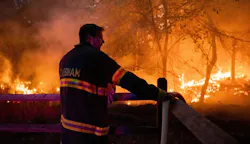
The ominous gray smoke filled the horizon behind Ken Whittom’s Forked River home.
Emergency sirens blared in the distance like a scene from an apocalyptic movie. The wildfire was coming, firefighters had warned him earlier that day. Time to evacuate.
But this is New Jersey, the highway construction worker thought. A destructive wildfire … here?
Then the broad-shouldered former linebacker with a crew cut felt a rush of heat. Whittom watched in disbelief as orange flames danced nearby in towering pine trees, approaching fast.
“Holy s---!” he said, his voice trembling.
Whittom scooped up his chihuahua, grabbed an elderly neighbor by the arm and raced to his black Ford Explorer on the evening of April 22, 2025. By then, the flames were creeping just beyond his neighbor’s backyard fence.
“I can’t even breathe. I can’t breathe. I can’t breathe,” he said in a whisper, choking on smoke as he filmed the encroaching inferno on his phone. “Please God.”
Just like that, one of New Jersey’s largest recorded wildfires had arrived at his door, 2.5 miles from Barnegat Bay.
The infamous Jones Road Wildfire burned for three weeks in the spring of 2025, sweeping across 15,300 acres, leveling a commercial building and forcing the evacuation of 7,000 in South Jersey, including Whittom’s own frantic sprint to safety.
But the state’s largest wildfire in 19 years could have been much worse. It threatened at least two towns, more than 55,000 residents and one former nuclear power plant before round-the-clock efforts by 460-plus firefighters brought it under control.
Next time, New Jersey might not be so lucky, experts soberly warn. The nation’s densest state is increasingly vulnerable to catastrophic wildfire and only somewhat prepared, they say.
“A huge bullet was dodged,” said David Robinson, the now-retired New Jersey state climatologist. “It was close to getting into neighborhoods like we saw in California and we’ve seen in other communities outside of Denver."
Wildfires are erupting more frequently — and with more intensity — in New Jersey, encroaching ever closer to crowded neighborhoods with limited escape routes. In 2025, 1,322 wildfires scorched 27,200 acres — a 22% increase in fires and a 116% spike in acreage burned compared with the 20-year average. Pine Barrens communities throughout Atlantic, Burlington and Ocean counties are at risk, as are wide swathes of North Jersey in Passaic and Sussex counties.
Extreme weather conditions fueled by climate change — like months-long droughts and hotter and longer summers — threaten to spawn a volatile crisis, experts say. A “megafire” torching 100,000 acres and destroying entire neighborhoods is no longer an unimaginable scenario here.
The probability is “higher than it’s ever been. Period,” said Stephen Strader, a disaster expert at Villanova University.
New Jersey is better prepared than its East Coast counterparts, standing at a 6.5 on a scale of 1 to 10, according to Erica Smithwick, a Pennsylvania State University professor who has studied wildfires for two decades. But it faces myriad deficiencies in its preparation, including outdated wildfire detection methods, limited staffing and aging equipment. And it remains largely untested in a new era of explosive and unpredictable wildfires.
“New Jersey hasn’t had their moment yet,” Smithwick said. “I mean, we’ve had big fires, but not the big one.”
The terrifying near-miss of the Jones Road Fire is a clarion call for even stronger emergency preparedness, sweeping policy changes, and investment in equipment and new technology, experts say.
But almost no one seems to be listening.
“I’m not no wimpy dude,” Whittom said. “I was scared for my life, and I’m never like that.”
Recipe for disaster
The chaos began with an unassuming puff of white smoke.
It was spotted from the Cedar Bridge Fire Tower in Barnegat at about 9:45 on a sleepy Tuesday morning.
From on high, lookout Rick Pumphrey quietly plotted degree readings on his map to pinpoint the fire’s precise location.
The timing was catastrophic.
Unsettling conditions in the Pine Barrens had worried state officials for weeks in the spring of 2025. A months-long drought had broken records. And thousands of dead and dying trees, surrounded by shrubs, twigs and brambles, sat like a million matches waiting to be lit.
Officials had scaled back controlled burns before the spring wildfire season — running from March through May — concerned that even a prescribed fire could spread out of control.
Then teenagers started a bonfire in the 32,000-acre Greenwood Forest Wildlife Management Area on the evening of April 21. They decided to throw stolen wooden pallets on it, douse it with gasoline and walk away before it was extinguished, police say.
The Jones Road Wildfire was born.
It soon found thickets of parched pine trees. Twenty-five mph winds stoked its explosive growth.
By the time firefighters arrived around 10 a.m., the blaze was displaying “extreme fire behavior,” according to Trevor Raynor, a New Jersey Forest Fire Service division fire warden.
Initial attempts to stamp out the blaze — dousing it with water, carving fire lines, lighting prescribed burns to eliminate its fuel and using helicopters to drop hundreds of gallons of water or fire retardant — failed.
“Even with a big show of force to contain this fire, it still grew,” Raynor said.
By 4 p.m., the fire stretched over 12,500 acres, 10 times the size it was three hours earlier.
Smoke choked the sky, tripping air quality monitors more than 80 miles away in New York City. Afternoon resembled dusk as it blocked out the sun along County Road 532.
The flames would threaten several family farms, scores of businesses, and neighborhoods in Lacey, Waretown and Barnegat. First responders rushed to evacuate residents, including ferrying some away on school buses, according to local officials.
Not far from where the wildfire first ignited, an alpaca farm and an animal sanctuary were preparing to evacuate — with animal transport vehicles at the ready, Ocean County first responders said. Then the wind changed course, sending ash raining down on them, but no fire.
The inferno was so ferocious it created its own wind. And it spread so far and burned so hot it appeared on National Weather Service satellite imagery as bright red blotches.
“Seeing how apparent it was on that satellite image was really hitting home how big this fire was,” meteorologist Sarah Johnson said.
But then came the moments that left many in awe. The blaze hopped all six lanes of the Garden State Parkway. Then it blew right through Route 9. Firefighters thought the barriers would act as firebreaks to contain the blaze.
They were wrong.
They had no choice but to dig in for a battle unlike any most had witnessed in decades.
“I’ve been on some really bad fires in my career,” Assistant State Firewarden David Achey said, “but I would say this: This one, duration-wise, it never really gave us a break … It was pretty, pretty relentless.”
Deadly shortcomings?
For some, the Jones Road Fire was a reminder that New Jersey is not as prepared as it needs to be.
Insufficient staffing. Archaic wildfire detection methods. A lack of training on the local level. A population experiencing severe wildfire threats largely for the first time while living in densely populated communities.
The state’s vulnerabilities are considerable and growing, according to a throng of experts.
New Jersey has a million acres of forest in the Pinelands and over 3 million acres in total. Whether residents know it or not, nearly half of them live in a “wildland-urban interface” — places where people are most at risk from wildfires.
And every year, it costs more and more to battle a growing number of fires. The Jones Road Fire response alone cost about $1 million.
The state recorded 533 wildfires in the first half of 2024 that burned about 980 acres. That figure exploded in the first six months of 2025 to 873, including the Jones Road Fire. And fire season is longer than ever — starting as early as January and extending into summer and beyond.
Nearly every one of the 25 largest wildfires in New Jersey history have occurred in or near the Pine Barrens. But the threat is growing in North Jersey. In the fall of 2024, the Jennings Creek Wildfire near Greenwood Lake claimed the life of an 18-year-old New York firefighter and scorched 5,300 acres.
Meanwhile, the number of homes in fire-prone areas increased 23% statewide between 1990 and 2020 to 884,114, according to data from the University of Wisconsin-Madison.
New Jersey needs more resources and more training, according to Smithwick. She pointed to the relatively small number of personnel on hand to fight wildfires in heavily populated areas with limited road access. As new developments rise near dense forests, she and other experts worry those precious few escape routes could bottleneck and create panic, similar to what happened in Maui during its deadly 2023 wildfires.
Worse, those roadways were not built for the amount of people who now reside in those areas.
“Until a fire’s location is known, along with direction and severity, a specific evacuation plan cannot be finalized in advance,” said Caryn Shinske, a state Department of Environmental Protection spokesperson, in a statement.
Unlike many Northeast states, New Jersey does have a dedicated forest fire service. But its staffing had dwindled to 74 full-time employees in 2024, down from 94 in 1990.
About three years ago, the fire service had as few as 50 full-time staff, according to Adam Liebtag, president of Communications Workers of America Local 1036, the union that represents central and southern New Jersey Forest Fire Service staff.
“There’s only so much 60 guys and gals can do,” then-Gov. Phil Murphy said bluntly during a February 2025 roundtable on wildfires that revealed deficiencies in the state’s preparation.
But 1,400 part-time firefighters can be called into service for wildfires, state fire officials say. However, most municipal fire departments are not specifically trained or equipped to fight wildfires in New Jersey, unlike other fire-prone states across the country.
“The state forest guys, they have fire retardant clothes. Nomex clothes. Shirts. Pants. Boots. Helmets. I believe they wear face respirators, and they have fire shelters,” said Dennis Allen, the chief fire marshal in Ocean County.
New Jersey sometimes has to turn to part-time firefighters to man fire observation towers, including in the northern part of the state.
The Garden State relies on those towers to detect wildfires. They can be effective, but Arizona, California and Colorado monitor their landscapes with a network of cameras and artificial intelligence. The California Department of Forestry and Fire Protection scans its forests every two minutes with precise results.
New Jersey has invested in equipment, infrastructure and additional staffing in recent years, according to the DEP. The state appropriation for firefighting was raised to $9.4 million in 2026.
It also receives a nominal allocation from the U.S. Forest Service that totaled $3 million between 2015 and 2025.
But one Ocean County senator asked if all that was enough.
“The Jones Road Fire, which decimated thousands of acres in my district, highlights the urgent need for forest fire preparedness in our state,” Sen. Carmen Amato (R- Ocean) said during a 2025 hearing.
Preparation and staffing are “not where we will need to be in the future,” said Liebtag, the union official, “given that we’re anticipating the effects of climate change to create more severe and more frequent wildfires.”
Equipment is another concern. The New Jersey Forest Fire Service maintains a fleet of 123 fire engines, 34 bulldozers, eight water tenders and other vehicles. The DEP did not address questions about their age.
But several towns pointed to equipment issues they worry could contribute to problems on a major blaze if they’re called on to help.
Woodland’s firetruck is 25 years old, according to Mayor William DeGroff, well past the industry’s 10-year benchmark for reliable frontline service. Bulldozers and other equipment date to the 1970s.
“We’re running two engines that are 1995s,” said Forked River Deputy Fire Chief Dennis Barcalow.
Showdown on River Drive
The fate of Forked River hinged on a crucial last stand.
The inferno was running out of unoccupied forest to consume, John Earlin Jr. saw from the sky, piloting a Forest Fire Service helicopter over Whittom’s South River Drive cul-de-sac.
All that stood before it now were lives and homes and the former Oyster Creek Nuclear Generating Station. Its spent nuclear material was stored in containers designed to protect against fires, its parent company said. But no one wanted to see their effectiveness tested.
At least one small fire did ignite on the property, but was quickly extinguished.
Meanwhile, state fire trucks raced toward South River Drive, joining 30 local first responders in an effort to save Whittom’s neighborhood — and the rest of Forked River.
Columns of smoke rose for miles, forming a strange ginger haze. It was so thick Norman Dotti couldn’t see the sky from the cul-de-sac.
A cop knocked on the 80-year-old’s door that morning, ordering him to leave by the afternoon. But Dotti — an engineer with gray and white hair who was on dialysis and worried about making his next appointment — paid no heed.
Then the fire arrived outside his window.
“I just didn’t expect it to come over,” said Dotti, who spent 35 years as a Kinnelon firefighter.
Frank Monto, an Air Force veteran with a salt-and-pepper beard, plopped a suitcase on his bed and stuffed it with socks, underwear, important personal documents, his wife’s medication and a phone charger.
But he ran into more chaos as he and his family fled.
The Parkway was closed because of the fire. Blocked streets dotted their escape route, adding to the panicked confusion.
“When I got to the corner on Route 9, the cop said, ‘Where are you going?’” Monto recalled. “I said, ‘I’m going to go to Barnegat.’ He said, ‘No, you’re not.’”
There was little anyone could do with only one way out of town.
“Route 9, in my own words, I’m gonna tell you it was a s---show,” Barcalow said. “You can’t move traffic on a two-lane road in a major incident … It’s not built for the amount of people that have moved into the area.”
Back in the cul-de-sac, firefighters frantically dug trenches to deny the inferno fuel. Others pummeled the blaze with water.
“For about a half hour,” Achey said, “it was a pretty interesting firefight.”
But finally, after eight hours of intense combat, the line held. The fire would burn for weeks, but it had been halted from devouring Forked River.
Firefighters had a little help.
The wind shifted north mid-fire, changing its trajectory.
“It could have been just much, much worse,” said Robinson, the former state climatologist.
Firefighters “saved these people’s lives and their homes,” former Environmental Commissioner Shawn LaTourette said after flying 500 feet over the cul-de-sac to assess the damage.
“…We averted a major disaster.”
Joseph Kling, 20, of Waretown, awaits trial on charges of aggravated arson and arson in connection with the wildfire. A juvenile was also charged with arson, aggravated arson and hindering apprehension. More than 99.5% of the wildfires in 2025 stemmed from human activity.
No one died in the Jones Road blaze. But New Jersey lost 27 firefighters and six civilians to wildfire between 1917 and 1977.
The dramatic near-miss should have inspired legislation, housing policies and renewed focus on emergency preparedness, experts say.
But it has spurred none of the sweeping changes some hoped.
Public guidance for wildfire preparation remains little more than sternly worded suggestions — unless you live in the Pinelands. There, a commission sets requirements for development projects to mitigate potential wildfire damage, according to a state DEP spokesperson.
Nearly 50 municipalities have or are creating Community Wildfire Protection Plans, the spokesperson added. The frameworks for evacuation began to take shape in at least six towns since the Jones Road Wildfire.
”The fact that we have no loss of structure or life was miraculous with 15,000 acres,” former Lacey Mayor Peter Curatolo said. “People are more prepared now … There is a lot of positive news here.”
Since 2021, New Jersey has sought to increase the acreage of woods it intentionally burns in order to eliminate dead trees, twigs and underbrush that can feed blazes.
“We’ve been targeting 25,000 acres a year,” said Greg McLaughlin, administrator for Forests and Natural Lands in New Jersey.
However, the state had burned a piddling 3,320 acres through the third week in April 2025 — with the Jones Road Wildfire still raging — because of the unprecedented drought.
Many in Forked River won’t forget the fire. But they’re not sure it changed them.
“I think we looked at it as just a freak occurrence,” said Wally Okulicz, who lives next door to Whittom.
“We have two to-go bags ready … where we didn’t before. But we’re not living in fear.”
Dotti’s house was spared. But the fire blackened the wooden fence surrounding it.
Whittom says he learned his lesson. His girlfriend fled his house in the afternoon. But he stayed behind, wanting to see if the wind would change direction.
Then came that startlingly strong wind gust, fanning the flames right to his $900,000 home.
His house was spared — but only by a matter of feet.
The land behind his property burned to a crisp.
©2026 Advance Local Media LLC. Visit nj.com. Distributed by Tribune Content Agency, LLC.