Fire Department Trench Rescue Training Must be Sustainable and Executed Consistently
Key Takeaways
- Fire departments and technical rescue teams that didn’t host a trench rescue training and didn’t touch the equipment in recent months aren’t prepared to respond to a trench incident despite what their training records indicate.
- Rescuers who operate at a trench collapse who take shortcuts, place shoring incorrectly or skip basic steps, such as air monitoring and properly securing the trench, are at serious risk of becoming secondary victims.
- By focusing on the proper training level for each person who’s part of a technical rescue team—awareness, operations and technician—fire departments can develop a tiered response of capable first-due companies, trained support staff and subject matter experts.
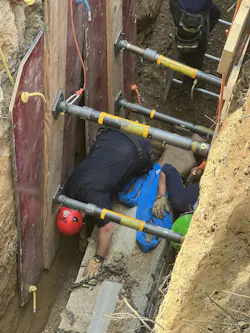
The leadership of most technical rescue teams or departments that respond to trench rescue incidents likely say that they are trained and prepared. If you ask them for an honest critique of operations or documentation on how they train, their response might not be so confident.
Trench rescue occupies a difficult space in the training world. Luckily, trench rescues are rare enough so that they don’t create the same urgency in training as structural fires and automobile accidents do. That said, they are complex issues that rely on infrequently held informal training sessions, which might leave critical gaps in a team’s preparedness. Those who hosted a trench rescue training three years ago and didn’t touch the equipment since then aren’t prepared, despite what their training records indicate.
The consequences of these gaps in preparedness can be severe. Trench collapses can kill without warning. Rescuers who take shortcuts, place shoring incorrectly or skip basic steps, such as air monitoring and properly securing a trench, are at serious risk of becoming secondary victims.
What follows is a framework that we believe helps agencies to develop a trench rescue training plan that genuinely prepares firefighters to operate at trench rescue incidents, rather than simply creating a team of “certified” members who haven’t trained in years.
An honest assessment
Before a team schedules any training, it must know where it stands. An honest assessment of capabilities and needs against a set standard builds confidence in a team’s self-awareness and growth. NFPA 1006: Standard for Technical Rescue Personnel Professional Qualifications provides some of this guidance.
Trench rescue training requirements are organized by level: awareness, operations and technician. Conveniently, these standards are specific enough to serve as a checklist. Teams can pull the standard, go through each job performance requirement (JPR) and ask themselves two questions: Can our personnel perform this skill correctly now, and can we document that they were trained on it properly?
Many JPRs from other disciplines are transferable to trench rescue, and multidiscipline teams might be capable of demonstrating these skills and providing sufficient training history. For example, if a team works in confined spaces, it already should have received proper air-monitoring training, which allows it to proceed to the next JPR. Some personnel might have attended classroom training but lack hands-on experience, which can be addressed quickly during a drill. However, certain skills might require formal training that isn’t provided in other disciplines. These gaps need the most attention.
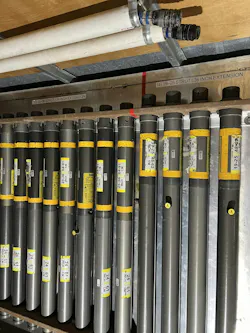
Be specific when identifying gaps. For example, shoring is a broad topic and not a specific gap. “Correct identification of pneumatic strut sizes for a 40-inch wide trench” is a gap. The more precise that you make the gap, the more targeted that your training goals and objectives can be. Use this process as an opportunity to audit your equipment. Training and equipment are two sides of the same coin. Identify what equipment that you’re missing for specific skills and work that into your budget.
Train by level
Training every member to be a technician in every technical rescue discipline is beyond the reach of many departments and teams. Even so, all members should have awareness-level training so that first-arriving members can take the correct actions and avoid the incorrect ones. This training should cover hazard recognition, securing and stabilizing the scene, and calling for the proper backup. This can be delivered in half a day, in a classroom and potentially on shift. This doesn’t require heavy equipment or a field site to accomplish objectives and create a solid foundation for the department.
Operations-level training builds off of the awareness-level skills and can include installing shoring components, performing air monitoring, supporting patient packaging and extricating victims. Critically, these team members can work under technicians if needed, acting as a force multiplier at a technician-level trench (a deep or intersecting trench, for example). The operations level does require hands-on skills, and students who are in these classes should be evaluated against specific JPRs, not just attendance. Checklists or national certification tests that assess specific JPRs are a good way to achieve this.
This level of training is the bread and butter of the trench rescue world. Good candidates for this class include primary rescuer personnel, support companies and company-level officers.
Dedicated rescue personnel should be prioritized for technician-level training. Technician-level training is the most resource- and time-intensive training of the three levels but also the most critical. These personnel will plan and execute the most complex trench rescues and should be subject matter experts in this field. Evaluate technicians through JPRs, practical scenarios and continuing education.
Build a calendar, not a class
Once you identify who needs training, at what level those members need training and the gaps that exist in your program, you can incorporate this into your training calendar. One of the most common issues that we see in trench rescue training plans is treating classes as something that you can achieve once and be done with forever. Time and time again, departments request multiple trench rescue classes and fill an entire summer getting their personnel online as technicians only to never train on the topics again. Trench rescue skills are perishable; they must be practiced and honed. By focusing on the proper training level for each person, departments can develop a tiered response of capable first-due companies, trained support staff and subject matter experts. This can be used to create a sustainable training calendar that keeps personnel’s skills current.
Monthly: Brief trench rescue topics often can be incorporated into regular drill nights. Spending 5–10 minutes on soil dynamics, a quick review of shoring equipment, bump testing and a review of air monitoring is worthwhile. These don’t need to be full evolutions; they are back-to-basics refreshers to keep knowledge fresh.
Quarterly: These drills should be half-day, hands-on training sessions that focus on specific trench rescue components that are identified as training deficiencies. They might cover shoring system installation within a timeframe, an air-monitoring scenario or a patient-packaging evolution. Team members can operate at their level of training and hone their skills.
Annually: A full-day exercise allows teams to test individual skills in a real-world, timed event. Consider bringing in outside evaluators to add objectivity to the assessment.
Documentation
Proper training documentation in trench rescue goes far beyond record keeping. It proves your organization’s capabilities and shows that you did due diligence in training your team. At a minimum, document the date, duration and location of each event along with the JPRs that were addressed. Also record the instructors, the participants and a performance evaluation. The latter is critical. A training record only shows attendance; it isn’t proof of competency. Build your documentation around competency, not just attendance.
Evaluate the program
Your trench rescue training plan should be a living document, not something that you create once and never revisit. Like any living document, it requires regular evaluation.
After every major training evolution, conduct an after-action review. What went well? Where did team members struggle? Were there any equipment issues? Did the training identify any gaps in the program’s curriculum? Use these reviews to update the training plan, not just the exercise.
Additionally, review the program whenever a new NFPA standard is released, because many JPRs can change. A training plan that was current five or 10 years ago might have significant gaps that are relative to the current editions of NFPA 1006 and NFPA 2500: Standard for Operations and Training for Technical Search and Rescue Incidents and Life Safety Rope and Equipment for Emergency Services.
A plan executed consistently
A trench rescue training plan alone won’t make your department ready. A sustainable plan that’s executed consistently over time makes a department ready. Think of the training plan as a map that will take you where you need to be.
Start with an honest assessment, anchor the program to set standards and build the training to all three levels (awareness, operations and technician). Make sure that the training program is distributed throughout the year and that you evaluate performance. When a team does these things and is dispatched to a trench rescue, all personnel will know what to do, and they’ll do it safely and efficiently.
About the Author
 Christian Brown
Christian Brown is a 19-year member of FDNY, where he holds the rank of lieutenant. He has spent time in special operations and is also a special operations instructor for the state of New York. He is pursuing his bachelor’s degree in emergency management at Metropolitan College of New York.
 Jeffrey Mondo
Jeffrey Mondo is a fire protection specialist with the New York Office of Fire Prevention and Control (New York State Fire) and is assigned to the Technical Rescue Branch. He also is a rescue team manager with New York Task Force 2 Urban/Technical Search and Rescue (NY-TF2). Mondo is an adjunct instructor at Onondaga Community College who is assigned to the fire protection technology program.