Key Takeaways
- A good starting point for fire departments that want to create an ice rescue program or formalize an existing one is NFPA 2500: Standard for Operations and Training for Technical Search and Rescue Incidents and Life Safety Rope and Equipment for Emergency Services.
- Conducting a hazard identification and risk assessment as outlined in NFPA 2500 can help to provide clarity for the people who hold the purse strings via an objective analysis of the potential hazard locations.
- Reaching out to neighboring and/or regional fire departments provides an organization that wants to create or formalize an existing ice rescue program with the opportunity to learn about equipment manufacturers and training providers, to aid in its own decision process.
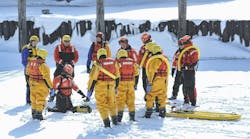
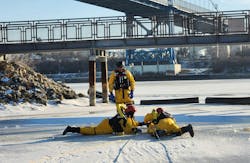
Despite appearing relatively straightforward, ice rescues can be dangerous, particularly when a fire department is ill-prepared for them. Although many departments maintain a cache of ice rescue equipment, it’s less common to see departments that developed a formal ice rescue program to include a formal risk assessment, standard operating procedures (SOPs), minimum training standards and an annual competency evaluation of rescuer skills.
A good starting point for departments that want to create an ice rescue program or formalize an existing program is NFPA 2500: Standard for Operations and Training for Technical Search and Rescue Incidents and Life Safety Rope and Equipment for Emergency Services. It’s a consolidated standard that incorporates NFPA 1670: Standard on Operations and Training for Technical Search and Rescue Incidents, NFPA 1858: Standard on Selection, Care, and Maintenance of Life Safety Rope and Equipment for Emergency Services and NFPA 1983: Standard on Life Safety Rope and Equipment for Emergency Services.
The NFPA 1670 portion of NFPA 2500 (Chapters 4–23) is intended to provide the authority having jurisdiction (AHJ) with an organized framework to assess potential technical rescue hazards in its jurisdiction, identify the needed level of technical capability and establish operational guidelines for employing this capability. Additional general requirements that are found in NFPA 1670 include establishing written standard operating guidelines (SOGs) that don’t exceed the organization’s operational capability; provisions for initial and continuing training; documenting such training; and conducting an annual competency evaluation.
Define the problem
When a department doesn’t provide water rescue services currently or doesn’t have a body of water that’s used recreationally or commercially or that’s driven past frequently, convincing elected officials and others of the importance of an ice rescue program might be challenging. For departments that have large bodies of water in their jurisdiction, particularly those that are frequented year-round for recreation, the potential for ice rescue incidents is fairly clear, and when budget requests are made for equipment and/or training, the importance of such equipment should be understood easily by the people who hold the checkbook.
Whether your department falls into either of the scenarios that are listed above or is somewhere in between, conducting a hazard identification and risk assessment as outlined in NFPA 2500 can help to provide clarity for decision-makers via an objective analysis of the potential hazard locations. Often, this is done best by a small group rather than one person. Begin by listing from memory as many target hazards (i.e., bodies of water that are large enough for a person to fall through ice) as possible. Using maps and satellite imagery, locate other target hazards that are in your response area, such as creeks and retention ponds. Record these in writing by listing address, business/location/park name (if applicable) and a short description of the hazards at the particular site and any complications (e.g., limited access) and rate the potential risk as low, medium or high.
To evaluate the risk that’s at each target hazard as objectively as possible, reference historical incident data, local knowledge of the site (“everyone ice fishes on that pond in winter”), population within a predefined distance from the hazard, number of annual visitors (e.g., for a park), etc.
Although this list will prove invaluable for the department, chances are that it will create information overload for the people who have to vote on the budget request. Therefore, the department should compile a one-page executive summary of target hazards (e.g., one river, four creeks, 67 residential ponds and five retention ponds) and three to five statistics as bullet points (prior incidents, number of visitors, etc.). One particularly useful statistic to include is the total amount of water that’s in the jurisdiction, listed in acres or square miles, because this number might be surprising.
Choose a service level
Historically, NFPA 1670 identified three levels of organizational capability for responding to technical rescue incidents, and the “Awareness, Operations, Technician” terminology carried over to NFPA 2500. Once an AHJ identifies a potential hazard, all organizations that are within that jurisdiction that might respond to such an incident should, at minimum, meet the awareness-level requirements for that rescue discipline. Furthermore, written plans and procedures should be developed for how to request additional resources if an incident exceeds the organization’s capabilities. The particulars of each organizational capability level can be found in NFPA 2500 Chapter 19.
Identical to other disciplines, such as hazmat and trench rescue, awareness-level ice rescue is a nonintervention modality that focuses on size up, hazard recognition, scene control, requesting additional resources, and supporting operations-and/or technician-level responders.
In addition to the foundational aspects of the awareness level, organizations that perform at the ice rescue operations level should have necessary PPE and be trained in its use and be capable of evaluating ice strength and conditions. Some might choose to permit properly trained and equipped rescuers to conduct nonentry rescues with equipment, such as throw bags, pike poles, inflated fire hose, etc.
Organizations that operate at the ice rescue technician level (the highest level of capability that’s identified in NFPA 2500) will use specialized equipment and techniques to conduct go rescues in addition to the capabilities that are found at the awareness and operations levels. Given the greater increased complexity of technician-level operations, departments that seek to provide these capabilities for their jurisdiction will require more funding than those that choose to operate at the awareness or operations level. Deciding at which level to operate will lead the department to the training, equipment and budget that’s needed to fund such a program.
Do your research
When developing a list of the equipment and training that’s needed to stand up ice rescue capabilities, departments should start by reaching out to local and/or regional departments or external resources to find out what equipment and training provider that they use. Not only will their experience with various equipment manufacturers, local training providers and other vendors prove beneficial, but by contacting local agencies first, relationships can be built that lead to improved interoperability when an incident occurs.
Next, leverage the power of social media to expand your professional network. Join rescue-related groups where you can ask questions, solicit firsthand reviews of equipment that you’re considering and obtain copies of SOPs/SOGs to use as a starting point for your program.
The insight that’s obtained from both in-person and virtual relationships can be extremely helpful when starting a program, because it often consists of tips and tricks that can come only from experience.
Once you have a good idea of how much equipment that you must obtain and what brands you want to evaluate, reach out to your local vendors to see whether they have any demo equipment that you can use in training or to other agencies to see whether they are willing to lend you equipment to trial.
In a time when local government budgets are stretched thin, when the time comes to purchase equipment, don’t overlook the value of small local grants from private entities, such as nonprofits, foundations and fraternal organizations.
Many organizations might be capable of providing ice rescue training. These include private training companies, state fire academies and other government agencies, such as the U.S. Coast Guard, the state fire academy, the state Department of Natural Resources, etc. Regardless of the training provider that’s selected, departments should ensure that the instructors have the necessary training and experience and that all training meets applicable standards, such as NFPA 1006: Standard for Technical Rescue Personnel Professional Qualifications. Chapter 20 of NFPA 1006 covers the job performance requirements that the individual rescuer must meet for qualification at the ice rescue awareness, operations or technician level.
Justification
It’s easy to underestimate the legwork that’s needed to start an ice rescue program from scratch, but with a relatively minor amount of advance work, departments will be far better prepared to provide objective justification on why an ice rescue program should be started and properly funded. Furthermore, the process that’s described above can be extrapolated with minor differences to help to create rescue capabilities in other disciplines.
Product Spotlight
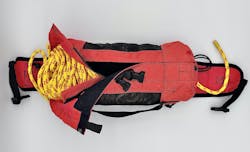
Water Ops Rope Bag
Anderson Rescue Solutions soon will introduce its ARS Entropy Water Ops
Rope Bag. Based off of the company’s popular Entropy Rope Bag, the Water Ops version is designed to include ample drainage and a large handle for rope-based water rescue operations. The bag can hold as much as 150 feet of ³/8-inch rope and allows the operator to access both ends on the center of rope.
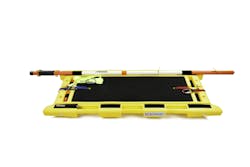
Ice Rescue Rapid Transport Sled
The R.T.S. (Rapid Transport Sled) from Ice Rescue Systems is designed for ease of operation for rescue in an ice extrication for victim care. It includes a tactical reach pole and a victim buoyancy sling. No assembly is required, and color-coded bridles offer high-efficiency response for multiple victim extrications.
Water Rescue Suit
Switlik’s Torrent water rescue suit delivers proven cold-weather protection, unrestricted movement and compatibility with a thermal undergarment for extreme conditions. Handmade in the United States, the Torrent is a tried-and-true design that’s derived from the company’s U.S. Coast Guard aviation anti-exposure dry suit, to provide superb durability and performance for water-rescue professionals.
Product Spotlight
Water Ops Rope Bag
Anderson Rescue Solutions soon will introduce its ARS Entropy Water Ops Rope Bag. Based off of the company’s popular Entropy Rope Bag, the Water Ops version is designed to include ample drainage and a large handle for rope-based water rescue operations. The bag can hold as much as 150 feet of ⅜-inch rope and allows the operator to access both ends on the center of rope.
ANDERSONRESCUE.COM
Ice Rescue Rapid Transport Sled
The R.T.S. (Rapid Transport Sled) from Ice Rescue Systems is designed for ease of operation for rescue in an ice extrication for victim care. It includes a tactical reach pole and a victim buoyancy sling. No assembly is required, and color-coded bridles offer high-efficiency response for multiple victim extrications.
ICERESCUESYSTEMS.COM
Water Rescue Suit
Switlik’s Torrent water rescue suit delivers proven cold-weather protection, unrestricted movement and compatibility with a thermal undergarment for extreme conditions. Handmade in the United States, the Torrent is a tried-and-true design that’s derived from the company’s U.S. Coast Guard aviation anti-exposure dry suit, to provide superb durability and performance for water-rescue professionals.
SWITLIK.COM
About the Author

Jake Hoffman
Jake Hoffman is a private with the Toledo, OH, Fire & Rescue Department who is assigned to Rescue Squad 7. He has spent time assigned to both the Special Operations Bureau and the Training Bureau. Hoffman is a HAZMAT team manager with the Ohio-Task Force 1 Urban Search and Rescue Team. He is a co-owner of Squad 5 Fire Training.