Firefighters Take Heed: The Dark Side of 'Service Before Self'
Key Takeaways
- The calling that prompts people to become firefighters is commendable, but when “the job” makes members ignore their family and the well-being of their coworkers, they compromise their ability to provide their community with the best service.
- The mindset of service before self can expose members of the fire service to burnout, family neglect, lack of personal and professional development, and unsafe and/or toxic work environments.
- A focus on technology as it relates to departmental programs shouldn’t exceed that which creates better health and wellness for members and their families.
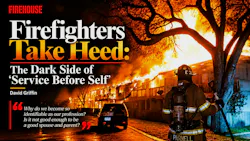
The statement “service before self” has been used in emergency services for generations as a badge of honor, but is it really true? Does service before self offer the best support for our members, the department, their families and the communities that are served? If we always are focused on everyone else, who is focused on our family and our well-being?
Do you believe that other people who you work with will ensure that you’re physically and mentally healthy and that your family is loved and cared for properly?
We must evolve this mindset. We are witnessing too many young firefighters leave this profession because they see the older generation having given their entire adult life to a “job.” Spin it however you want—a calling, a purpose or whatever else makes you feel important—but at the end of the day, it’s a job.
Why does this job create leaders who are more worried about their upward trajectory than they are about their family?
Off-duty focus on the job
The next time that someone tells you how many years of service that they have, ask them these questions: Out of those years, in how many of them have you been a good and honorable spouse? In how many of those years have you been a good parent who’s focused on your child’s well-being? The statistics indicate that the answer to both of these questions would be a very low number. The emergency responder divorce rate is between 60 percent–75 percent, which is significantly higher compared with the percentage for the general public of the mid-to-high teens. Does the mentality of service before self perpetuate this? Absolutely.
Think about how many family events—youth baseball games, family dinners, birthdays, etc.—that you missed because you “had” to be at a department function.
Now, I’m not talking about shift work. That’s the job. If you’re on shift, it is what it is. We protect the community, so we must be there.
I’m referring to all of the time that you spend off duty with or focused on your job and the department. Why do we become so identifiable as our profession? Is it not good enough to be a good spouse and parent?
I worked for 21 years in a department, and I was more focused on the department than on my own family. How does that make any sense? Herein lies the problem.
You might be in the same situation. You do realize that when you leave your department that you’re replaced before you’re even gone, right? We believe that we’re so important to our respective department, but let’s be honest here, we aren’t. Plenty of others are capable of doing just as good of a job or much better as we are. It can go the other way, too, but at the end of the day, we are replaceable, and that’s OK. That’s part of life. We did our time. It’s someone else’s turn. Wish them the best and move on.
What isn’t OK is when you have leaders who overstay their welcome, floating along and not improving the department or the health and wellness of the members or their own family. That’s the predicament that many organizations are in.
How do we fix this?
We must evolve our thought process on service before self. Now, I already can imagine some of you reading this article with steam coming from your ears. However, deep down inside after you let your ego digest this, you know what I’m saying holds validity. We aren’t our position. We are human beings first, and we should care about other human beings we work with first. If we can’t serve the folks we work with as well as ourselves to be the best version mentally, physically and emotionally, do you really believe that we can give the best service to our community? No, we absolutely can’t.
Health and wellness
The mindset of service before self creates issues that all of us are seeing:
- Burnout and exhaustion of all ranks in an organization.
- Department members neglecting their family.
- Lack of personal and professional development.
- Unsafe working conditions, as members struggle with sleep deprivation and mental health issues.
- Toxic work environments where the most important asset of the organization, the people, aren’t focused on.
We worry more about what piece of technology that we want to buy for a department than health screenings for members. How does that make sense?
About technology: I’m all for technology to improve firefighter health, wellness and safety. However, what I’m not for is focusing so much on technology that we forget about the people in an organization who use the technology.
Here’s a question for department leadership: In the past six months, have you had more discussions and meetings on technology for various departmental programs or on how you can create better health and wellness programs for your members and their families? I already know the answer.
We seem to be more worried about what the next “program” is rather than the improvement of the lives of the members of the organization and their families. Have we forgotten that without those people, there is no organization?
Here’s another question for you: The last time that you went to a conference, how many vendors were “teaching” classes to sell their products? It’s quite disturbing to see this. Of those vendors, how many of them were sharing valuable information that benefits your department members and their respective family’s health and wellness? From what I’ve seen, very few.
We have plenty of programs to conduct rig checks, to track training, for scheduling and to replicate what’s already been done. Furthermore, we’re falling for it every time. Why don’t we realize that much of this is repetitive? If we were this repetitive with battling cancer, suicide, toxic work environments and mental health issues, our members would be much safer and healthier and the environments that they work in would be more fulfilling.
Service before self?
Service before self doesn’t seem to be working for our members. Increased suicide rates, divorces, infidelity, drug use, alcoholism, prescription drugs: I can keep going, but I hope that you get my point. It’s time to wake up and focus on what matters: the health and wellness of our members and families.
If you’re putting this “job” and your “position” before your family and the betterment of the people you work with, I can promise you, it won’t turn out well. I’m speaking from experience here. Stop letting a job define you. What defines you is how you treat your family and the members of your organization. How did we get this so out of alignment?
About the Author
 David Griffin
David Griffin, EdD, recently retired as the assistant chief of administration in Charleston, SC, and is a Firehouse Contributing Editor. He was the operator of the first-due engine on June 18, 2007, when nine of his fellow firefighters perished. Griffin progressed through the ranks in operations in every uniformed position, from firefighter to battalion chief and shift commander to assistant chief, during his 21-year career in Charleston. He has a bachelor's degree in education from The Citadel, a master's degree in executive fire service leadership, and a doctorate of education in organizational leadership and development. Griffin is the author of "In Honor of The Charleston 9: A Study of Change Following Tragedy," among three other books. He is an international speaker and instructor, a certified Chief Fire Officer and Chief Training Officer with The Center for Public Safety Excellence, an IFSAC/Pro Board-certified Fire Officer IV and a graduate of the Executive Fire Officer Program from the National Fire Academy. He is a graduate of Harvard University's Kennedy School of Executive Education program: Senior Executives in State and Local Government and of the Psychology of Leadership program at Cornell University's SC Johnson College of Business. Griffin is the owner of On A Mission LLC, at drdavidgriffin.com.