Simple Tools to Help Firefighters to Reduce Cancer Risk
Key Takeaways
- A five-gallon bucket that’s stocked with clear trash bags, duct tape, liquid dish soap, a short-handle scrub brush, an all-purpose spray bottle, baby wipes, two 50-foot ⅝-inch hoses, two garden hose spray nozzles, a 2½-inch female X adapter, a ¾-inch male GHT adapter and a collapsible traffic cone has proven to encourage on-scene decontamination by firefighters in Florida.
- Older firefighters might be more motivated to participate in exposure-reduction behaviors for their family’s sake or because they know a firefighter who was diagnosed with cancer.
- Non-white firefighters might be less likely to use a decon bucket—and participate in exposure-reduction behaviors—as a result of differences in training access, communication gaps or resource availability within a department compared with white firefighters.
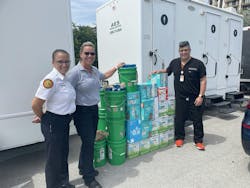
Firefighters across the United States know that the odor of a fire lingers long after the flames were extinguished. Soot that’s on gear, residue that’s on skin and particles that are embedded in a fire apparatus’ cab carry invisible hazards, many of which are linked to long-term health risks, such as cancer. Although awareness of these risks has
grown, translating knowledge into action remains a challenge.
One low-cost, high-impact solution quietly is gaining traction: the “decon bucket,” which is better known in Florida as the “Green Bucket.”
In a recent analysis of survey responses from 371 Florida firefighters, Sylvester’s Firefighter Cancer Initiative at the University of Miami found that a simple five-gallon bucket that’s stocked with baby wipes, liquid soap and other basic supplies is making a measurable difference in firefighter behavior. Most importantly, firefighters are using it.
Lifesaving potential
The Green Bucket is designed to be an integral part of preliminary exposure reduction (PER), which is the seven-step post-fire gross decontamination process. After responding to a fire, firefighters can use the bucket to remove surface contaminants from their gear, tools and exposed skin.
The method isn’t complex, doesn’t require advanced training and can be done on the fireground or at the station. What makes it remarkable isn’t the technology but the uptake: 91.1 percent of surveyed firefighters were adopters of the decon bucket, and 93.8 percent reported using it at least occasionally after fire incidents. Even more striking, nearly 60 percent reported using the decon bucket after every fire.
Who uses the bucket?
Two independent surveys were administered by Sylvester’s Firefighter Cancer Initiative to study Green Bucket usage among Florida firefighters. Usage patterns varied slightly between the two groups. The initial study (156 survey respondents), which was conducted among Florida fire service leaders (i.e., company officers and chiefs), showed nearly universal adoption and regular use. The second study (215 survey respondents), which surveyed a broader group of rank-and-file personnel, still reported strong usage, but with more variability in consistency.
Experience played a role: Firefighters who have 10 or more years of service (68 percent of all of the survey respondents) were nearly six times more likely to adopt the Green Bucket than those who have less than 10 years of service. This difference was statistically significant. Fire service leaders (53 percent of all of the survey respondents), including lieutenants and captains, also showed higher adoption rates compared with those of firefighters and EMTs.
This trend suggests that institutional knowledge and leadership buy-in are powerful drivers of behavioral change. The more seasoned the firefighter, the more likely that individual is to recognize long-term health risks and to take action to mitigate those risks. There are several possible reasons for this difference in usage patterns. For example, older firefighters might be more proactive about taking care of themselves for their family’s sake, or they might be more motivated to participate in exposure-reduction behaviors, because they know another firefighter who was diagnosed with cancer.
Barriers to adoption exist
Despite encouraging results, the data also revealed gaps. Approximately 9 percent of surveyed firefighters hadn’t adopted the decon bucket. Among nonadopters, the most common behaviors included never using the decon bucket supplies (60.6 percent) and rarely or never refilling the bucket (65.6 percent).
Ethnicity emerged as an important factor. Hispanic firefighters appeared less likely to use the Green Bucket compared with non-Hispanic firefighters. However, this difference wasn’t statistically significant. These disparities might reflect differences in training access, communication gaps or resource availability within departments.
For departments that aim for universal adoption, these findings are critical. Targeted outreach, particularly to younger and newer firefighters as well as underrepresented groups, might be key to closing the implementation gap.
The winning attribute
When asked how easy it is to use the decon bucket, 98.3 percent of users responded that it was either “very easy” or “somewhat easy.” Although the PER process itself often is described as burdensome in other contexts, PER with the Green Bucket was considered easy by a large majority of users. Most reported that it takes no more than 10 minutes to complete the seven-step gross decon, and nearly half said that it took no more than five minutes.
Convenience matters. For an intervention to gain traction in the fire service, it must not interfere with operations or morale. Although it might take a little time and training to make the Green Bucket a routine part of post-fire practices, most firefighters report satisfaction with the process and feel the benefits are worth the extra effort. More than 86 percent of respondents to the survey said that they definitely would continue to use it, and 99 percent would recommend it to a colleague.
Why the bucket works
The science behind PER is clear: Removing toxic soot and fireground chemicals from gear and skin reduces the amount of carcinogens that are absorbed by the body. Harmful substances can enter a firefighter’s body through inhalation, ingestion and skin absorption. Immediate decon disrupts these pathways.
This is why a stocked $30 bucket (including wipes and cleaning supplies) can function as an effective cancer-prevention tool. However, the Green Bucket is more than just another piece of gear. It’s a behavioral nudge. It makes the healthy choice the easy choice.
Leadership from the field
Fire service leaders are positioned uniquely to model and reinforce personal decon behavior. In our study, firefighters who are in leadership positions were significantly more likely to be Green Bucket users. Departments that incorporate gross decon into their standard operating procedures (SOPs), that provide supplies regularly and that train crews during onboarding saw higher usage rates.
One Florida fire officer put it best: “When the buckets are stocked and inspected, they get used. When the captain uses it, the crew follows.”
Study to standard practice
Our study findings demonstrate that simple interventions can drive widespread change when deployed thoughtfully. Although high-tech solutions, such as wearable sensors and advanced filtration systems, often grab headlines, it’s the low-cost, high-yield tools, such as the decon bucket, that might have the most immediate effect on firefighter health.
Departments that are looking to implement this approach can start small:
- Assign a decon bucket to each vehicle or crew.
- Develop an SOP that outlines which unit/member is responsible for setting up the decon station so that it’s ready when crews exit.
- Train on proper use during department drills.
- Include decon bucket use in after-action checklists.
- Refill supplies regularly and track use across time.
Culture change
In a profession in which bravery is a given and cancer is an ever-present risk, tools that protect firefighters without slowing them down are rare and valuable. The decon bucket stands out, not because of its complexity, but because of its simplicity. It’s a tool that firefighters can use, want to use, will use and will benefit from using.
As the fire service continues to confront occupational cancer, these findings offer a clear takeaway: Culture change doesn’t always require sweeping reform. Sometimes, it just takes a bucket—a green bucket.
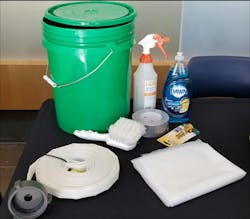
Build a Bucket
If you want to add a decontamination bucket to your apparatus, here’s what you’ll need:
- Five-gallon bucket and leak-proof lid.
- Clear trash bags (6 mil).
- Duct tape.
- Liquid dish soap.
- Short-handle scrub brush.
- All-purpose spray bottle.
- Baby wipes.
- 50-foot ⅝-inch hoseline (2).
- Garden hose spray nozzle (2).
- Adapters: 2½-inch female X, ¾-inch” male GHT (2).
- Collapsible traffic cone.
Post-Fire Decontamination Steps
1. Gross Decon. Existing crews stay on air and use the Green Bucket to perform wet decon as a crew.
2. Drop Zone. Doff bunker coat, hood, SCBA pack, helmet and gloves and placed neatly on clean surface or disposable tarp for redeployment.
3. Personal Decon. Perform a thorough personal decon using wipes. Don’t cross-contaminate. Use a new wipe for each area.
4. Rehab. Repeat Steps 1–4 after each entry or if exposed.
When demobilized, continue to Step 5.
5. Bag/Clean Up. Bag gloves, coat and pants, in that order. Clean helmet and any contaminated tools and equipment.
6. Hood/Glove Swap. Swap hood and gloves for clean ones, if available, before leaving the scene.
7. Fire Station Decon. Additional routine cleaning as needed. Swap into second set of PPE if available or hang to dry. Shower within one hour.
Source: Adopted from the Florida Statewide Post-Fire Gross Decontamination Field Operation Guide.
About the Author
 Chelsea Kavanaugh
Chelsea Kavanaugh
Chelsea Kavanaugh is a senior research associate with Sylvester’s Firefighter Cancer Initiative (FCI) at the University of Miami, where she leads cancer prevention education and outreach initiatives. As a Certified Health Education Specialist and spouse of a firefighter, Kavanaugh leverages health education theory and evidence-based strategies to encourage individual and organizational efforts to improve health and safety in the fire service.
 Emilie Brown
 Emilie Brown
Emilie Brown is a senior research associate with Sylvester’s Firefighter Cancer Initiative (FCI) at the University of Miami, where she leads the National Firefighter Cancer Survivorship Program and supports the Health, Exposure, and Reproduction (HER) Study that investigates the reproductive health of female firefighters. With a concentration in health policy, Brown is passionate about leveraging scientific evidence to advance systemic change within the fire service and to protect the occupational health of firefighter populations.
 Dr. Natasha Schaefer Solle
 Dr. Natasha Schaefer Solle
Dr. Natasha Schaefer Solle is a research associate professor in the Department of Medicine and Public Health Sciences at the University of Miami Miller School of Medicine and Sylvester Comprehensive Cancer Center. She serves as co-deputy director of the Firefighter Cancer Initiative, leading cancer prevention, education and survivorship programs for firefighters. Schaefer Solle’s research focuses on occupational cancer risks and improving cancer screening in underserved communities, leveraging her expertise in qualitative and community-based participatory research. She also serves as assistant director of the Behavioral and Community-based Research Shared Resource, supporting biobehavioral and population research aligned with community needs.
 Tulay Koru-Sengul
 Tulay Koru-Sengul
Dr. Tulay Koru-Sengul is a professor at the Department of Public Health Sciences at University of Miami Miller School of Medicine. She has affiliations with Sylvester Comprehensive Cancer Center and The Miami Clinical and Translational Science Institute.
 Vincent L. Reynolds
 Vincent L. Reynolds
Vincent L. Reynolds is a board-certified toxicologist and does independent consulting as president of Florian Consulting in Toxicology and Safety Assessment. He also has been active for more than 50 years as a firefighter, engine chauffeur, ladder chauffer/tillerman and EMT with paid, volunteer, combination and industrial departments. Reynolds was a field instructor with the Delaware State Fire School. His certifications include Firefighter I, Firefighter II, Fire Officer, Fire Instructor I, Fire Instructor II and Safety Officer. Reynolds currently is a life member of the Aetna Hose, Hook & Ladder Company of Newark, DE, and a member of the Greenfield, IN, Fire Department.
 Christopher Pecori
 Christopher Pecori
Christopher Pecori serves as a fire lieutenant with Miami-Dade Fire Rescue and has practiced as an emergency medicine physician assistant for 29 years. With 21 years in the fire service, he collaborates with Sylvester’s Firefighter Cancer Initiative at the University of Miami, contributing to research and education that’s aimed at reducing occupational cancer risk among firefighters.
 John Schmidt
 John Schmidt
Chief John Schmidt (Ret.) had a distinguished 39-year career in the fire service, advancing from firefighter to fire chief. Currently, he is dedicated to advancing firefighter health and safety initiatives, such as on-scene decontamination and occupational health programs. Schmidt serves on numerous committees and boards that support the fire service community.
 Erin Kobetz
 Erin Kobetz
Dr. Erin Kobetz is the associate director for community outreach and engagement at Sylvester Comprehensive Cancer Center and the founding director of Sylvester’s Firefighter Cancer Initiative (FCI). Across her leadership roles at the University of Miami, she advances interdisciplinary research that translates scientific discovery into practical applications for disease prevention and improved health outcomes.
 Alberto Caban-Martinez
 Alberto Caban-Martinez
Dr. Alberto Caban-Martinez is a board-certified physician-scientist, a professor (tenured) of public health sciences, a deputy director of the MD-MPH Program and interim vice-provost for research & scholarship at the University of Miami. He has more than 23 years of domestic and international research expertise in environmental and occupational epidemiology. Caban-Martinez serves as the deputy director of Sylvester’s Firefighter Cancer Initiative at the Sylvester Comprehensive Cancer Center, with a focus on firefighter subgroups, such as arson investigators, firefighter trainers/instructors, wildland-urban interface and volunteer firefighters.