Built for Today, Ready for Tomorrow: Future-proofing Volunteer Fire Stations for the Career Transition
Key Takeaways
- The process of futureproofing for volunteer firehouses includes understanding changing staffing models, call volumes, and operational demands to remain effective over decades.
- Designing for future capacity in today's volunteer fire stations involves flexible layouts, scalable mechanical and electrical systems, and provisions for future expansions or conversions.
- A case study demonstrates how integrating futureproofing principles into station design ensures facilities can evolve with community needs and staffing models.

Fire stations are long-term civic investments, often expected to serve their communities for 50 years or more. Many of these facilities were originally designed to support volunteer fire departments, particularly in suburban and rural areas. However, the realities of fire and emergency medical services are changing rapidly. Increasing call volumes, evolving training requirements, and shifting workforce dynamics are placing a growing strain on the traditional volunteer model.
Across the country, fire departments are increasingly transitioning toward combination staffing models that blend volunteer and paid personnel or are moving entirely to career staffing. These shifts are often gradual and driven by operational necessity rather than through long-term planning. As a result, many existing fire stations are not equipped to support overnight or duty crews, shift work, or expanded staffing.
Futureproofing is a concept that offers a practical solution. By incorporating flexibility and scalability into design and construction, fire stations can meet current needs while preparing for future transitions. This approach allows communities to adapt without costly renovations, ensuring that facilities remain effective and resilient as service demands evolve.
Reasons for decreased volunteers
The decline in volunteer firefighters is driven by a combination of economic, social, and operational factors that continue to intensify.
One of the most significant challenges is the shift in workforce patterns. In many communities, particularly rural areas, volunteers often commute longer distances due to housing affordability and regional job distribution. They also tend to have less flexible work schedules, especially during daytime hours, limiting their availability to respond to calls. Dual-income households have further reduced the time individuals can dedicate to community service.
Economic pressures also play a key role. As the cost of living increases, many individuals must prioritize paid employment over volunteer commitments. What was once a feasible contribution to the community has become more and more difficult to justify without compensation.
Training requirements have increased substantially as well. Firefighting demands proficiency in a wide range of disciplines, including fire suppression, EMS, hazardous materials, and technical rescue. With the world becoming more litigious, fire departments have been forced to significantly enhance well documented training in an effort to reduce risk and meet standards. While these standards improve safety and effectiveness, they also increase the time commitment required to participate.
This issue becomes further exacerbated by the reality that call volume is at an all-time high. As outlined in a previous article by David Pacheco, AIA, NCARB, departments are increasingly asked to do more with less. According to the National Volunteer Fire Council (NVFC), there was roughly a 25 percent decrease in volunteer firefighters in the U.S. between 1984 and 2020. However, the increased emergence of EMS, rescue, and service calls has resulted in call volume tripling in that time frame.
Recruitment and retention challenges further compound the issue. Younger generations often seek structured, predictable commitments, and the open-ended nature of volunteer service can be less appealing. Existing volunteers also face administrative responsibilities and fundraising demands, contributing to burnout.
As a result of these overlapping pressures, many departments are reevaluating their staffing models. While volunteer service remains essential, the shift toward combination or career staffing is becoming increasingly common.
Futureproofing techniques to consider
As departments navigate these changes, designing for adaptability is essential. Futureproofing does not mean overbuilding, but rather making strategic decisions that allow facilities to evolve with minimal disruption and cost.
Planning for future residential use is one of the most critical considerations. Introducing overnight crews brings the building under International Building Code requirements for sleeping areas, classified as Group R occupancy. Even in a volunteer-only station, incorporating these provisions early can greatly simplify a future transition. This includes providing appropriate fire-rated separations between the Group R occupancy, ensuring compliant egress from sleeping spaces, and integrating smoke and carbon monoxide detection. Evaluating potential sprinkler requirements as defined by the building code is also essential, as incorporating these systems during initial construction is far more efficient than retrofitting later.
Mechanical systems should also be designed with future capacity in mind. Systems that are adequate for a lightly occupied volunteer station may not support a fully staffed, 24-hour operation. Designing HVAC systems to accommodate increased occupancy, and provide zoned control, supports both flexibility and long-term efficiency.
Electrical and technology infrastructure is another key component. Fire stations continue to rely more heavily on communication systems, alerting technology, and data networks. Installing spare conduit pathways, allowing for additional electrical capacity (such as extra space in an electric room or capacity in panelboards), and providing expandable IT space enables departments to integrate new systems without major upgrades.
Space planning plays a central role in adaptability. Offices, training rooms, and support spaces can be designed with future conversion in mind, allowing them to transition into bunk suites or living quarters as staffing models change. Structural layouts that support modification, along with the use of demountable partitions, make these conversions more efficient and less disruptive. One example is the ready room (or day room). In a volunteer station, this is a hub for volunteers to gather before or after a call, allowing for camaraderie, information sharing, sign-in location, and more. Upon conversion to career, this space may become a more traditional alarm room or house watch. If the space and infrastructure is in place, minimal changes to the furniture, fixtures and equipment within the space can make the transition very cost effective.
To help manage initial construction costs, certain areas can be left as “white box” spaces for future build-out when funding becomes available. These spaces are often allocated for some other temporary use in the meantime. If bunk accommodations are not included in the initial program, planning for future additions is equally important. This includes identifying expansion areas on site, maintaining efficient circulation between additions and the apparatus bay to preserve response times, and accommodating parking for overnight crews or future parking expansions. Whenever a future addition is planned, there are ways to accommodate the structure, such that the addition can easily be connected to the primary building without major modifications, such as providing planned openings with lintels already in place.
Equally important is designing for firefighter health and well-being. Modern stations should incorporate clear separation between apparatus bays and living areas, along with dedicated spaces for decontamination, gear storage, and laundry. Separating the laundering of personal linens from operational gear supports a clean living environment through hot-zone design and aligns with current standards such as NFPA 1585.
Beyond functionality, the station environment should reflect the reality that career firefighters often spend extended periods in the building. Incorporating durable yet comfortable materials and thoughtfully designed living spaces helps create an environment that supports both performance and well-being.
Case study: Friendship Engine and Hose Company
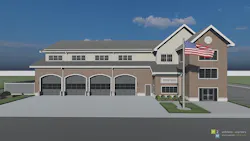
The new station for the Friendship Engine and Hose Company, currently under construction in Merrick, NY, demonstrates how futureproofing can be successfully integrated into a volunteer station.
Originally built in 1931, the existing station faced numerous limitations, including undersized apparatus bays, limited circulation space, and a lack of modern support areas. The new facility addresses these deficiencies while anticipating future operational needs.
Although the station is designed to support a volunteer department, it incorporates key features that allow for a transition to shift-based staffing. A dedicated bunk suite provides accommodations for three private bunk rooms and is designed for flexibility, allowing either individual beds or bunk beds. Lockers promote overnight use by offering offer storage for personal belongings and linens.
The bunk suite includes a private bathroom, enabling comfortable operation for overnight crews while maintaining separation from public and operational spaces. A shared living room provides an area for rest and informal interaction, encouraging use of the primary station kitchen to reinforce camaraderie while avoiding redundant spaces.
A dedicated laundry area for bunk linens further supports a clean-living environment. By separating these functions from gear and other potentially contaminated materials, the design reinforces the distinction between operational and residential zones.
In addition to these features, the station includes updated apparatus bays, improved circulation, decontamination areas, and expanded support spaces. These improvements address immediate operational needs while positioning the department for future staffing changes.
The result is a facility that functions effectively today while remaining adaptable for tomorrow. The department has previously introduced overnight crews and a creative partial staffing system that accommodates college students and other firefighters who are only in town for short periods of time. The transition to a more formal combination or career model is now supported by the infrastructure already in place.
Conclusion
The fire service is undergoing a significant transformation driven by changing demographics, increased service demands, and evolving expectations. While volunteer departments remain essential, the shift toward combination and career staffing is likely to continue in many communities.
Futureproofing provides a proactive approach to managing this transition. By incorporating flexibility, scalability, and long-term thinking into fire station design, communities can ensure their facilities remain functional and relevant over time.
Rather than reacting to change, futureproofed stations are prepared for it. They allow departments to adapt their staffing models, maintain service levels, and support firefighter well-being without major disruption or expense.
Ultimately, designing for the future is about creating resilient, adaptable spaces that serve both the community and the firefighters who protect it, today and for decades to come.
About the Author
 Patrick O. Stone
Patrick O. Stone
Patrick O. Stone, RA, LEED AP, is the director of the public safety market at H2M architects + engineers. He has 17 years of experience in the design of emergency service and public safety facilities and 19 years of service as a volunteer firefighter at two Long Island, NY, fire departments. Stone is responsible for overseeing H2M’s specialized team of experts and uses his firefighting experience to enhance the facilities that he designs to integrate best practices and the latest trends. He is a regular speaker at national symposia and was published on a variety of station design trends.
 Rachael Grodzki
Rachael Grodzki
Rachael Grodzki, R.A. is a project architect who has more than eight years of experience at H2M architects + engineers. She specializes in architectural design for public safety facilities. Grodzki holds a Bachelor of Science in architectural engineering technology from the State University of New York at Farmingdale and is a registered architect in the state of New York. She is experienced in the programming and design of public safety facilities to ensure the health, safety and well-being of the communities and clients that H2M serves.