Modernizing Fire Station Alerting
Key Takeaways
- Turnout timers, color-changing lights, so-called heart-smart ramping audible tones, and text-to-speech readouts are among the technological innovations that have been applied to fire station alerting systems.
- An in-station LCD message system provides more characters per square inch than what might be possible with LED signage as a means of delivering better information about call type, the status of a call, units that are responding and other computer-aided dispatch information.
- One station alerting system can include a device that’s placed underneath the bed of a sleeping first responder to provide a vibrating tone that increases gradually to waken the member.

At FireFusion 2025 last October, Dr. Joel Billings and Blake Richardson, who is CEO of EaseAlert spoke to how firefighters’ bodies react when they are awakened by an emergency call and the physiological effect, cardiovascular risk, cumulative exposure and fatigue that results. The two men shared statistics from the Center for Fire Rescue and EMS Health Research that showed a spiked heart rate in firefighters when waking up to an emergency alarm. Over time, that increases cardiovascular risk and negatively affects mental and physical clarity.
Enter the modern approach to station alerting systems, including progressive tones, pre-announced soft voice messages, graduated lighting (to allow eyes to adjust) and zoned alerting. Even the lasting edition of NFPA 1550: Standard for Emergency Responder Health and Safety includes a section on modernizing station alerting.
Thanks to APS Firehouse Alerting, Bryx, EaseAlert, US Digital Designs and others, there are cutting-edge solutions to address this challenge to firefighter health and well-being.
A full system
Bryx’s overall station alerting system is in operation at more than 2,000 U.S. fire departments and push out more than a million messages per day.
Brian Bush tells Firehouse that the company’s customers embrace Bryx systems for their consideration.

of every aspect of station alerting and personalized solutions for turnout timers, color-changing lights, heart-smart ramping tones, text-to-speech readouts, Google street view and navigation, full station automation, modular architecture, zoned alerting, automatic switch screens, uninterruptible power supply, radio and audio integration and printer integration.

This, Bush says, has led to more portable applications for a healthier and quicker way of alerting first responders inside and outside of the station.
In and out of the station
More specifically, two recent USDD products are directly applicable to life inside and outsdie of the firehouse. Its LCD Message Sign provides alert information in a full-color and high-resolution format. This comes from the company’s long history of producing LED signs, but limitations to the LED format became the catalyst for transition. The LCD Message Sign is twice the size of previous models and allows for the display of more information than what can be delivered via a scrolling ticker.
“The responders are getting more information in that snapshot,” Edward Hadfield, who is a regional territory manager, says. “They're getting more pertinent information. They're not having to wait for it to scroll across and miss something. The LCD Message Sign gives you more situational awareness, and it starts to establish cognitive decision-making.”
The LCD Message Sign provides more characters per square inch, the status of the call, units that are responding, the call type, address and other computer-aided dispatch notes.

“They always say your eyes and ears are the window to the brain,” Hadfield tells Firehouse. “If you're not getting a good, clear snapshot of information visually and then hearing it, your brain can't process that from a cognitive decision process to be able to make good decisions.”
USDD’s Flex Alert gives first responders an alerting system for outside the station, which pays dividends in the volunteer space.

"One of the number one things we're looking at is firefighter health and safety,” Hadfield remarks. “We built that same health and safety feature into the Flex Alert for the volunteer community, because they're just as important. It provides a portable fire station alerting system."
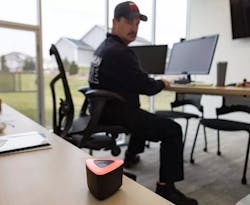
Flex Alert is about the same size as an Amazon Alexa module and has very similar features. The unit can be customized to deiver specific alerts and a repetitive feature. It has a ramping tone to them and a slow light display.
Health and safety
The focus on the health and safety side is preached by EaseAlert and Richardson.
The origin of EaseAlert came from a school project by Richardson and his personal connection with his dad being a firefighter and wanting to provide a safer and healthier solution to station alerting. It evolved into a full-blown wireless system and complimentary products. One of the latter is BunkAlert. The device is placed underneath the bed of the first responder and vibrates in a ramping tone to awaken the member.
“We knew some of the critical things of it needing to stay on for 60 seconds, it being customizable, and an off and on option,” Richardson says. “We think it's best to have a wireless solution that can alert responders individually.”
The first department that Richardson approached with his concept was the St. Augustine, FL, Fire Department. Fire Chief Carlos Aviles has seen the benefits and recently got BunkAlerts installed.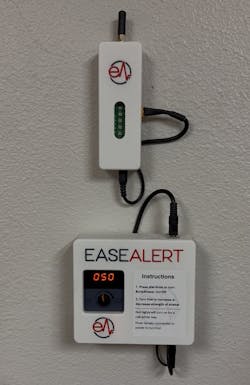
“The feedback has been great,” Aviles notes. “Members didn't realize how powerful the vibrator was. I got one captain that would sleep through a train barreling through the station, and he's reported that he's really satisfied with the product and how well it's performed.”
Mobile
APS Firehouse Alerting’s mobile app integrates station alerting in its entirety including alerting displays, non-emergency information, apparatus status and news.
“Anything that we can do on the mobile app automatically gets displayed in the station, and anything that we get added through the browser user interface also gets pushed out to the users in the mobile app,” APS Firehouse Alerting’s Marc McNeal explains.
Messages can be sent to individuals, groups of individuals, the whole jurisdiction and certain stations through the app. The station display and the mobile app are essentially interchangeable in terms of the information that's provided.


Frederick County, MD, Division of Fire & Rescue Services outfed its 29 stations with the APS Firehouse Alerting system. Chief Thomas Coe loves the pre-alerting feature that gives stations a jump on a call, given that seconds can be the determining factor in saving a life. He also appreciates the system’s functionality of always being capable of sending notifications.
“Certain cellphone vendors, because texting regulations have reduced the effectiveness of us sending text messages through their servers,” Coe says. “The APS app allows all text messaging to go out through the app, regardless of cellphone carrier. Our messages are being received more reliably.”
So much today in the fire service is about being more efficient and healthier. Station alerting is in congruence with that theme. Enhancements, integrations and innovations that wouldn’t have been feasible even five years ago are opening a lot of eyes.
About the Author
 Ryan Baker
Ryan Baker
Associate Editor
Ryan Baker is a writer and associate editor with prior experiences in online and print production. Ryan is an associate editor for Firehouse with a master's degree in sciences of communication from the University of Wisconsin-Whitewater. He recently completed a year of teaching Intro to Public Speaking at UW-Whitewater, as part of his graduate program. Ryan acquired his bachelor's degree in journalism in 2023 from UW-Whitewater, and operates currently out of Minneapolis, MN. Baker, also writes freelances for the Ultimate Frisbee Association (UFA) in his free time, while also umpiring baseball for various ages across the Twin Cities Metro Area.