Central Texas Fire Departments Adopt Wildfire Technology
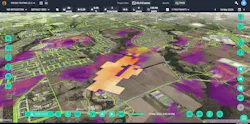
Four Central Texas fire departments are adopting two new AI platforms—FiSci for wildfire prediction and Genasys for evacuation plans—to improve community safety and response.
The four departments involved are Travis County Fire Rescue (TCFR), Pflugerville Fire Department, Lake Travis Fire Rescue (LTFR), and Westlake Fire Department. Each department is at a different point in the onboarding process, but TCFR Chief Ken Bailey spearheaded the process with FiSci, while Pflugerville Chief Nick Perkins took the reins on bringing Genasys into the system.
“We're always looking to use technology as a tool, especially emerging technology that shows some promise,” LTFR Chief Bobby Abbott told Firehouse. “We don't do it blindly, though. We work a lot with the company that puts the material out there, and we try to shape it.”
The four departments are collaborating on multiple aspects, so the implementation and interoperability of these platforms worked for the entire group.
“We're all on the same page and understand where we want to go,” Westlake Chief David Wilson said.
Bailey noted that each department will use these platforms differently, depending on the circumstances and factors that impact the different communities.
Fire modeling with FiSci
The Australian-based company was discovered by Bailey when he was trying to find training material on YouTube and he came across a model showing a spot fire, which was when conversations with FiSci began.
Increased concern about wildfires in his region motivated Bailey to find FiSci, a platform that models fire behavior to help predict and mitigate larger wildfires by accounting for conditions, fuels and topography.
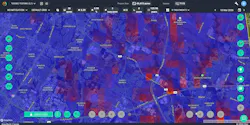
FiSci runs AI-driven simulations to predict wildfire risk and its impact on communities based on real-world conditions.
Factors FiSci can use to run its simulations are:
- Past fires
- Weather
- Terrain
- Vegetation
- Homeless encampments
“This tool is really powerful, because we're able to simulate fires under our actual conditions, and it shows how big these fires will get or can get,” Perkins shared.
Other detailed inputs that the departments can enter in the model to see anticipated conditions include:
- Shaded fuel breaks
- Roadway access
- Vegetation management
- Detailed mapping
- Construction sites
- Wind changes
“You have a neighborhood that abuts a wilderness area,” Bailey proposed. “You can run a simulation under the current conditions, fuel load and topography on the worst-case scenario day. Does it spot over into this neighborhood? What if we made that shaded fuel break? We can simulate that. Then, in the first 100 feet, a simulation is performed. Are we pleased with that? No, okay, let's make it 200 feet. Rather than going out and making the investment, we can model that to see if it's worth the investment.”
Other notable operations:
- By scrolling over the map you can see the flame height, burn area and fire intensity in BTUs
- Create the ignition points to show the fire's progression from a specific starting location
- Ability to add multiple mitigation strategies
- Ability to layer many options with one click
The greatest impact on operations with this tool is the pre-attack plans and incident command decision, the aspect Perkins is most excited about. It also allows for smarter, more efficient resource and staffing deployment if these larger incidents were to occur.
“I view this more as a planning tool, meaning I'm able to run all these simulations for my communities that I'm worried about, and include that in the plan,” Perkins said. “Then, we integrate that into our training as part of our wildfire preparation.”
While FiSci opens a whole new world in wildfire risk management for these departments, they are also aware that it is not the final decision-maker.
“It allows us to run some simulations,” Bailey noted. “It’s a sundial, not a watch, and so you have to temper with that in mind.”
The technology doesn’t stop there. While FiSci is mainly used for wildfire pre-attack plans and incident command decisions, Genasys addresses evacuations during wildfires.
Emergency evacuations using Genasys
The Genasys platform is an evacuation planning and execution tool that runs on a zoned-based platform. This can be utilized for any major events, including floods, wildfires, gas leaks and other natural disasters.
Perkins discussed the platform with CAL Fire and other departments out west and ultimately decided to bring it to Central Texas.
“The coolest part is a knucklehead like me can actually do it all,” Perkins said. “It allows us to quickly identify people at risk, come up with a plan on how to move them, and communicate with them. I'm able to send this info over within minutes to begin those notifications and processes.”
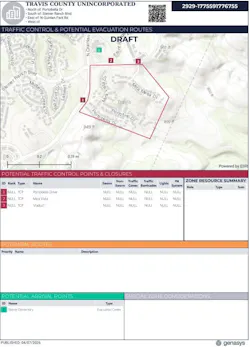
The software pulls the most recent publicly available GIS data from the Esri Atlas and outputs the number of people, vehicles, and homes in the area, as well as daytime and nighttime population. That data helps the departments build the response area by identifying shelters, arrival points, evacuation routes and large parking lots for waiting areas. All of this is done in real time and outputs in less than five minutes.
“I think with this software, the promise that it is showing, matched with the ability to use our experience, can really gauge if it's working or not. I think it's going to be great,” Abbott told Firehouse.
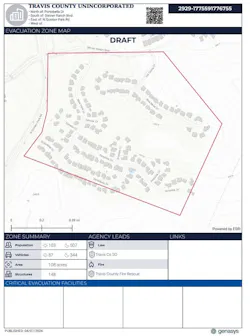
The platform that needs to be built out for each jurisdiction, including zones and jurisdictional lines and associating those with the lead agencies to attach them to shelters and local hazard maps.
It takes time
Building and implementing FiSci and Genasys for each community takes time, but the departments are confident these platforms will significantly improve wildfire planning and emergency evacuation in the future.
About the Author
 Ryan Baker
Ryan Baker
Associate Editor
Ryan Baker is a writer and associate editor with prior experiences in online and print production. Ryan is an associate editor for Firehouse with a master's degree in sciences of communication from the University of Wisconsin-Whitewater. He recently completed a year of teaching Intro to Public Speaking at UW-Whitewater, as part of his graduate program. Ryan acquired his bachelor's degree in journalism in 2023 from UW-Whitewater, and operates currently out of Minneapolis, MN. Baker, also writes freelances for the Ultimate Frisbee Association (UFA) in his free time, while also umpiring baseball for various ages across the Twin Cities Metro Area.