Unlocking the Flames: How AI Is Transforming Cold Case Arson Investigations
Key Takeaways
- Artificial intelligence (AI), with its capability to analyze massive amounts of data, recognize subtle patterns and connect seemingly unrelated information, provides new tools for fire investigators.
- By examining decades of fire reports, photographs and incident data, AI systems can identify similarities that might otherwise remain unnoticed.
- Computer-vision technology can enhance old images of poor quality, clarify smoke patterns and reconstruct fire spread sequences.
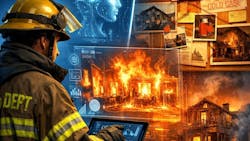
Arson long has stood as one of the most difficult crimes to solve. By the time that investigators arrive, much of the physical evidence was consumed by the fire, and what remains is often fragile, distorted or hidden beneath debris. Motives vary (from financial fraud to revenge to thrill-seeking), and eyewitnesses often are scarce. For decades, this combination has left many cases unsolved and relegated to the shelves of cold case files.
Today, however, the fire service is witnessing a shift. Artificial intelligence (AI), with its capability to analyze massive amounts of data, recognize subtle patterns and connect seemingly unrelated information, provides new tools for fire investigators. What once seemed impossible—breathing life into decades old case files—now is increasingly within reach.
How AI can help to solve cold case arson
Pattern recognition across fires. Human investigators are skilled at spotting trends, but AI can process far more information than they can and very quickly. By examining decades of fire reports, photographs and incident data, AI systems can identify similarities that might otherwise remain unnoticed. Repeated ignition points, consistent accelerant usage or recurring burn patterns across multiple incidents could suggest the same individual or group is responsible.
Image and video analysis. Cold cases often include photographs or videos that, by today’s standards, are of poor quality. Computer-vision technology can enhance these images, clarify smoke patterns and even reconstruct fire spread sequences. Old surveillance footage that once was dismissed as unusable can be reanalyzed with new precision, to provide leads that were previously out of reach.
Accelerant and debris analysis. Machine learning can be applied to laboratory data. By examining chemical signatures from debris samples, AI can help investigators to distinguish accidental fires from deliberate ones. When paired with updated lab work, AI can compare new findings against old evidence, to uncover inconsistencies or confirm suspicions of arson.
Linking suspects and locations. Arson rarely happens in isolation. AI excels at connecting the dots between individuals, properties and events. By reviewing arrest records, insurance claims, utility usage or even public social media activity, AI tools can highlight suspects who had motive, opportunity or a history of fire-related activity. This doesn’t replace detective work, but it gives investigators a sharper starting point.
Predictive mapping. Beyond solving old cases, AI can help to prevent future ones. By analyzing historical fire data, AI can generate maps of high-risk areas, which allows investigators to anticipate where a serial arsonist might strike again. This proactive approach strengthens both casework and community protection.
Benefits of AI in cold case work
For families of victims and for communities that are scarred by fire, the utilization of AI in cold case arson investigations means renewed hope. Cases that once were considered unsolvable now have a chance at closure.
The benefits of the utilization of AI in cold case work are:
- Efficiency: What might take an investigator weeks or months to do, AI can process in hours.
- Objectivity: Unlike humans, AI isn’t prone to fatigue, bias or tunnel vision.
- New leads: By uncovering patterns that are buried in old files, AI can spark new investigative directions.
Things to look out for
Although AI holds immense promise, it isn’t without challenges. Fire service leaders and investigators should keep the following in mind:
- Data quality matters: AI is only as effective as the information that it’s given. Poorly documented fire reports or compromised evidence can lead to flawed conclusions.
- Human oversight is crucial: AI never should replace experienced fire investigators. It’s a tool, not a substitute for professional judgment.
- Privacy and ethics: When AI tools draw from insurance claims, utility records or social media, investigators must balance investigative needs with legal and ethical boundaries.
- Cost and training: Implementing AI systems requires investment and training. Smaller departments might find it difficult to adopt these tools without regional or state-level support.
New era for arson investigations
AI won’t solve every cold case. Some fires always will leave too little evidence to reconstruct. However, for the first time in decades, investigators have access to a toolset that’s powerful enough to revisit cases that once were thought to be permanently stalled.
When paired with the instincts and experience of fire marshals, detectives and forensic specialists, AI has the potential to transform the way that we pursue justice in arson cases. The technology doesn’t erase the need for skilled human judgment; it amplifies it.
The flames may have burned long ago, but thanks to AI, their secrets don’t have to remain buried. With every new discovery, we bring light to lessons that once smoldered in the dark.
About the Author
 Joshua Wright
Joshua Wright
Joshua Wright is a career firefighter who has more than 15 years of service and currently serves with the Forsyth County, NC, Fire Department. His career spans fire suppression and EMS, where he has gained extensive experience in emergency response, incident operations and public safety initiatives. Wright is particularly interested in how emerging technologies and data-driven tools can support modern fire investigations and improve outcomes in the fire service.