Green Bay, WI, Fire Pairs Team Awareness Kit with FirstNet for Real-Time Command
Key Takeaways
- The Team Awareness Kit (TAK) offers real-time location tracking, map overlays, and resource coordination, creating a shared digital map for fire and law incident commanders and responders.
- During the 2025 NFL Draft, TAK enabled rapid response by Green Bay firefighters by visually guiding teams, freeing radio channels, and improving multi-agency communication efficiency.
- During a major warehouse fire, TAK and FirstNet facilitated coordination among multiple agencies, enabling real-time hotspot identification and resource deployment during a week-long incident.
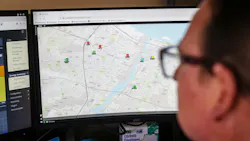
When the 2025 NFL Draft came to Green Bay, WI, security perimeters stretched for blocks. Massive crowds filled the city streets. Public safety teams operated in tightly defined divisions, each responsible for a slice of the event space.
For the Green Bay Metro Fire Department, the challenge was clear: how do you see, in real time, where every team is operating — and be ready to move them instantly should conditions change?
The answer was the Team Awareness Kit (TAK), which began as an exploratory project for the department and evolved into a fully operational, FirstNet-powered situational awareness platform that reshaped how Green Bay manages both day-to-day responses and large-scale events.
What is TAK?
TAK is a geospatial situational awareness platform built by the U.S. government that provides real-time location tracking, map overlays, resource coordination, and data integration across public safety teams. The platform enables incident commanders to visualize personnel, apparatus, and critical infrastructure on a shared digital map. Crucially, it provides a common operating picture for complex operations.
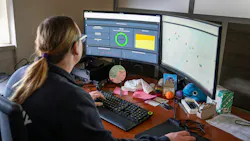
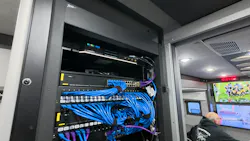
The Green Bay Metro Fire Department began to build its own TAK ecosystem to improve situational awareness and personnel tracking. Run locally on a rack-mounted server and connected through a modem operating on FirstNet, the system allows field personnel carrying FirstNet-enabled smartphones to run the TAK application, feeding live data back to command. The result is a secure and resilient public-safety-grade platform capable of handling the operational demands of large events.
2025 NFL Draft puts TAK to the test
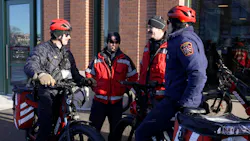
The 2025 NFL Draft served as Green Bay Metro Fire’s first large-scale deployment of TAK. With thousands of attendees and physical barriers shaping foot traffic, locating a team near an incident can be difficult using radio alone. TAK changed that dynamic.
Prior to the event, teams overlaid the grounds onto the digital map and divided the footprint into operational zones. On the day of the draft, TAK displays in the command vehicle, responder devices, and department headquarters displayed real-time personnel movement.
When an incident occurred near the stage in a congested area, commanders didn't need traditional radio to guide responders. Teams could instantly determine the closest unit, visually navigate to one another using the shared map interface, and redirect resources accordingly. “Being able to put resources on scene much faster — and the right resources — really is an advantage for us,” Assistant Chief Ryan Gibbons said.
By shifting routine location updates from voice to data, the department freed up radio channels for more critical communications. This had a significant operational benefit, especially during multi-agency response efforts.
Marathon operations
In addition to NFL events, Green Bay hosts multiple large races each year, including the EPIC Marathon and Bellin Run. Unlike a static event, a marathon creates a moving operational environment that can stretch for miles.
Before TAK, coordinating resources along race routes relied heavily on paper maps and pre-scheduled plans. Now, Green Bay Metro Fire overlays the racecourse, water stations, emergency tents, and traffic routes directly into TAK. If an incident occurs, commanders can digitally mark their exact location and determine the closest available unit. The system also tracks the progression of the race, allowing ambulances and emergency personnel to move with the runners.
Color-coding based on assignments also allows commanders to identify unit type and operational roles at a glance.
“We can pin it on a map exactly where the incident is and figure out who is the best resource to send,” explained Gibbons.
Deploying for daily operations
TAK has quickly evolved into a daily operational asset for Green Bay Metro Fire. The department uses the technology to track apparatus across the city and support specialized teams, like marine rescue units on the bay. Even internal logistics for IT support and fleet coordination have improved.
“I use it for every day,” said IT Specialist Gwen Magyar. “If I get a work order for anything, I know exactly where the vehicle is.” This convergence of operational response and administrative efficiency underscores the broader value of TAK for public safety.
Historic industrial fire puts TAK to the test
Green Bay Metro Fire also explored using personnel-level tracking technologies on TAK to enhance awareness during structure fires and in low-connectivity environments. In March 2026, they put their research to the test.
Amid a historic blizzard that dumped over 26 inches of snow over the region, a warehouse filled with paper products burned on the west side of Green Bay. As Green Bay Metro Fire arrived on the scene, workers began clearing the snow. Fueled by the strong blizzard winds, flames rose through the roof of the warehouse. As firefighters began setting up, the structure started to collapse.
A fire this size required complex coordination across multiple agencies, and that meant TAK technology would be a vital part of their response. The department set up their mobile command vehicle, connected to FirstNet, to serve as the incident command post. To facilitate their recovery and investigation, the department utilized a combination of TAK and drones connected via FirstNet to identify and extinguish hot spots throughout the warehouse.
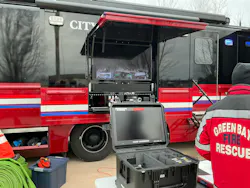
Fire inspectors could drop pins from their phone for incident commander to monitor their locations in real time.
Over 100 firefighters across three fire departments responded to the blaze — the largest the city had seen in decades. With TAK and FirstNet technology facilitating interoperability, Green Bay Metro Fire coordinated the massive operation, identifying crisis points and directing resources throughout the duration of the intense fire, which took over a week to extinguish.
FirstNet connectivity fuels mission-critical communications
At the heart of TAK’s effectiveness is reliable connectivity and secure, resilient data transport. Green Bay Metro Fire’s TAK ecosystem runs entirely over FirstNet, the nationwide public safety broadband network, serving as a testament to the department’s confidence in the network.
Location-based services like TAK running over FirstNet are a significant safety advancement for responders, said former Green Bay Police official Paul Ebel.
“Location based services allows dispatch and your fellow officers to actually see where you’re at in real time,” said Ebel, a FirstNet Authority Senior Public Safety Advisor. “It's very important. It's a safety aspect for the officer.”
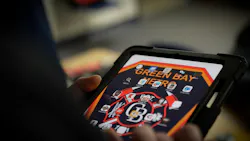
Tracking personnel in real time enhances responder safety, improves coordination, and supports cross-agency interoperability. This is made possible with FirstNet connectivity.
The future of large-scale operations
TAK provides Green Bay Metro Fire with instantaneous visibility into its resources, reduced radio congestion, accelerated dispatch decisions, and strengthened responder safety. It has evolved from a special event experiment into an integral part of how the department operates — supporting fire response, marine rescue, daily apparatus tracking, and situational awareness for large events.
With TAK and FirstNet working in tandem, Green Bay Metro Fire has built a scalable, innovative model for modern public safety operations.
About the Author
 Paul Ebel
Paul Ebel
Paul Ebel brings over three decades of dedicated service in public safety to his role as Senior Public Safety Advisor for the First Responder Network Authority. Currently overseeing five states within FEMA Region 5, Paul plays a pivotal role in advancing public safety communications and technology across Illinois, Ohio, Michigan, Minnesota, and his home state of Wisconsin.
Before joining the FirstNet Authority, Paul served for 34 years with the Green Bay, WI, Police Department, a tenure marked by a commitment to excellence and leadership in various capacities. Throughout his career, Paul held several key roles within the department, including Operations Commander, district captain, and interim director of the county-wide 9-1-1 center. His career culminated with his retirement in 2022 as the Investigations Commander, where he demonstrated exceptional skill in managing complex investigations and ensuring community safety.
During his time with the Green Bay Police Department, Paul played a crucial role in overseeing law enforcement deployment for large-scale events in the city, including Green Bay Packers games, showcasing his ability to coordinate resources effectively and maintain public safety during high-profile gatherings.
Post-retirement, Paul continued to contribute his expertise to the field of emergency management, spending a year with Hospital Sisters Health System as the Emergency Manager for the Wisconsin Division, where he was instrumental in enhancing emergency preparedness and response across six hospitals.