Fire Departments Considering a Robotics Program Benefit from Lessons Learned by FDNY
Key Takeaways
- FDNY’s thorough research resulted in a conviction that embracing robotics as a whole—not just uncrewed aircraft systems (UAS)—would help to close a gap in proficiency with technical equipment and response capabilities.
- The objectives of a response and what combination of UAS platforms and sensors will accomplish the objectives best sometimes requires input from everyone who’s involved.
- FDNY Robotics Division trainees must pass a 40-hour Public Safety UAS course and complete knowledge and proficiency testing on every robotic platform that’s in the fleet. Once they are approved to join the team, they must complete a 40-hour mapping course, 16 hours of night operations training, a 48-hour Advanced UAS Operations course, a Wildlife and Environmental Awareness class, specialized training for hazmat or marine qualifications and a yearly medical exam as well as maintain current New York State Certified First Responder-Defibrillation certification and attend yearly water rescue training.
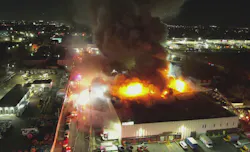
The roots of the FDNY robotics program go back further than most people realize. The program didn’t begin in the air but with a meeting on the ground. In 2012, FDNY sat down with the Federal Aviation Administration (FAA) to begin a conversation about what uncrewed aircraft systems (UAS), or drones, could mean for the largest fire department in the United States. That conversation quickly turned into action. FDNY launched its research and development efforts to utilize drones in New York City, and the first test flight took place at a training center in Perry, GA, in 2014. It would take three years of testing, refining and building institutional knowledge before the program conducted its first operational flight at an incident in March 2017.
For a department that has more than a century of tradition that’s built around ladders, hoselines and boots on the ground, the decision to invest seriously in UAS wasn’t a small one. It meant building a new discipline from scratch inside of an institution that measures its history in decades and its procedures in years of diligent practice. That slow, deliberate build was intentional.
Early on, FDNY looked to the Austin, TX, Fire Department, which developed its own Robotics Emergency Deployment (RED) team, as a model worth studying. What emerged from that research was a conviction that embracing robotics as a whole—not just UAS but uncrewed ground systems (UGS), remotely operated vehicles (ROVs) and response technology in total—would help to close a real gap in proficiency with technical equipment and response capabilities within FDNY’s all-hazards response matrix.
A home on the organizational chart
One of the most consequential early decisions in building a robotics or drone unit is deciding exactly where that unit fits on the organizational chart. There’s no universal answer; every department must work that out for itself.
For FDNY, the answer was Special Operations. The Special Operations Command Chief oversees four divisions: Rescue, Marine, Hazmat and Robotics. As the fourth and smallest leg of Special Operations, the Robotics Division has leaned heavily on its three sister divisions. This process helped to build the program in regard to logistics, finance, training and just about anything else that’s needed to succeed. This created a mutually beneficial partnership that allows the Robotics Division to assist with all Special Operations responses.
Today, the Robotics Division is built from a number of specialized components: one supervisor unit, two dedicated operational units, three seasonal beach patrol units, one marine unit that’s staffed by Marine 9, a logistics response unit, one Robotics Mobile Command Vehicle, an educational unit and even a robotics club at the FDNY high school. The program spans emergency response, seasonal public safety coverage and youth education all at once.
Operational backbone: Command Tactical Units
At the center of day-to-day operations are the two units that are staffed 24/7/365, each with four members. These are the Command Tactical Units, or CTUs. CTU 1 is based on Roosevelt Island; CTU 2 is located in Brooklyn. Together, these two units divide the city into two response zones, to provide round-the-clock coverage across all five boroughs of the city.
The CTUs respond to second alarms, searches, hazmat incidents, maritime emergencies and other major emergencies. They handle safety and investigation requests, and they can be special-called to any scene where an incident commander (IC) believes that their capabilities could be beneficial.
Support flows in behind the CTUs as part of a tiered technology response. The logistics section responds on fourth alarms or whenever a command tactical officer requests additional assistance or specialized equipment. The Robotics Division supervisor also responds on fourth alarms with airspace deconfliction and overall robotics coordination as the primary responsibilities. For the longest and most complex incidents, the Robotics Mobile Command Vehicle rolls out. It’s a hub that’s built for edge computing, on-scene mapping and processing. It’s staffed by a dedicated technologist.
Four roles, one mission
Each CTU operates as a tightly choreographed four-person team, and every position carries distinct responsibilities.
The officer serves as team leader and typically is positioned at the command post. This member acts as the communications link and interpreter of information for ICs, functions as the robotics safety officer and is responsible for monitoring incoming data. In the event of a UAS emergency, the officer performs the required emergency notifications.
The remote pilot in command (RPIC) is responsible for the safe navigation of the UAS. This role carries a long list of responsibilities that are defined both by the FAA and by FDNY’s robotics manual.
The visual observer plays a role that’s easy to overlook but essential in practice: scanning the airspace alongside the RPIC and assisting with communications. The visual observer is positioned directly next to the pilot for these reasons.
Finally, the data specialist manages an equally demanding set of tasks, including assisting with setup; swapping batteries; ensuring that communications, streaming and data links remain safe and functional; and overseeing data management. When the Robotics Mobile Command Vehicle isn’t on scene, the data specialist also handles on-scene processing. Beyond that, this role carries responsibility for data uploading, notifications and maintaining the chain of evidence.
Equipment: Matching platform to mission
Each CTU is equipped with a purpose-built fleet of robotic platforms and supporting technologies. A particular mission drives the selection of the appropriate platform.
The key questions are: What are the objectives of a mission, and which combination of platforms and sensors will accomplish the objectives best?
In some situations, the answers might be straightforward.
In others, selecting the right resources might require input from everyone who’s involved. During large, complex, dynamic incidents, mission objectives can change rapidly, which requires the team to reassess its approach and adjust the technology that’s being deployed.
A thorough understanding of each piece of equipment—its capabilities as well as its limitations—is just as important as understanding how to achieve the mission objectives. Effective operations depend on matching the right technology to the right mission at the right time.
Tethered quadcopter. The primary sensors and capabilities are RGB imagery, zoom and thermal. The drone provides long-endurance aerial observation with a high level of operational safety. It’s ideal for persistent situational awareness and extended incident operations.
Small quadcopter. The primary sensors and capabilities are RGB imagery and a 1¼-inch camera that has a mechanical shutter. The drone is used primarily for press events, training documentation, filming, inspections and other missions that require high-quality visual imagery.
Small indoor quadcopter. The primary sensors and capabilities are RGB imagery and zoom. The drone is designed for indoor inspections, investigations, confined-space operations and environments in which larger aircraft can’t operate safely.
Medium quadcopter. The primary sensors and capabilities are RGB imagery, zoom, thermal, a drop device, a speaker and a spot/floodlight. The drone offers rapid deployment, excellent reliability and stable performance in stronger wind conditions. It often is the first choice because of its capability to accomplish multiple mission objectives via a single platform.
Next-generation medium nonfoldable quadcopter. The primary sensors and capabilities are RGB imagery, zoom, thermal and a drop device. The drone provides rapid deployment and reliable performance. It will replace the medium quadcopter series and serve as a versatile, multimission aircraft.
Large quadcopter. The primary sensors and capabilities are RGB imagery, zoom, thermal, a drop device, a speaker, a spot/floodlight, hazmat sensors and communications. It requires more time to deploy but provides significantly enhanced capabilities and sensor options. It’s selected when advanced sensors or communications capabilities will have a meaningful effect on accomplishing mission objectives.
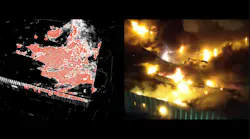
It’s important to mention that the Robotics Division is in a constant cycle of R&D for the next generation of its robotic platforms. Best-in-class robotic technology usually yields fewer than two years of operational use. This can be attributed to thorough R&D and long procurement procedures.
The Robotics Division also operates quadruped ground robots that provide unique capabilities in complex and hazardous environments. One quadruped is equipped with an array of hazmat-detection meters and a mesh ad hoc network communications system. Powered by onboard processors, the system can collect, process and relay critical information to an IC while it operates in areas that might be inaccessible or unsafe for personnel.
The Robotics Division currently operates two of these ground robots. Each is configured with different capabilities that can be employed individually or together to meet specific mission objectives. The selection of the appropriate platform is driven by the operational needs of the incident.
A good example of mission-to-platform selection occurred during the Ann Street parking garage collapse in Manhattan in 2023. Although the quadrupeds are configured primarily for hazmat detection, we selected one for the incident because its mobility, sensors and communications capabilities could help to collect and validate critical information and support situational awareness in a challenging and potentially dangerous environment. This demonstrates the importance of selecting a platform that’s based not simply on its primary intended use but on the particular capabilities that are required to accomplish the mission objectives.
Remote pilot training pipeline
A dedicated robotics team demands specialized, rigorous training, and for FDNY’s Robotics Division, that pipeline starts with the FAA’s Part 107 Small Unmanned Aircraft Systems (UAS) license. Before a member can apply for a position within the Robotics Division, the individual must have three years of service as a firefighter and hold a current FAA UAS license.
Once a position opens, the selected member is detailed to one of the units as a trainee. From there, the learning phase begins with FDNY’s college-accredited 40-hour Public Safety UAS program, which is the foundation for basic skills and safety practices. Trainees also must complete knowledge and proficiency testing on every robotic platform that’s in the fleet. As trainees sharpen their skills, they progress toward full FDNY RPIC status, at which point they are cleared to operate independently.
The training doesn’t stop there. Members are required to complete a 40-hour mapping course, 16 hours of night operations training, FDNY’s 48-hour Advanced UAS Operators course, and a Wildlife and Environmental Awareness class.
Specialized training for hazmat or marine qualifications adds to the prerequisite list before a member can become an FDNY robotics instructor.
On top of the technical curriculum, every member must pass a yearly department medical exam, maintain current New York State Certified First Responder-Defibrillation certification and attend yearly water rescue training—a reminder that these are firefighters first and technologists second.
Tiered technology response
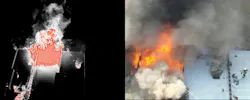
On April 10, 2026, CTU 1 responded to a fire in the College Point neighborhood of Queens. It involved a large, indoor lumber yard. The fire quickly escalated to multiple alarms.
The tiered technology response begins with our dispatch software, which includes critical information about the building. While responding, CTU 1 utilized the FDNY incident command application for satellite imagery, response information and mapping. Once on scene, CTU 1’s drone live-streamed video back to the incident command application as well as to the command post. Other responding units then had a better operational picture of the incident.
The Robotics Division supervisor and robotics logistics personnel arrived after the fourth alarm to assist with airspace deconfliction, communications and operation of a second drone. This information assisted with fireground safety, establishing collapse zones, and monitoring fire spread, water application and real-time decision validation for the IC.
Looking ahead
FDNY’s Robotics Division continues to expand, and the department is increasingly seeing the real-world value of robotic technology during live operations. Much of the current work centers on integrating all tiered response technology into a single, intuitive, usable system that’s designed to enhance operations and overall efficiency rather than add complexity. The program also is exploring human-in-the-loop artificial intelligence software to assist overtasked positions with rapid information analysis during fast-moving incidents.
None of that growth will come easily. Like many departments, the Robotics Division has faced real challenges with funding and personnel during the past several years of expansion, and those constraints have slowed innovation and delayed key projects, including Drone as First Responder initiatives.
The road from a single meeting with the FAA in 2012 to a 24/7/365 citywide operation hasn’t been a straight line, and it hasn’t been an easy one at all times. However, the trajectory is clear, and the appetite for what robotics can bring to fireground operations, technical rescue and hazmat response continues to grow across the department.
Still, one measure of success stands out clearly: watching the units normalize operations over time. In the earliest days, the program was, in many ways, making up things as it went along. There weren’t a lot of data to draw on. There were few examples from other departments to follow and hardly any regulatory framework to guide the work.
Today, new members are stepping into a mature program that’s built on years of hard-won experience—and taking it to new heights, pun very much intended.
About the Author
 Michael Leo
Michael Leo has served with FDNY for 25 years and currently is a captain. While earning his bachelor’s degree in fire and emergency management from John Jay College, he studied the expanding role of uncrewed aircraft systems (UAS) in emergency management and public safety operations. Leo has contributed to the advancement of public safety robotics and UAS through his participation in the Federal Aviation Administration’s Advanced Aviation Advisory Committee, NFPA’s UAS Standards Committee and several ASTM International committees. He also served in advisory roles with DroneResponders, National Institute of Standards and Technology and Commercial UAV Expo. Leo has presented at conferences and events around the world, including AUVSI Xponential and the World Police Summit.