The Essential Role of Community Risk Assessments in Community Risk Reduction
Key Highlights
- A detailed community risk assessment (CRA) is crucial for identifying community-specific risks and guiding effective CRR strategies.
- Utilize fire incident data, EMS records, and demographics to prioritize risks and target hazards effectively.
- Implement, monitor, evaluate, and modify CRR initiatives in a continuous cycle for sustained community safety.
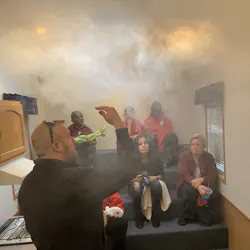
Community risk reduction (CRR) has been a buzz word in the fire service for many years, but there are many steps tot take before a CRR initiative that need to be completed to make sure you are getting the proper messaging out to citizens in your jurisdiction. A good CRR initiative starts with a good community risk assessment (CRA). The CRA is the most often overlooked step, however it is the most crucial step in the process. A good CRA will tell you what your CRR program should be, it will tell you How to get your why? As in, why are we doing this program? Because the data we received from our CRA told us this is the greatest risk in our community.
The (CRA) can be very detailed and complex, or it can be very basic and simple depending on the size of the community and the information you want to include.
The following steps will help you better identify risks in your community and what steps can be taken to mitigate those risks.
What is a community risk assessment
The first thing we want to do is Identify risks to our community. How do we do that? First, and usually the easiest place for most fire departments to start, is with their own incident data. We can also look at dispatch records and EMS runs in our community.
Next, we want to look at the demographics for our area. what is the age, sex, race, and socioeconomic status of your community. All this information will help you make a more informed decision for your CRR. Based on your incident data, the dispatch records, EMS records and demographics you will be able to Identify the population that is at the greatest risk in your community.
Then, we will prioritize the risk and target hazards. How do we do this? We use all the data gathered to see what is the greatest risk to your citizens. The data can give us a picture of your community, and every community is different.
CRA basics
- Identify risks, analyze fire incident reports, dispatch records, EMS runs
- Prioritize risks, what is the greatest risk to your citizens?
- Analyze your community demographics: age, sex, race, and socioeconomic
- Develop tactics to mitigate risk, what you think your department’s problem is may not be the highest risk
- Use fire data to identify principal causes of fire and fire fatalities in your community
- Look at data on fire Fatalities to determine if victims fall into similar demographics
- Look at your EMS runs for similar runs in the same area, vehicle accident, falls, and lift assists
Combining community risk assessement with CRR
The first thing we want to do is prioritize the risks we identified in your CRA. What is the greatest risk to your citizens based on what your CRA told us. This can be anywhere from excess calls for falls/assists in senior housing complexes to excessive wrecks at a certain intersection or an increase in fire fatalities in your community. Whatever is the greatest risk to your community is. That is what you should base your CRR program around.
Develop risk mitigation strategies based off your CRA. This Is a good time to look at local partners. Who or what agency has a vested interest in your target audience for the CRR initiative? And what could they help with?
Prepare your CRR plan. Once we have determined our target audience, get appropriate messaging, materials, and community partners involved.
Then we will implement our CRR plan but once you implement the program that is not the end of your CRR journey. We need to monitor the program to make sure we are seeing a favorable outcome. We also need to evaluate the program’s effectiveness. Lastly, we need to modify our programs.
Fire prevention is a never ending and always evolving endeavor.
CRR basics
- Prioritize highest risk and your audience.
- Develop your risk mitigation strategy.
- Prepare your CRR plan, appropriate messaging, materials, and community partners.
The steps below are a never-ending process that continually repeats:
- Implement your CRR plan.
- Monitor your CRR plan, make sure your plan is having the desired outcome.
- Evaluate your CRR plan, measure your plan’s effectiveness.
- Modify your CRR plan, modify your plan to be more effective.
- Repeat, repeat, repeat!
About the Author
 Paul Martin
Paul Martin
Paul Martin serves as the Assistant Chief of the Fire Prevention Bureau of the Ohio State Fire Marshal's Office and brings 26 years of fire service experience across roles including firefighter/EMT, lieutenant, captain, and assistant fire chief. He is a certified Fire and Life Safety Educator II, Youth Fire Misuse Program Manager, and Training Coordinator for the Ohio Fire Academy’s Fire Prevention courses. Martin represents Ohio as the NFPA Fire and Life Safety State Representative and is the state team leader for Sound Off with the Home Fire Safety Patrol. He was chosen as a Vision 20/20 Champion and Emerging Leader in Community Risk Reduction. Outside of work, Martin enjoys coaching baseball, camping, fishing, playing guitar, and spending time with his children, Emma and Gage.