Blueprint for Rescue of Victims Over Ground Ladders by Few Firefighters
Key Takeaways
- Chief Alan Brunacini said, “Risk a lot to save a lot.” Risk to firefighters is determined by what’s known from reports, what’s witnessed on arrival and what’s identified from the fireground size-up.
- Although the various tasks at a single-family dwelling fire (water supply, forcible entry, access, stretching hoselines, search, rescue, command, etc.) ultimately are performed simultaneously based on immediately available staffing, those tasks must be prioritized until the needed staffing arrives.
- As hectic as an emergency incident might be, strict and disciplined command, control and accountability must be integral parts of every firefighter and officer action from the beginning of a response.
In their career, everyone will respond to a “Super Bowl” fire or emergency at which all of our experiences, training and abilities come together to “fix” that significant incident. We will have seconds to size up, make decisions and take actions, which might mean placing members at great risk based on conditions to save lives. It’s why we must be ready (the training never stops) and engaged always. This column is about one of those incidents.
My appreciation to the Board of Fire Commissioners, Chief Thomas Eade, Assistant Chief Eric Hirsch, Lt. Sam Slotoroff and all of those who shared their account. Additional thanks to all of the Lake Mohegan, NY, Fire District (LMFD) members; the mutual-aid departments, including the Continental Village Fire Department, Millwood Fire Company, Montrose Fire District, Peekskill Fire Department (PFD), Putnam Valley Volunteer Fire Department and Yorktown Heights Volunteer Fire Department; the numerous agencies that provided EMS support; Westchester County Cause and Origin Team; New York State Police; and the Westchester County Department of Emergency Services (WCDES) dispatchers who handled the run from the start. Thanks also to Chief Denis Onieal, Jersey City, NJ, Chief of Department (Ret.) and Deputy U.S. Fire Administrator (Ret.), who assisted with the review of this incident.
The incident
A 9-1-1 call was made to the WCDES 9-1-1 center. The dispatchers frantically were told, “The house is on fire. We are trying to get the family out!” People were trying to rescue trapped teenagers. Multiple tones were sounded: “Respond to a reported house fire with entrapment.” An update reported six people trapped. The LMFD knew that it had critical work—talking/guiding callers as people were trapped—ahead of them.
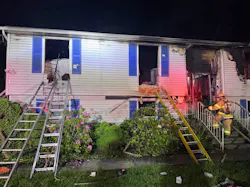
Companies arrived to find heavy fire out of the second-floor bay window. Because of the confirmed report of people trapped with reliable known location and because of the volume of fire presenting from the A side window and front door, members initiated an immediate VEIS rescue.
A line was stretched and put into operation for confinement purposes. As this was done, members conducted VEIS in each of the two front bedrooms, and a victim was located in each bedroom. Because of the girth and weight of each victim, removal over the windowsill onto the ladder was exceedingly difficult. In light of this, members cut away the portion of wall below the windowsills, thereby making the windows into doors. The victims were removed through the enlarged window openings. Firefighters and EMS immediately commenced resuscitative efforts, and the victims were brought to ambulances for transport to the hospital.
Concurrent with rescue efforts, a positive water source was established, and a second attack line was placed into operation, because the fire had spread through the basement and attic. (Note: Fire was in the basement with rescue operations already in place.)
Account from Slotoroff
First-due Engine 254 arrived with fire showing from the A side. I arrived and transmitted a second alarm. I communicated with the family on the front lawn, who reported that their son was in the room on the second floor at the top of a neighbor’s ladder that was in place.
E-254’s firefighter placed the rig in pump, had a face-to-face with me and made entry through one of two second-floor bedroom windows via the civilian ladder to conduct VEIS. Rescue 32’s firefighter arrived and was directed to support E-254’s firefighter’s search of the second floor. I stretched a 1¾-inch line from E-254 as Engine 256 arrived. I instructed E-256’s firefighter to charge the line off of E-254 and to take over operations from the exterior in a transitional attack.
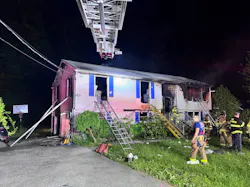
Heavy fire was showing from the bay window and front door on the A side as well as from openings on the C side. We balanced our best efforts to extinguish as much fire as we could while knowing that we had members who were attempting rescues.
Simultaneous with charging of the initial line, the members of VEIS located a victim in one of the bedrooms and attempted to remove the individual. I repositioned to the top of the civilian ladder to assist in removal. The firefighters who were in the first bedroom had zero visibility with black smoke and intense heat and fire overhead. Conditions were deteriorating, with fire spreading, including through the first-floor windows.
Ladder 35 arrived and set up the aerial for roof operations and to support rescue efforts. Engine 255 secured a positive water source to E-254. E-255’s firefighter then assisted with suppression on a 1¾-inch line.
Because of fire conditions and the first victim’s size, removal was extraordinarily difficult. I instructed fellow VEIS members to keep up efforts for removal and that I was retrieving a saw to perform a cut-down of the window. L-35’s firefighter provided the saw. I instructed that member to obtain a second ground ladder to assist with removal.
A window cut-down was performed, and that window’s sill/wall was removed.
Car 2267 arrived and brought the second ladder to assist with victim removal.
PFD firefighters arrived and assisted with removal of the first victim and then immediate CPR, resuscitative efforts and movement for transport.
Engine 253 arrived, and its firefighters split, with Firefighter A teaming up with units that were supporting suppression efforts. E-253 Firefighter B and L-35’s firefighter raised a ground ladder to the other second-floor bedroom, which is where the family reported another person missing.
E-253’s Firefighter B made entry through the A side window on the second floor and found a second victim in the threshold between the bedroom and the upstairs hallway. I made entry through the window to assist with removal.
E-253’s Firefighter B already had pulled the victim back into the bedroom and shut the door to the hallway. Because of the smoke conditions, unknown interior stair conditions, uncontrolled fire and the second victim’s physical size, another call for a window cut-down and ladder removal was made.
L-35’s firefighter performed the cut-down and made entry into the second bedroom to assist with removal as additional members positioned a second ladder to remove the second victim. Upon removal, CPR, resuscitative efforts and movement of that victim to EMS for transport were performed.
At this time, initial crews exited the structure and convened with C-2267 to perform a personnel accountability report of all members and to reassess operations and progress.
Account from Eade
I was off duty at the time of the initial dispatch and responded from home and arrived approximately 30 minutes after initial disptach. Hirsch was operating at the command post and directing fireground operations, and Slotoroff was conducting personnel welfare checks of members who were involved in the rescue operations. I met face-to-face with both officers to assess operational status and to determine any immediate resource needs.
I began to obtain accountability and assignments for all resources.
At the time of my arrival, the first rescued victim already was transported from the scene. The second rescued victim was being brought to an ambulance while CPR and resuscitative efforts continued. The second victim was transported to the hospital.
During the scene assessment, I also checked on a firefighter who was receiving oxygen therapy and evaluation by EMS personnel. I subsequently assisted Hirsch with command functions that were related to incident stabilization, including confirmation of complete extinguishment, completion of secondary searches and overhaul operations.
All remaining fire was extinguished, and overhaul operations were completed with the assistance of the members of various mutual-aid departments.
Comments from Onieal
It would be difficult to point to any item, decision, tactic or strategy that could have been improved at this fire. Several LMFD members took extraordinary risks with their own life to try to save the victims.
Firefighters entered the burning building after portions of it reached flashover and the structure was burning from front to back. They entered the building through side windows via ground ladders without the benefit of a hoseline to protect themselves. There would have been little opportunity for the firefighters to save their own life had the fire extended.
The LMFD’s response within five minutes of the alarm was excellent considering that the alarm came in at 2 a.m. and with poor road lighting and the rural nature of the area and the roads.
The first-arriving officer identified the life hazard, ordered immediate rescue action to address the life danger and called for additional help.
The first hoseline attacked the fire.
The two victims were removed from the building, and they were given immediate medical aid/CPR and transported to a medical facility.
The generally recognized firefighting priorities of life safety (find and remove victims), incident stabilization (extinguish the fire) and property conservation (check for fire extension, protect salvageable property and contents) were followed properly and in sequence.
Comments from Goldfeder
As I discussed in my opening, this is that run where everything must come together and the members must give 110 percent to do all that they can to get victims out. As noted, they went above and beyond, but sadly, the two young victims couldn’t be saved at the hospital.
As Chief Alan Brunacini said, “Risk a lot to save a lot,” and the risk is determined by what we know from the reports, arrival and size-up. The members of the LMFD had every reason to believe that there were savable victims in the dwelling, and they did all that they could to give those kids the best possible chance.
Readers might be surprised by the staffing model, but it must be stated that the LMFD is growing, is being funded, is improving and, quite frankly, is doing better than many departments that refuse to face the well-documented volunteer staffing issues. The LMFD’s leaders’ heads aren’t in the sand. The LMFD started career staffing many years ago to take on the challenges to do what’s best for its community, and it continues to improve on behalf of its taxpayers with a force of dedicated volunteer and career members.
Tactically and operationally, LMFD’s members understood the need for immediate water with simultaneous search, rescue and removal. The word “immediate” is key, because no department can do it all simultaneously without the needed resources. So, in this case, various members took on multiple responsibilities to support one another, which supported those who were trapped. All tasks—and those who carried out the tasks—definitely needed more help. However, they took the resources that they had and put them to the best possible use. This is a reminder to all of us that, although the various tasks at a single-family dwelling fire (water supply, forcible entry, access, stretching lines, search, rescue, command, etc.) ultimately are performed simultaneously based on immediately available staffing, those tasks must be prioritized until the needed staffing becomes available. As hectic as the emergency might be, strict and disciplined command, control and accountability must be integral parts of every action from the start.
It also should be noted that automatic mutual aid and immediate striking of additional alarms fill gaps to support first-due companies. The equation is simple: Figure out the tasks that you want to be performed in the first few minutes, figure out how many members are needed to perform those tasks and then add up your people. It might be just your department providing it, or it might be automatic mutual aid—whoever can get there first and fast, whatever it takes. Think that it’s your family in the house and then decide the right model.
Every one of our response areas has single-family dwellings that have family members sleeping at night. By all accounts, the LMFD firefighters took extreme risks but needed heroic measures to do all that they could to try to get those kids out as quickly as possible while controlling the fire. They did their job above and beyond.
Lake Mohegan Fire District
The Lake Mohegan Fire District (LMFD) in Westchester County, NY, is a combination department of both career (IAFF Local 2956) and Mohegan Volunteer Fire Association members that serves 48,000 people. There are 44 career members, with seven firefighters and one officer who are on duty per shift. These members operate the apparatus and respond to all fire and EMS incidents. In 2024, this amounted to 4,608 calls for service. The 50 volunteer members respond as available.
A mixed suburban/rural area, the district is led by Fire Chief Thomas Eade. He is supported by a mix of career and volunteer fire officers. Each shift is led by a career duty officer who responds in a command vehicle.
LMFD responds from four firehouses with a single-firefighter-per-apparatus model. This model is being altered to overcome the realities of community response needs, public service requirements, personal safety and the decline in volunteerism.
Station 1 (Headquarters): A quint (Ladder 35), Engine 256 and Rescue 32; three career firefighters and one career officer staff the station; each firefighter operates an apparatus, and the officer operates a command vehicle.
Station 2: Engine 255 with a single firefighter.
Station 3: Engine 253 with two firefighters.
Station 4: Engine 254 with a single firefighter.
About the Author
 Billy Goldfeder
BILLY GOLDFEDER, EFO, who is a Firehouse contributing editor, has been a firefighter since 1973 and a chief officer since 1982. He is deputy fire chief of the Loveland-Symmes Fire Department in Ohio, which is an ISO Class 1, CPSE and CAAS-accredited department. Goldfeder has served on numerous NFPA and International Association of Fire Chiefs (IAFC) committees. He is on the board of directors of the IAFC Safety, Health and Survival Section and the National Fallen Firefighters Foundation.