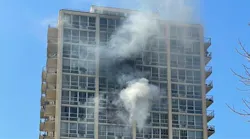
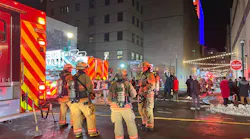
High-Rise Firefighting Requires Firefighters to Utilize Different Strategies & Tactics Compared With Conventional Structural Fires
Key Takeaways
- Some firefighting strategies and tactics are applicable at both residential and commercial high-rise fires, but there are significant differences between the two as well.
- Using a standpipe system at a fire at a high-rise building almost always requires at least four firefighters.
- Establishing a continuous water supply to a high-rise building’s Siamese connection is the pumper driver’s responsibility.
There are numerous types of firefighting operations—for example, structural fires, vehicle fires, wildland fires, electrical fires and flammable liquid fires. As far as structural fires, several dramatically different types of buildings can be involved, and that variation often dictates different tactical operations. This includes high-rise fires.
Mitigating friction loss
The first important fact that you must remember about high-rise firefighting is high-rise residential buildings (e.g., apartment houses and hotels) and high-rise commercial buildings (e.g., office buildings) require significantly different tactics and strategies, although some operational tactics are performed in both types of buildings.
One issue that must be acknowledged about high-rise firefighting is that it requires a substantially larger staffing element. This will be evident in regard to the tactics and evolutions that must be performed that are noted below.
The most basic tactic that’s required for a high-rise fire is an attack hoseline.
Because our work will be in a multistory structure, we depend on the standpipe as our interior water supply system. For both residential and commercial high-rise operations, a 21/2-inch hoseline continues to be the first choice for the attack line. The simple reason for this is pressure. The friction loss that’s created when using 13/4-inch hose dramatically reduces the pressure that’s delivered to the nozzle, which results in an inadequate stream. It’s worth noting that some departments that use the 21/2-inch hose replace the lead length with a more manageable 13/4-inch hose.
Four firefighters
Rather than stretching a line off of the apparatus, the nozzle team uses the standpipe system and carries several lengths of hose to the floor that’s below the fire and connects to the standpipe system. Some buildings have a single standpipe riser in a single stairway; larger buildings might have standpipe systems in several stairways. Using a standpipe system almost always requires at least four firefighters. One of the firefighters is at the standpipe outlet on the floor below the fire, one is at the stairway door on the fire floor, and two advance the line onto the fire floor.
Pumper driver’s role
Often, water supply is provided by a building roof tank, but we still must establish a continuous water supply into the building’s Siamese connection. This job is in the hands of the pumper driver and consists of connecting supply hose to the Siamese, locating and connecting to a hydrant for the water supply, and providing the proper pressure for the involved floor level of the fire.
Search
Like any other structural fire, a search team(s) must be deployed into the building to find the fire and locate and remove any trapped or overcome occupants. The search process for residential high-rises is like low-rise residential buildings, but the search in commercial high-rises involves much larger and more complex floor arrangements, which often require a larger assignment of personnel. Additionally, the floor(s) that are above the fire must be examined, which might require calling for additional firefighters and companies.
Elevator use
For buildings that are taller than seven stories, many departments use the elevators to reduce firefighter fatigue and to transport equipment to the upper floors. The prevalence of “fire service elevators” makes this operation must safer than before that technology was available.
When elevators are used for firefighting, each elevator car that’s used must be staffed by fully equipped firefighters who operate and remain in the car. This ensures that firefighters who are on the fire floor or above won’t be stranded without an elevator to bring them down from the fire area if needed. The firefighter who operates the elevator should wear full PPE and be equipped with SCBA, hand tools and a radio.
About the Author
 John J. Salka Jr.
Battalion Chief
JOHN J. SALKA JR., who is a Firehouse contributing editor, retired as a battalion chief with FDNY, serving as commander of the 18th battalion in the Bronx. Salka has instructed at several FDNY training programs, including the department’s Probationary Firefighters School, Captains Management Program and Battalion Chiefs Command Course. He conducts training programs at national and local conferences and has been recognized for his firefighter survival course, “Get Out Alive.” Salka co-authored the FDNY Engine Company Operations manual and wrote the book "First In, Last Out–Leadership Lessons From the New York Fire Department." He also operates Fire Command Training, which is a New York-based fire service training and consulting firm.