New FSRI Study Details What Firefighters Need to Know About EV Fires
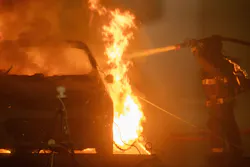
UL Research Institutes’ Fire Safety Research Institute (FSRI) shared their latest research, giving firefighters the information they need to navigate the growing concerns around responding to electric vehicles (EV) fires.
The study, conducted over three years at a cost of nearly $3 million, examined a range of battery-powered electric vehicles and suggested both traditional suppression tactics and new techniques. The research reinforces a critical point that may be overlooked by some firefighters: EV fires are still vehicle fires, but with unique challenges encountered with battery access and vehicle construction.
They burned six EVs and three fuel-powered vehicles in three phases under a series of realisitic fireground conditions.
“I can say it’s construction that’s the biggest challenge,” Adam Barowy, principal research engineer with FSRI, told Firehouse.com. “If you take the gas tank off a gas car, if you take the battery off a battery car, they burn the same. They’re the same vehicle. It’s a metal cage full of plastic.”
“Just because the car is on fire doesn’t mean the battery’s involved,” Barowy added. “So when you knock it down before it gets to the battery, it’s as easy as it gets.”
Where the challenege of the EV comes in
Where EVs differ, Baroway explained, is in how they are built to protect their power source-the battery. The battery systems are enclosed, elevated and sealed, which creates a significant obstacle for firefighters.
“The chassis, the vehicle cabin, is watertight and the battery is mounted safely up inside,” he said. “And then the battery is watertight…that also means that’s the biggest impediment to firefighting. You try to throw water and the water is just not getting where the water needs to go.”
That limitation shapes the tactical approach. Testing showed that while firefighters may not be able to directly extinguish the battery, they can quickly control the bulk of the fire—primarily the passenger compartment—using traditional tactics.
“Most of what’s burning is the cabin,” Barowy said. “So, you can make the fire small, fast, less than 200 gallons of water and less than 75 seconds. And it’s like a standard car fire. Now it’s just down to the battery.”
If the battery is involved, the strategy shifts. With limited ability to penetrate the battery, crews may need to focus on containment and exposure protection rather than complete extinguishment without trying to access the battery where it’s mounted.
“With a regular hose stream, there’s no getting the water in the battery,” Barowy said. “So it effectively just burns out in front of us. We can control it. We can protect exposures.”
What should firefighters do?
In the report released last week, FSRI shared a list of key operational points that firefighters should use for EV fires, including suppression strategies during and after the fire, plus health and safety concerns. The include:
Suppression strategy
- Use water from a handline; added suppression agents are not required
- Copious water on the vehicle and battery pack is ineffective due to vehicle construction
- If deployed, EV fire blankets should not be repositioned
- Using EV fire blankets indoors or in confined spaces can present significant deflagration risk
Health and safety
- EV battery fires can produce elevated levels of nickel, manganese, cobalt, aluminum, copper, particulate fluoride, PAHs, and VOCs
- Approach from upwind, utilize the reach of the hose-stream, and minimize contact with debris and runoff
- Perform on-scene gross decontamination, bag contaminated PPE, and shower and launder gear back at the station
Reignition and post-incident control
- Assume persistent reignition risk (unless the battery so clearly damaged as to be completely burned out)
- Inspect for signs of active thermal runaway, including smoke, audible cues, and increasing temperature before release
- Escort the tow truck with a suppression unit and maintain a minimum 16 feet quarantine distance at the tow yard
FSRI also released, “EV Fire Tactical Decision Aid,” a step-by-step guide firefighters and incident commanders to ensure they are following the new best practices.
Beyond the application of water
During the evolutions, researchers also tested vehicle fire blankets, under-vehicle nozzles and water additives, including foam.
Barowy said fire blankets can limit smoke travel in structures but should not be considered a primary tool for suppression.
“They have a place,” Barowy said, but the threat exists are if a blanket is removed and the fire reignites. He also said there are concerns with contamination and reuse.
Researchers wrote in the report: "While these tactics may hypothetically overcome impediments to suppression (e.g., the water-tight battery enclosure), they can be resource intensive. Relocating the vehicle requires significant manpower, placing the vehicle into a submersion container requires a container, heavy equipment and large volumes of water which then become contaminated , and battery penetration requires expensive specialized equipment and training that may be prohibited in certain jurisdictions. These factors typically make these less popular tactics infeasible for most fire departments."
Firefighter safety is paramount
In May 2024, FSRI released their initial findings on EV fire research as the departments across the country were encountering EV fires that took hours, if not days, to control and contain.
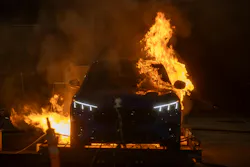
The expanded research underscores the importance of early intervention to knock down the fire before it spreads to the battery compartment and to focus on responder safety while working around the vehicle.
“There’s an awful lot of concern about the smoke contaminants and what that can do to human health,” Barowy said. “On the car on its own, we know about as much as we can know, but now… what changes when you stick it in a building?”
Once the fire is contained, Barowy said firefighters need to remain on high alert, and on SCBA.
“Until that vehicle is on a tow truck and getting off scene, having a charged hose line nearby… is critical,” Barowy said. “Staying in PPE and staying hooked up to your SCBA for as long as you’re working on the vehicle too… because the reignitions have no warning.”
The fire is out, now what?
Barowy said firefighters need to move the car from the scene to a tow yard or other location with a focus on protecting the area.
“We’re basically saying every time, as soon as it’s safe for you to work on it… get it out of there,” Barowy said. “And then give it 16 feet in all directions to minimize risk of fire spread.”
What should departments do with the researsh?
Barowy shared a number of free resources from UL FSRI that departments should access and review to start:
- Full-Scale Electric Vehicle Fire Experiments and Recommendations for Fire Incident Response
- Electric Vehicle (EV) Fire Tactical Decision Aid
“Don’t throw out your experience or your SOPs,” Barowy said. “This is still a vehicle fire. There’s some unique attributes to it… you already know a lot of what you need to know....now, just add what we recommend.”
“UL’s latest work on electric vehicle fires gives us better evidence to move beyond assumptions and make tactical decisions based on what is actually occurring with the vehicle, the battery, and the surrounding exposures,” Pflugerville, TX, Fire Chief Nick Perkins told Firehouse.com. “For our department, that means taking this research back to our operational guidelines, making sure our SOG reflects the latest science, and then training our firefighters so the guidance translates into sound decisions on the street. EV fires are not a problem that requires us to abandon the fundamentals of firefighting, but they do require us to understand the unique hazards and adjust our tactics accordingly.”
About the Author
 Peter Matthews