At Least 64 Killed When Trains Collide in Spain
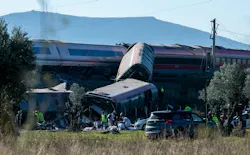
A high-speed rail service slammed into another train about 60 miles south of Madrid on Wednesday, killing at least 64 people — the second major accident on Spain’s rail network this year and the deadliest crash in over a decade.
“We’re talking about an enormous death toll,” said Emiliano García Page, president of Castilla-La Mancha region, where the accident occurred. “Firefighters expect that more victims will still be found.”
Prime Minister Pedro Sánchez is traveling to the area as evacuation efforts continue.
The crash has become Spain’s most lethal railway catastrophe since 2013, when 80 people perished after a train derailed in the Galicia region, north of Madrid. Another collision this past January also killed more than 40 people, provoking intense scrutiny of Spain’s rail infrastructure — once seen as a point of national pride.
Both accidents this year happened on the line running south from Madrid and involved state-owned train operator Renfe and Iryo, a rival operator controlled by Italy’s state-owned company Ferrovie dello Stato.
Wednesday’s collision occurred just before 9 a.m. local time, when a Renfe high-speed train hit an Iryo train between the villages of Los Yébenes and Urda, according to an official at Spain’s railway infrastructure manager Adif. The impact derailed at least two carriages on the Iryo train, interrupting all traffic on the high-speed line between Madrid and Seville.
- La Mantia: MCI & MPI Preparations
Local authorities quickly dispatched ambulances, helicopters, police and Red Cross personnel, while the Spanish government deployed the army’s Emergency Military Unit, a special task force for civilian disasters and accidents.
Several trains are now halted as Adif helps travelers reach stations.
A spokesperson for Spain’s Transportation Ministry said the initial assessment suggests human error, potentially by an Adif rail traffic controller, was to blame. The Adif official declined to comment on what might have caused the accident.
- Evans: EMS: Tactical Worksheets
The crash is likely to become a major talking point in Spain’s upcoming national election on Nov. 29. Sanchez and several ministers canceled their appointments for the day, as did the opposition leader.
Even before the cause or death toll was known, Santiago Abascal, leader of the far-right Vox party, blamed the accident on the “abandonment, ruin and betrayal suffered by Spaniards” at the hands of Sánchez’s government.
Vox is polling third and could play a decisive role in forming the next government, with polls showing the conservative People’s Party in the lead.
Spain’s last major railway accident sparked a nationwide debate over the safety of the country’s nearly 4,000 kilometers of high-speed rail network, the world’s second-largest, according to the International Union of Railways.
That incident remains under investigation, but the opposition blames the government for neglecting infrastructure, from railways to roads.
Some 40 million people traveled on Spain’s commercial high-speed rail services in 2024, up 77% from 2019, according to data from the national competition authority. The increase partly reflects population growth as well as a surge in tourism, with Spain now receiving close to 100 million visitors a year.
—With assistance from Rob Fenner.
___
©2026 Bloomberg L.P. Visit bloomberg.com. Distributed by Tribune Content Agency, LLC.