Fire Department Company Officers: You Can't Vent Your Way Out of a Ventilation-Limited Fire Condition
Key Takeaways
- Because a ventilation-limited fire has an excess of fuel and heat compared with the oxygen that’s available for combustion, the fire can grow rapidly in heat release rate and size when supplied with additional oxygen (air).
- Reducing the heat release rate of a ventilation-limited fire and cooling the fire gases enable vertical vents to provide lift, which improves visibility and makes the interior of the building tenable for firefighters who are in full PPE.
- Armed with research results and engineering tools, company officers and firefighters can identify changes in tactics and tactical timing to increase fireground effectiveness.
The Fire Safety Research Institute (FSRI) has studied near-miss incidents for years. A formal project was initiated through the Assistance to Firefighters Grant (AFG) Program as a Fire Prevention and Safety Grant to continue to apply fire research results to address questions that are generated by near-miss incidents, line-of-duty injuries (LODIs), line-of-duty deaths (LODDs) or unpredicted/unexpected fire phenomena.
The goal of this project is to enhance the tactical effectiveness, situational awareness and safety of firefighters by developing knowledge that’s based on the application of fire dynamics research to significant fire incidents. By analyzing the factors that contribute to incidents using knowledge of fire dynamics, results from past studies and current fireground experience, FSRI provides recommendations on changes to codes, standards and tactics as well as develops reports and training materials to improve the outcomes of similar incidents.
Incidents for examination are selected based on the potential for each analysis to yield important insights with broad application. FSRI partners with a requesting fire department using existing fire research results and, in some cases, computational modeling to provide insight and explanations of the fire incident. Additional experiments might be conducted to develop the data to fill gaps from previous studies. The goal of the incident analyses is to prevent similar events in the future.
Incident reviews have the potential to provide a unique opportunity to collect information from the scene and the fire personnel who were involved within a short time after the incident. These firsthand accounts enable the most accurate representation of events. The combination of firsthand experience and the knowledge from the research facilitates an objective determination of the factors that contributed to the outcome. Examining incidents provides opportunities to identify both positive fireground actions and missed opportunities.
The incidents that have been studied to date occurred in a wide range of occupancies and fire conditions. Incidents include an explosion from a battery energy storage system (BESS), rapid fire spread through a single-family house, a post-flashover room-and-contents fire in a garden-style apartment, a warehouse fire, live fire training incidents and an LODD fire in rowhouses.
FSRI also has been involved in the review of several other near-miss incidents that are documented and released by the fire department that was involved. One example of a publicly issued report is the Baltimore County Fire Department’s “After Action Review Report: Commercial Building Fire With Mayday.”
Knowledge gaps on the fireground
Every fire is different, but as fires are examined, there are common threads that are based on fire dynamics and practice.
During the past 15 years, information about physical changes to the fireground in terms of building construction and fuel load and how these affect the fire environment was added to the fire service literature and training manuals.
During this same time, the “fire behavior” chapters in the training manuals evolved to help officers and firefighters to recognize, assess and respond to the fire dynamics. For purposes of this column, the focus is on one gap that has presented itself in fire analysis that FSRI conducted as well as in National Institute for Occupational Safety and Health reports over the years. The gap is the lack of recognition and understanding of a ventilation-limited fire condition.
Ventilation-limited fires
As defined in NFPA 1700: Guide for Structural Fire Fighting, in a ventilation-limited fire, heat release rate and fire growth are regulated by the available oxygen that’s within the space (i.e., the fire has an excess of fuel and heat compared with oxygen available for combustion). As a result, a ventilation-limited fire can grow rapidly in heat release rate and size when supplied with additional oxygen (air).
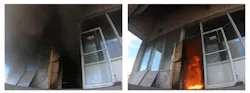
From the exterior, the look of a ventilation-limited fire can range from nothing showing, to dense black smoke flowing out of an opening, to flames extending out of an opening. From the interior, a ventilation-limited fire has a significant amount of unburned fuel, typically characterized by dense black smoke with a hot gas/cool air interface height that’s close to the floor, which results in little to no visibility. When oxygen from fresh air is added, the fire quickly becomes bigger and hotter (possibly getting to flashover) unless additional intervention is made (e.g., removing heat through water application or the air intake by closing a door). In basic terms, you can’t vent your way out of a ventilation-limited fire condition, and any opening that increases air flow to the fire increases the hazard to anyone in that environment. This has been seen repeatedly on the fireground and was proven in studies that were conducted by FSRI.
Small commercial example
FSRI conducted a series of fire experiments in an abandoned strip mall. In an experiment in a 30 x 70 x 15-foot unit, the fire became vent limited, and the open front door became a bidirectional vent with hot smoke flowing out of the top of the doorway and cool air flowing into the bottom portion of the doorway. A 32-square-foot vent in the roof was opened. The front doorway changed from a bidirectional vent to a unidirectional intake vent, supplying more air to the fire. Temperatures in the building increased. When the roof vent was expanded to 64 square feet, an increase in temperatures and heat release rate resulted, with fire growth inside and outside of the building.
The only way that the roof ventilation would improve conditions would be if the opening of the roof was coordinated with effective water on the fire. Reducing the heat release rate of the fire and cooling (contracting) the fire gases then would enable the vertical vents to provide lift, which would improve visibility and make the interior of the building tenable for firefighters who are in full PPE.
The strip mall experiments were used as a comparison to a fire that occurred in a second-floor warehouse. The 45 x 90-foot warehouse had a 10-foot ceiling height. The fire was ventilation limited and then increased in heat release rate and spread the length of the warehouse because of vertical ventilation without effective water on the fire.
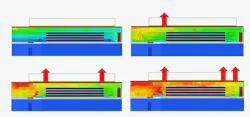
Figure 1 shows side views of the warehouse. The fire started toward the front of the warehouse (left side in figure). The first floor of the warehouse is at ambient temperatures (blue), because open doors on the first floor served as intake vents for fresh air. This air flows to the fire on the second floor via two stairways, one toward the front and one in the rear of the warehouse. Interior suppression crews went up both stairways, but they were unable to apply effective water on the fire because of a combination of shielding, obstructions, lack of visibility and distance. Vertical ventilation (red arrows) was performed in three locations. With each subsequent vertical-ventilation opening, fire conditions on the interior of the warehouse worsened, and interior crews reported higher heat and limited effectiveness of suppression efforts. Conditions deteriorated until all crews that were operating on the second floor were forced to evacuate.
Tactics & tactical timing
A fire that creates smoke in a building doesn’t react to holes the way that a bucket of water does. With a bucket of water, the more holes that are in the bucket, the faster that the water drains out. In a building with a ventilation-limited fire inside, adding holes without effective water on the fire increases the size of the fire and the amount of smoke.
The application of research results and engineering tools to real-world events can provide insights into fire incidents that might be difficult to piece together with a debriefing that’s conducted right after the fire. Changes in tactics or changes in tactical timing can increase effectiveness on the fireground.
About the Author
 Dan Madrzykowski
Dan Madrzykowski
Dan Madrzykowski is the senior director of research for the Fire Safety Research Institute (FSRI), which is part of the UL Research Institutes. He has a doctorate in fire engineering from the University of Canterbury and a master’s degree in fire protection engineering from the University of Maryland. Madrzykowski has more than 35 years of experience working to improve fire safety by conducting research and development in areas of fire dynamics, fire test methods, fire control and fire investigation. He is a member of the NFPA and serves on the committees for Fire Service Training, Structural Fire Fighting and Fire Investigation. Madrzykowski is a member of the International Fire Service Training Association's Executive Board and has collaborated with the International Association of Arson Investigators, International Association of Fire Chiefs, International Society of Fire Service Instructors and the National Fire Academy in the development of training programs. He is a Fellow with the Society of Fire Protection Engineers.