Firehouse Product Review: Power Hawk R.A.V.E Strut
When a crashed vehicle is on its side or roof, stabilization efforts to limit movement in any direction is difficult because of the limited footprint of the vehicle contacting the ground. Balance is compromised when the vehicle isn’t resting on its tires, so it’s necessary to direct the vehicle weight into the ground to provide stabilization. This is when stabilization struts are placed into service.
The R.A.V.E. Strut
Firehouse’s Product Review team tested the R.A.V.E. (Rapid Automatic Vehicle Extrication) Strut from RESQTEC, which is avaible through Power Hawk. It’s designed to stabilize vehicles and objects that are in unbalanced positions.
The strut boasts a 2:1 safety factor when deployed (weight rating of 5,512 lbs. per strut when set at a 90-degree angle) and operates at approximately 71 inches when fully extended. The assembly’s built-in, 2,645-lb.-rated ratcheting strap can be connected to the vehicle with a built-in hook.
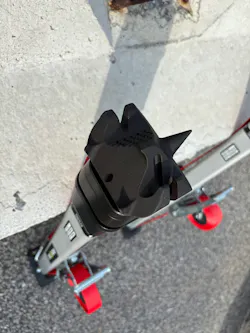
The strut head has four built-in options for placement against the vehicle: Spike; Edge Support with grip; Grip Surface; and Chain Holder, which works with 5/16-inch chains. To set the head to the receiver that’s best suited for the incident, lift up on the head and turn it so that the desired head surface is positioned to rest against the vehicle. The telescoping strut’s extension locks automatically to the desired length.
Strut deployment
To use the R.A.V.E, the rescuer selects the appropriate head surface and approaches the single stabilization point with the head facing the vehicle and the ratchet strap assembly facing up. Calculating the angle for placement of the strut, the rescuer stops at the approximate base point and places the strut base down. The base plate can be used with the Crib Block to distribute the load over a wider footprint, or an Earth Nail can be deployed through the base plate when working on soft soil.
The ratchet strap is unlocked by extending the handle and extending the strut to make contact with the vehicle. The ratchet strap’s built-in, sliding heat sleeve protects it from any high-temperature drivetrain/exhaust objects. The sleeve can be positioned prior to setting the strap.
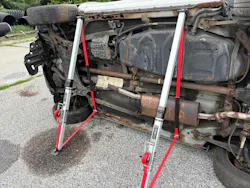
The rescuer connects a steel hook that’s built into the strap to a point on the vehicle close to the ground to build the triangle buttress shape. Utilizing the ratchet assembly, the rescuer sets the strut assembly between the ground and the vehicle by tightening the strap.
Post-incident breakdown begins by removing the tension by unlocking the strap and ratchet assembly and removing the strut by lifting up the base and moving away from the vehicle prior to collapsing the strut. Close the strut assembly by lifting up on the lock collar. The strap auto-rolls back into the spool.
A few points
As with any strut, angle of placement is critical. Struts can lose strength as the angle of placement to the ground becomes less than 90 degrees. Calculation of vehicle weight must be considered prior to utilizing any strut and selecting how many to use. The R.A.V.E strut can be set as low as 45 degrees and still support approximately 3,900 lbs. of force at the head.
When vehicles are on their side, many departments deploy multiple struts to the underside of the vehicle and utilize wedges and cribbing on the roof side; however, when the strut is to be set against the painted surface or an area that lacks an opening for the hook, an opening can be made, or a secondary strap can be used to complete the setup.
Another option is a grab hook chain kit to increase capabilities for connecting to the vehicle. The base plate has a connection point facing the vehicle where a ratchet strap can be deployed with the struts to facilitate rapid setup on any vehicle surface by tying two struts on alternate sides of the vehicle together.
The takeaway
Successful stabilization involves efficient techniques, alternative accessibility and proper equipment. The R.A.V.E. Strut can be set into position rapidly and has multiple vehicle connection points on its swivel head. A built-in connection strap allows rescue teams to gain control of vehicle stabilization so that patient care can be initiated almost simultaneously.
The R.A.V.E. Strut kit would be a substantial addition to the rescue tool cache for any vehicle extrication rescue team and earns the Firehouse Product Review Seal of Approval.
About the Author
Firehouse Staff
Content written and created by Firehouse Magazine editors.