Air Superiority: Innovation in SCBA
Key Takeaways
- Manufacturers of SCBA for firefighters acted quickly to evolve their products in consideration of changes and updates that result from NFPA 1970: Standard on Protective Ensembles for Structural and Proximity Firefighting, Work Apparel, Open-Circuit Self-Contained Breathing Apparatus (SCBA) for Emergency Services, and Personal Alert Safety Systems (PASS).
- Changes in NFPA 1970 regarding SCBA for firefighters focus on air management, easier decontamination, improved connectivity, enhanced electronic safety and greater interoperability.
- Updates in NFPA 1970 regarding SCBA for firefighters relate to end-of-service-time indicators (EOSTI), removable soft goods, wireless connection indicators, intrinsic-safety requirements, PASS technology and universal emergency breathing safety systems (UEBSS).
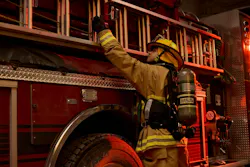
With the consolidation and changes to the NFPA standards for SCBA, fire departments must take a closer look at the age, capabilities and life cycle of their equipment.
NFPA changes
According to NFPA fire protection engineer and volunteer firefighter Robin Zevotek, the 2025 consolidation of the SCBA standards that were in NFPA 1971, NFPA 1975, NFPA 1981 and NFPA 1982 into NFPA 1970: Standard on Protective Ensembles for Structural and Proximity Firefighting, Work Apparel, Open-Circuit Self-Contained Breathing Apparatus (SCBA) for Emergency Services, and Personal Alert Safety Systems (PASS) was consequential. The consolidation makes NFPA 1970 a one-stop shop for SCBA requirements including standards changes.
The changes focus on air management, easier decontamination, improved connectivity, enhanced electronic safety and greater interoperability. Updates relate to the end-of-service-time indicators (EOSTI), removable soft goods, wireless connection indicators, intrinsic-safety requirements, PASS technology and universal emergency breathing safety systems (UEBSS).
"The soft goods are probably the biggest change," Zevotek tells Firehouse. "It all goes around decontamination. Firegrounds are full of carcinogens. Those carcinogens get trapped in the soft goods. The standard now includes the requirement that those soft goods need to be removable from the SCBA to be laundered, like you would launder turnout gear.”
Effect on manufacturers
3M Scott Fire & Safety’s Air-Pak XD, Dräger’s PSS Airboss and MSA’s G1 weren’t as affected as one might think. For these manufacturers, soft goods didn’t need to change in a major way.
For Dräger, Michael Cheek states that the new standards required “additional engineering iterations, validation work and coordination among product development, certification and manufacturing.”
The EOSTI for a 4,500-psi system used to have a setpoint at 35 percent of the cylinder’s rated pressure; now, the alarm threshold sits at 31 percent.
“That change involved more than adjusting a number,” Cheek explains. “The pressure-sensing system, software, heads-up display indications, audible warning, and associated documentation all had to work together and be validated as a system.”
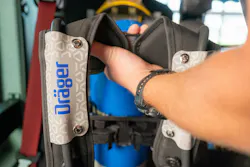
MSA had to tweak its G1 because of the new EOSTI regulations, too. The G1 already had a new control module alarm screen display with pressure and time remaining, but the company added text to the screens to alternate with an alarm icon to meet the new standard.
“We built it from the ground up, and we were planning as much as we could to future-proof this product,” Dom Berardinelli says. “We're not reconstructing the product.”
To make future changes even more streamlined, MSA added a QR code on the G1 for consolidated user instructions instead of using the traditional CD.
“Any time that QR code is scanned, the most recent late-breaking updates are always available,” Patti Tavelli adds.
3M Scott was on a path as MSA as it prepared to release the Air-Pak XD in late 2025, congruent with the new standards. Again, the EOSTI was the biggest change that was needed on its product, according to Jason Cannon.
“Software changes were made so that the audible alarms are tied in as part of the PASS device,” Cannon tells Firehouse.
Innovation keeps these companies ahead of the game when new standards come out. Technology that keeps them ahead of the rest.
Technological advancements
A key focus for 3M Scott and MSA was upping the ante on how electronics operate and communicate within their SCBAs.
Cannon says that 3M Scott “looked at bringing in more modern technology into the electronics package.” This resulted in its SEMS 3.0 wireless SCBA telemetry.
The company’s SCBA can communicate via laptop to an incident commander and present data, such as how much air the firefighter has, alarm conditions, and a greater range on the connection between the SCBA and the incident commander (IC).
MSA’s G1 has central power, with only one battery that powers all of the electronics. Its Bluetooth and communication system has been a massive hit with the Los Angeles County Fire Department.
“The thought of tracking and clear communications on Bluetooth comms were very exciting for [the ICs and chiefs],” Fire Captain Mike Loput tells Firehouse.
Loput also praises MSA’s thermal imaging camera that’s integrated into the PASS device, or what MSA calls its control module. It gives every firefighter thermal imaging capability for improved situational awareness.
“It was a must, because we have issues with firefighters getting lost in buildings,” Loput mentions. “The integrated thermal imager is a great firefighter rescue device.”
The foundation
The groundwork for each manufacturer looks a bit different. For Dräger, it’s about firefighters and the history of the SCBA. For MSA, it’s about comfort, mobility and compatibility. For 3M Scott, it’s about redundant safety features and its wireframe.
“Firefighters do not experience an SCBA as a collection of individual features,” Cheek says. “They experience the entire system on their back.”
He adds that his company heard a lot about muscle memory and how firefighters develop familiar movements through years of training. The location of the features played a big role in creating the PSS AirBoss.
“AirBoss was designed around the realities that follow the incident,” Cheek remarks. “Its harness uses low-absorption, rubberized materials rather than conventional fabric in key areas. Frequently removed components can be disassembled without tools.”
MSA’s G1 has a shorter lumbar pad and doesn’t interfere with the buckles. “We are always looking to make sure that firefighter comfort and experience improvements are top of mind,” Tavelli says.
The SCBA sits closer to the body for a reduced profile, and the focus was on the ability to configure different options that can be mixed and matched with MSA’s catalog of SCBAs.
"L.A. County is not looking for a piece of equipment. We are looking for a partner for the safety of our firefighters,” Loput says. “I feel like I can wear it for hours longer than I could any of our older steel-frame SCBAs.”
Two of the biggest differentiators for 3M Scott are wireframe and cleanability. Due to the NFPA standards, 3M Scott moved away from the wireframe but upon heavy request, the configuration returned in its Air-Pak XD.
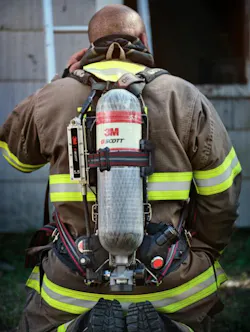
"We did a pretty rigorous and extensive trial with our PPE committee, and what they wanted was a pack that was simplified," Oklahoma City Fire Department Battalion Chief Lamont Smith explains. “It fit better to [the firefighters'] bodies and gave them a lower, reduced profile.”
3M Scott uses a stainless-steel wireframe for simplicity’s sake and an unpadded harness for making it easier decontamination.
“The SCBA actually rides closer to the individual's back, and because of that, the weight distribution is different,” Cannon states.
Striking a balance
SCBAs are one of the most important pieces of equipment on the fireground. There is a fine line between maximizing the SCBA's use and capabilities and doing too much to it, to the point that it becomes another worry in an emergency.
“You don't want to overcomplicate the SCBA,” Cannon states. You want to keep innovating the SCBA, but you want to make sure it does its primary function: delivering air to the firefighter safely and reliably.”
About the Author
 Ryan Baker
Associate Editor
Ryan Baker is a writer and associate editor with prior experiences in online and print production. Ryan is an associate editor for Firehouse with a master's degree in sciences of communication from the University of Wisconsin-Whitewater. He recently completed a year of teaching Intro to Public Speaking at UW-Whitewater, as part of his graduate program. Ryan acquired his bachelor's degree in journalism in 2023 from UW-Whitewater, and operates currently out of Minneapolis, MN. Baker, also writes freelances for the Ultimate Frisbee Association (UFA) in his free time, while also umpiring baseball for various ages across the Twin Cities Metro Area.