In Quarters: Tempe, AZ, Fire Station No. 2
This facility received the Career 1 Gold award in the 2026 Firehouse Station Design Awards. Find the full list of winners here.
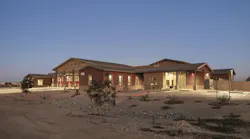
Tempe Fire Station No. 2 replaces a 50-year-old fire station and maintenance building that were located on site and no longer met the needs of the Tempe Fire Medical Rescue Department (TFMRD). The new 17,677-sq.-ft., two-story station situation on a compressed site earned the praise of multiple Station Design Awards judges. One of them called the solution “excellent” and praised the design team’s capability for “fitting six apparatus bays and a substantial program while maintaining the existing station in operation through carefully planned phased construction.”
In addition to the bays, the facility includes support areas, a community/training room, a physical conditioning room, offices, a kitchen/dining/dayroom area and dormitory space.
The phasing required an innovative design and phasing plan. Phase one consisted of demolition of the maintenance building, construction of the fire station living side and partial build-out of two of the six bays. Phase two consisted of demolition of the existing fire station (post-occupancy of the new station) and construction of four additional bays and support spaces.
The innovative two-story design of the station that the team produced also led to a highly efficient floor plan and enhanced operational and response time efficiencies through direct and visually intuitive wayfinding.
The station’s architectural design integrates with the adjacent industrial area, with massing and form that’s contextually appropriate. Further, it’s responsive to the Sonoran Desert climate and includes numerous passive and active sustainable design strategies that are aligned with the city’s Climate Action Plan and the International Green Building Code. A simple, natural, low-maintenance palette of materials is utilized, including ground-face concrete masonry that defines the building façade; an upper-level cantilevered volume that’s clad in smooth and ribbed aluminum composite material; and red steel-plate shade hoods that offer variation in scale, color and texture while shading the operable dormitory vertical-slit windows. The design team’s attention to sustainability earned a 10 (the highest mark) from one of the judges.
Pedestrian-orientated urban design strategies that are at the street frontage include an open, inviting entry sequence that’s shaded by an expansive cantilevered roof canopy, which defines the building entry and provides cover for the second-level exterior deck. Cast-in-place concrete benches at the entry double as forced elements to protect the public lobby.
Site circulation is intuitive at the pedestrian level, with the main entry, lobby, community/training room and vertical circulation clearly identifiable from the street frontage. Secure staff parking and emergency apparatus ingress are provided through two operable vehicular gates.
The fire department was passionate about connecting the station design to the culture of the department and paying tribute to fallen TFMRD Firefighter Tommy Arriaga. The architect designed a turnout locker memorial and an edge-lit, mill-scale, finish-plate steel locker that’s located adjacent to the hazmat training room, which includes an inspirational quote from Arriaga that’s noted above the entrance. One judge called the station “beautiful” and the art and tribute “amazing.”
Enhanced decontamination spaces supplement numerous other firefighter health and safety and building sustainability strategies, including a parking canopy; variable refrigerant flow mechanical systems; Hot/Warm/Cold Zone space planning; enhanced indoor and outdoor connectivity; open plan living areas and physical conditioning space; daylighting into all occupied spaces, with overhangs and shade hoods to reduce direct solar heat gain; energy-efficient LED lighting with motion and daylight harvesting sensors; low-flow plumbing fixtures; and indigenous landscaping.
Architect: LEA Architects
About the Author
Firehouse.com News
Content curated and written by Firehouse editorial staff, including Susan Nicol, Peter Matthews, Ryan Baker and Rich Dzierwa.