In Quarters: Charlottesville, VA, Fire Station No. 1
This facility received the Career 2 Gold award in the 2026 Firehouse Station Design Awards. Find the full list of winners here.
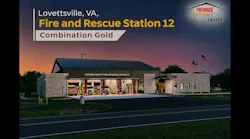
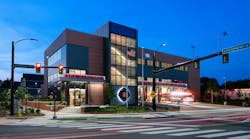
The new Charlottesville Fire Station No. 1 replaces a station that no longer met the operational, health and space needs of a modern fire department. The new facility was planned carefully to improve emergency response while supporting firefighter wellness, safety and long-term resilience.
The site presented one of the project’s biggest challenges. Steep slopes, nearby streams and an adjacent public park severely limited where the building could be placed. Rather than relying on extensive retaining walls and major earthwork, the design team elevated the building above the hillside on a structural slab and steel columns. This reduced environmental disturbance by preserving as much of the surrounding wooded park as possible, minimized excavation and created a distinctive architectural expression that responds directly to its setting. The reaction of multiple Station Design Awards judges to this facet of the facility certainly contributed to its rising to the top of the Career 2 category. “Impressive,” “excellent” and “Well done!” were among the judges’ remarks.
The building’s orientation and layout take full advantage of its unique park setting by maximizing daylight throughout occupied spaces and providing expansive views of the surrounding woods from the kitchen/dining/dayroom area. This enhancesthe daily experience of personnel while reducing reliance on artificial lighting. The fitness room is located adjacent to the park trail network. This allows easy access to trail running and provides an opportunity for park users to connect with the firefighters.
The station’s layout is organized to support fast, efficient emergency operations and reduce firefighter exposure to contaminants. The apparatus bay is separated from living quarters, with dedicated decontamination areas that help to limit the transfer of diesel exhaust and carcinogens into occupied spaces. The layout creates direct circulation paths between dormitories, gear storage and apparatus bays.
This approach also supports the goal for future expansion in the form of an additional bay to the west and another set of bunkrooms to the east.
Expanded dorms, modern living spaces, larger storage areas and improved indoor air quality create a healthier, more comfortable workplace compared with the original station. Interior finishes, materials and acoustical treatments were selected to reduce environmental impact.
From the onset, the city of Charlottesville set a goal of LEED Silver for the project. The station incorporates a 31-kW rooftop solar array that’s projected to generate more than 40,000 kWh annually, to offset roughly 42 percent of the building’s electrical demand while lowering long-term operating costs. Energy performance is approximately 51 percent better than the baseline that’s set by the American Society of Heating, Refrigerating and Air Conditioning Engineers. A bioretention system manages stormwater runoff, and the building supports the city of Charlottesville’s broader climate action goals through energyefficient systems and ongoing performance tracking. Fire Station No. 1 recently was awarded LEED Gold by the U.S. Green Building Council, which means that it exceeds the client’s goal of LEED Silver. One judge called sustainability efforts “exceptional.”
The station includes emergency power systems that support continuous service during emergencies. Every design decision balanced performance, maintenance and long-term flexibility to ensure that the building can serve the community for decades.
City staff, firefighters, the design team and the general contractor worked closely throughout design and construction to keep emergency operations uninterrupted while the replacement station was built. Construction sequencing maintained emergency access at all times.
Architect: Little Diversified Architectural Consulting
About the Author
Firehouse.com News
Content curated and written by Firehouse editorial staff, including Susan Nicol, Peter Matthews, Ryan Baker and Rich Dzierwa.