Dispatch Protocols For Active-Shooter Incidents
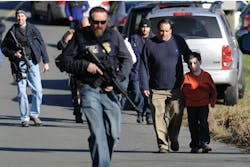
Active-shooter incidents are properly categorized as falling under the jurisdiction of law enforcement. However, this does not mean they are not a concern for fire dispatch centers.
With a significant number of fire agencies involved in medical first response, or outright provision of emergency medical services, the assignment of fire resources to such events is likely. Additionally, as two Colorado incidents show, improvised explosives or incendiaries may be involved that warrant our presence. The gunmen in the Columbine incident fashioned crude bombs from propane tanks; in Aurora the accused shooter booby trapped his apartment.
Whether the first call is relayed from another Public Safety Answering Point (PSAP) or received directly, gather as much information as possible. What is the exact location? How many weapons are being used and what type? How many shooters are involved? What do they look like? Are their identities known? Are they still on the scene? If not, where did they go and how? How many victims are involved? What is the extent of injuries? Are they in one spot or in multiple locations? Are there hostages? Based on local protocols and information provided by the caller, additional questions may be asked.
If the call comes in directly, try to determine if the caller is in a safe place or can reach one. If notification comes from law enforcement, verify the number and type of units requested and dispatch the appropriate assignment used by your agency for such events. It is critical too to obtain the location of the staging area and verify scene safety before apparatus and crews are committed. While timely response is sought, it is more important to ensure that first responders do not become victims.
Relaying information
During dispatch and thereafter, information must be quickly relayed to units. For example, descriptions of suspects and vehicles should be broadcast quickly in case they are encountered while enroute. Incidents such as this are continually morphing. “Active” in active shooter denotes that the crime is in progress during the call. Therefore, do not expect that all information will be received from the initial caller. In fact – especially in a large scene at night – this caller may not recognize the magnitude of the incident, and some of the information provided may even be wrong. That’s why dispatchers must not dismiss subsequent callers under the premise that “we already have that.” Since conditions are likely changing, these calls can supply the most updated information possible.
Channel assignments should be provided to units based on existing procedures. If this requires them to change channels, a roll call should be taken after this occurs. Units assigned on subsequent alarms must also be made aware of the proper frequency. Future traffic to these units from dispatch may also need to be on these channels. After command is established at the scene, another roll call may be in order to determine that assigned resources are accounted for and to identify companies that may have “self dispatched.”
Fire and law enforcement dispatchers must be assigned to the incident to maintain coordinated communications. Whether this is in a single consolidated center or in separate facilities is immaterial. If EMS is an individual entity, it must also be included. Much critical information will be developed that needs to be shared.
Notifications will also likely be included in fire-dispatch duties. These may include, but not be limited to, alerting key officers that a major event exists, initiation of mutual aid and/or off-duty callback and notification of local hospitals to expect multiple trauma patients. Some of these items may be covered under the jurisdiction’s mass-casualty incident (MCI) plan. Regardless of who makes the calls, they have to be made. An annual or semi-annual review of all such documents keeps the process up to date and helps prevent confusion over duties if an incident occurs.
Protecting the team
Active-shooter incidents place tremendous physical and psychological burdens on all involved. Dispatch staff should be augmented during the event, if possible, and dispatch personnel should be included in all debriefing activities, including counseling.
As with any other incident, fire dispatch plays an important role in firefighter safety through the collection and dissemination of timely and accurate information. However, unlike other incidents, the primary threat here comes from a person or persons intent on doing harm. That is why the proper handling of active-shooter calls must be understood and practiced by your communications team.
For more news and training on emergency communications, visit: http://www.firehouse.com/topics/technology-communications.