EFO Research Brief: The Moral, Ethical, and Personal Effect of Body-Worn Cameras on Firefighters
Key Highlights
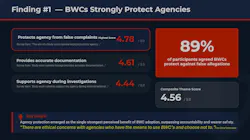
- Firefighters overwhelmingly see BWCs as tools for protection and accountability, with 89 percent believing they help defend against false allegations.
- The study emphasizes the importance of transparent policies, including footage access and privacy protections, to build trust among personnel and the public.
- Phased implementation, starting with leadership, allows agencies to address technical and cultural challenges before wider adoption.
Editor's note: "EFO Research Brief" is a new collaboration between Firehouse.com and the National Fire Academy's Executive Fire Officer Program to highlight the research conducted by students. Each month, we will provide a summation brief of the student's final research capstone spanning multiple fire service topics.
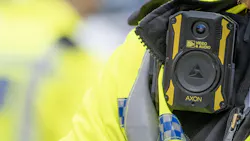
Body-worn cameras (BWCs) have become a routine part of American policing, but their arrival in the fire service is still new, and largely unstudied. While departments increasingly explore BWCs for documentation, liability protection, and transparency, almost no research has asked the people wearing them how the technology affects them personally, morally, and ethically.
This gap prompted a research study conducted through the National Fire Academy's Executive Fire Officer (EFO) Program, examining how firefighters and fire officers experience BWC use during incident responses and public encounters.
The research began with a real-world case study: a Central Texas fire department that has issued BWCs to officers and paramedics since early 2025.
That agency's rollout offers a useful blueprint. Leadership spent roughly a year holding information sessions and fielding concerns before deployment, then phased the cameras in first to battalion chiefs and safety officers, later to company officers and paramedics. Recording was limited to emergency responses and public encounters rather than day-to-day station life, and footage was handled under a strict, legally defensible chain of custody, including redaction capability for privacy. That measured approach, and the trust it built, became a recurring theme throughout the study.
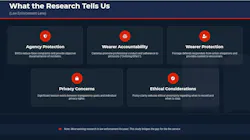
Because there was so little existing fire-service-specific literature to draw from, the study leaned on research from law enforcement, EMS, and healthcare settings, where BWC adoption is further along. Five themes emerged from that review: agency protection, wearer accountability, wearer protection, privacy, and ethical considerations. Those five themes then became the framework for original research: structured interviews with two fire chiefs: one leading an agency that already uses BWCs, one still weighing whether to adopt them, paired with a national survey of firefighters and fire officers with direct, hands-on BWC experience.
What the research found
The results were more one-sided than the researcher initially expected. Going in, the working hypothesis was that BWCs would carry a meaningful, negative psychological or morale cost for the people wearing them. The data told a different story.
Firefighters overwhelmingly viewed BWCs as a protective tool rather than a surveillance tool. Roughly 89 percent of survey respondents agreed the cameras help protect their agency from false complaints or allegations, and comparable majorities agreed that footage supports internal and external investigations and provides accurate documentation of public encounters. In open-ended comments, firefighters described specific incidents where footage exonerated them of a claim of malpractice or malfeasance, clarified a disputed patient-care decision, or even became key evidence in a criminal case.
Wearer accountability also scored high with 83% agreeing that BWCs encourage professionalism during public interactions. Firefighters described a kind of "subconscious awareness" that came with wearing the camera; a tendency to slow down, communicate more deliberately, and second-guess themselves less in high-stress or emotionally charged calls. Interestingly, they were far less convinced the cameras change how the public behaves toward them (agreement dropped to roughly 2.4 out of 5 on that question) suggesting the main behavioral effect of BWCs is internal, not external.
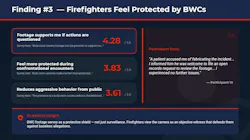
Perceptions around personal safety was more mixed, landing close to neutral, with the widest spread of opinion of any theme. Some firefighters said the camera made them feel more protected during confrontational encounters; others didn't feel it changed their safety at all.
Privacy, somewhat surprisingly, was the theme with the lowest level of concern. Most respondents disagreed that BWCs threatened their own personal privacy. Concerns were somewhat higher, and more variable, when it came to patients' and civilians' privacy, but even there, most firefighters expressed confidence that their agency's policies and footage-handling procedures were appropriate. Confidence in how footage was stored and managed was one of the strongest results in the entire survey.
Ethically, the findings were the clearest signal in the study. Seventy-eight percent of respondents said BWC use aligns with their personal ethical values, 89 percent said their agency uses the cameras ethically, and more than three-quarters agreed the benefits outweigh the ethical concerns. When one fire chief whose department already uses BWCs was asked directly whether he saw ethical problems with the technology, his answer was blunt: the ethical problem, in his view, belongs to agencies that have the means to use BWCs and choose not to.
Taken together, the leadership interviews and the survey data pointed to the same conclusion from two different vantage points: ethical hesitation about BWCs is strongest before implementation and tends to fade once an agency has lived with clear policy, a defined chain of custody, and a track record of using footage to protect and coach rather than punish.
What agencies should do with this
The research points toward several practical takeaways for chiefs and administrators considering a BWC program:
- Lead with policy, not just hardware. The agencies and firefighters in this study consistently connected trust in BWCs to clear, well-communicated rules about when cameras record, who can access footage, and how long it's retained.
- Build in real privacy protections. A legally reviewed chain of custody and the ability to redact footage (blurring faces and private images, muting audio) mattered to both wearers and the public and helped drive down privacy concerns in this study.
- Make the non-punitive intent explicit and prove it. The clearest driver of buy-in in this research wasn't the technology itself; it was firefighters seeing, in practice, that footage was being used to exonerate and coach rather than to discipline.
- Phase the rollout. The case-study department's tiered deployment, starting with chief officers before expanding to line personnel. This gave the organization time to work out technical and cultural kinks before wider adoption. Use footage for learning, not just liability. Integrating BWC footage into post-incident review and training, consistent with NFPA 1500's emphasis on organizational learning, can turn a compliance tool into a genuine professional development asset.
This study was limited by its sample size and its reliance on self-reported perceptions rather than observed behavior. These limitations are consistent with the scope of applied EFO research, but ones that point directly to what should come next.
Larger, more diverse samples across career, combination, and volunteer departments; longitudinal tracking of attitudes as BWC policies and practice mature; and research pairing self-reported perception with objective outcomes (complaint rates, discipline, training gains) would all sharpen the picture. But the early signal from this research is clear: when fire service agencies implement body-worn cameras with transparency, sound policy, and a stated commitment to protection rather than punishment, firefighters are far more likely to see the camera as an ally rather than an adversary.
About the Author
 Heath Doyle
Heath Doyle
Heath Doyle is a battalion chief with Travis County ESD #2 in Central Texas, where he has served for 26 years. Over the course of his career, he has held roles at every rank including company officer, safety officer, training chief and shift commander, giving him a firsthand perspective on both the risk-management and personnel-development sides of the fire service. Doyle holds a Master of Public Administration (MPA) and is a graduate of the National Fire Academy's Executive Fire Officer (EFO) Program and is a Chief Fire Officer (CFO) designee. He can be reached at [email protected].