Firefighting Robots: Removing Firefighters From Environments that Might Not Be Survivable
Key Takeaways
- Rather than considering robotic firefighting technology as a replacement for firefighters, the Los Angeles City Fire Department (LAFD) views it as a tactical resource for incident commanders to employ in circumstances in which the exposure of firefighters to risk outweighs the potential benefit.
- The first LAFD members to operate the department’s firefighting robot completed a two-day certification course that was conducted by engineers who developed the robot. The department then created an internal train-the-trainer program that allows experienced operators to certify additional personnel.
- Some of the LAFD’s greatest successes of the deployment of its firefighting robot have come at fires at large warehouses, industrial buildings and other structures that might have experienced localized collapse, removing firefighters from the task of advancing hoselines, moving debris and working for prolonged periods in unstable environments.
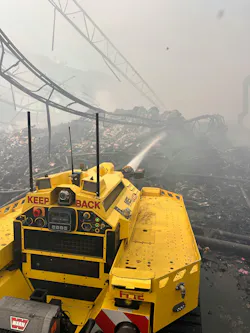
For generations, the fire service has relied on courage, experience and aggressive tactics to protect lives and property. Although those fundamentals remain unchanged, the environments in which firefighters operate continue to evolve. Larger commercial occupancies, lightweight construction, renewable energy systems, hazardous materials and increasingly complex incidents require departments to continually evaluate tools that improve operational effectiveness while reducing firefighter risk. One of those tools is robotic firefighting technology.
Fire departments that invest in the technology and, importantly, comprehensive training on it will be best prepared for increasingly complex incidents.
Why LAFD invested in robotic firefighting
The LAFD’s decision to purchase the Thermite RS3 firefighting robot by Howe & Howe Technologies was influenced by one of the most significant fires in recent history: the 2019 fire at Notre-Dame de Paris in France. Then-Fire Chief Ralph Terrazas observed the enormous challenges that firefighters faced in efforts to protect the renowned structure. The incident demonstrated the value of remotely operated equipment that’s capable of delivering high-volume master streams in environments that are too dangerous for personnel.
Rather than viewing robotic technology as a replacement for firefighters, the LAFD recognized it as another tactical resource that could extend operational capabilities when conditions exceed an acceptable level of risk.
The decision to purchase the robot aligned with one of the fire service’s most enduring principles: risk a lot to save a lot, risk little to save little, and risk nothing when there’s nothing to save. Robotic platforms simply provide incident commanders (ICs) another option when firefighter exposure outweighs the potential benefit.
When the robot goes to work
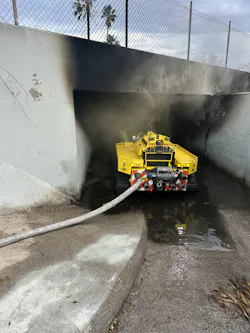
The LAFD doesn’t consider the Thermite RS3 for utilization at routine structure fires. The department deploys the robot when specialized equipment can accomplish work that otherwise would expose firefighters to unnecessary hazards.
The platform has proven valuable during large commercial occupancy fires, warehouse incidents, compromised structures, collapse hazards, and locations that have limited or dangerous access. Further, its mobility allows it to position significant water flow in circumstances in which traditional master streams might be difficult or impossible to place as an effective tool during extended overhaul operations in unstable structures.
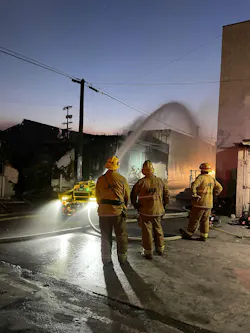
Once an incident transitions to a defensive strategy, the RS3 can deliver large-caliber master streams while operators remain a safe distance away.
Theoretically, it can be operated at a distance of approximately one-quarter of a mile, depending on conditions and signal reliability (i.e., the ability to maintain reliable communication between the operator and the robotic system).
Building construction, terrain and obstructions also can affect operating distance. Debris, uneven surfaces, structural components, hoselines, vehicles and other obstacles can interfere with movement.
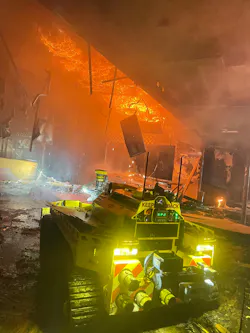
Operationally, the LAFD has used the system at approximately 1,000 feet. Because one of the most important operational considerations of the robot’s utilization is removing firefighters from environments where interior operations might not be reasonably survivable, the LAFD doesn’t deploy a firefighter staffing a hoseline to protect the RS3, because such an individual would be placed back into the environment that the robotic system is intended to eliminate.
Training is the key
As with the deployment of any specialized apparatus, the effectiveness of a robotic firefighting platform depends on the proficiency of its operators.
Initial operators completed a two-day certification course that was conducted by Thermite engineers at Howe & Howe Technologies in Maine.
The LAFD has nine certified robotic system operators who are trained to operate the RS3 and associated robotic systems. These operators are responsible for understanding the capabilities and limitations of the equipment, operating the remote control system, interpreting the video feed and positioning the robot to maximize its effectiveness. They use the remote control station and the onboard video to navigate the robot, identify the fire location, position the monitor and apply water.
Building on that foundation, the LAFD developed an internal train-the-trainer program that allows experienced operators to certify additional personnel while standardized operating procedures are maintained.
Additional personnel can monitor the operation, fire conditions, hoseline deployment and changing structural conditions while maintaining communication with the IC.
Today, after nearly 80 incidents that involved the RS3, operator proficiency continues to improve through structured training and real-world experience.
From the perspective of the LAFD In-Service Training Section, implementing new technology requires far more than issuing equipment. Operators must understand not only how to control the platform but also when it should be deployed, communications requirements, water supply considerations and how the robot integrates into the overall incident action plan.
Training reinforces one important principle: The robot is another tactical resource under the direction of the IC, not a standalone solution. Success depends on coordinated operations between suppression companies, heavy equipment personnel, command staff and safety officers.
Success in the field
Some of the RS3’s greatest successes have come at fires at large warehouses, industrial buildings and other large structures that might experience localized collapse as well as for extended demolition and overhaul operations.
Traditionally, these incidents require numerous firefighters to advance handlines, move debris and work for prolonged periods in unstable environments. The RS3 allows many of those tasks to be performed remotely while heavy equipment simultaneously removes structural debris.
By assigning hazardous tasks to the robot, firefighters remain available for assignments that require human judgment, problem-solving and tactical decision-making.
As large commercial warehouse fires continue to challenge departments nationwide, robotic platforms have become another valuable tool in the IC’s toolbox.
Lessons learned
Like many technological advances, the RS3 was met initially with skepticism. Many firefighters questioned where a robot fits within traditional firefighting operations. Experience has answered that question.
The RS3 hasn’t replaced the department’s firefighters; it’s enhanced their ability to manage risk.
The department also learned that robotic systems have limitations. Dense smoke can reduce operator visibility, and deep water can affect electronic components, and because the RS3 uses a conventional combustion engine, it requires oxygen to operate. Further, its electronics, batteries, mobility system and communications systems must continue functioning in extreme environments.
This reinforces the importance of operator training and having a clear operational plan before the robot’s deployment as well as understanding the platform’s capabilities.
Perhaps the greatest lesson for the LAFD has been recognizing that successful implementation depends as much on culture as technology.
Looking forward
No single tool solves every fireground problem, but providing ICs with additional tactical options allows them to make better risk-based decisions while improving firefighter safety.
As technology continues to advance, training must advance with it. Departments that invest in both innovative equipment and comprehensive training will be best prepared for the increasingly complex emergencies of the future.
The objective is simple: Place machines in harm’s way whenever possible, so firefighters avoid exposures that might not be survivable, while the department still accomplishes its mission of fire suppression. That said, operators must understand that the robot isn’t invincible. It’s an electronic machine that has limitations that involve power, communications, mobility and exposure to extreme conditions.
About the Author
 Richard Diede
Richard Diede is a Captain II with the Los Angeles City Fire Department. He currently serves as the Wildland Fuel Management Unit Captain, overseeing heavy equipment operations and wildland hand crews. Diede’s qualifications include Division Supervisor, Strike Team Leader for Type 1 and Type 3 resources, ICT4, FIRB, HEQB and CRWB. He is a state wildland instructor and is qualified as an operator of hydraulic truck cranes, heavy equipment and firefighting robots. Diede also serves as a heavy equipment rigging specialist with FEMA California Task Force 1 and on the FIRESCOPE Ad Hoc Committee for the Heavy Equipment All Hazard Task Force.