Firefighting Robots: A New, Mobile Tool in the Toolbox
Key Takeaways
- Although manufacturers of robots for use on the fireground only are scratching the surface on the capabilities that their products can provide, their machines already have protected firefighters and made personnel’s jobs easier.
- Because some robots that fire departments employ are electric, those machines are perfect for certain hazmat situations, because they don’t present ignition-source problems.
- The controls for robots that are used on the fireground and at other emergency scenes are intuitive for operators, which is beneficial for training and implementation.
The fire service has seen a number of technological advancements over the past couple of years, let alone in the past decade. One area that’s advancing quickly is fire and rescue robots.
A wide variety of robots for fire and rescue operations are on the market today, each with a different purpose behind its design. Whether they're keeping firefighters safe in a hazardous materials or life-threatening scenario, hauling hoselines or Stokes baskets, or suppressing fires, these robots are starting to make waves in the industry.
Rosenbauer America’s RTE, Boston Dynamics’ Spot, and Howe & Howe’s Thermite RS3 are meant to join a fire department’s arsenal.
Sizes and functions vary
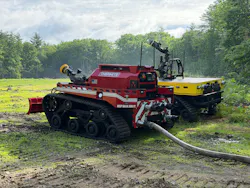
Rosenbauer’s RTE Robot is the smallest, measuring a little more than 47 inches long, 31 inches wide and 14 inches tall, purposefully designed to fit through standard doorways. The RTE is a multi-mission-capable platform that’s built on a simple chassis, giving firefighters the option to attach different modules for varying scenarios.
Moving up in size, Boston Dynamics’ Spot, which emulates animal movement measures 43 inches long, nearly 20 inches wide and 24 inches tall when walking and is more tailored toward safety of firefighters and law enforcement as well as surveillance.
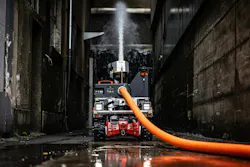
The largest of the three robots is the Thermite RS3 from Howe & Howe. This robot is meant for flowing water, pulling weight and clearing debris. At 120 inches long, 65 ½ inches wide and 64 ½ inches high, it can maneuver rugged terrain easily and withstand extreme conditions, with a maximum water flow rate of 2,500-gpm.
Flexibility in deployments and use
Although each robot has different sizes and purposes, all have a wide range of capabilities, which makes them useful in different scenarios.
Rosenbauer America’s Joe Caughey explains that the company designed the tool to be flexible. From pulling the weight of hoselines or victims to take the burden off of firefighters to fitting into areas that humans can’t reach, Rosenbauer didn’t want to limit the RTE's capabilities.
"We want to do a little bit of everything with this. We want this to be the Toyota Corolla of the industry," Caughey tells Firehouse.
The RTE has more than a dozen modules that can be mounted on the chassis, focusing on fire suppression, carrying victims and beyond line-of-sight vision, helping the operator view the scene beyond their eyesight. The robot also has several attachments, including a plow blade, a trailer hitch and a railroad adapter.
According to Caughey, the RM356 module is the most popular, delivering a 924-gpm flow rate and a 1 ¾-inch gated discharge on the rear, which lets firefighters use the robot as a mobile standpipe inside of a structure.
"It's not a one-trick pony," Caughey states. "It solves nearly everything."
As for Spot, Boston Dynamics built the robot with surveillance in mind. Still, its flexibility comes from its capability of walking on rugged terrain and to manipulate objects around it.
"Spot has advanced mobility, dexterity and intelligence that allow us to apply automation in difficult, dangerous or unstructured environments," Boston Dynamics’ Kamila Blain says.
The robot can climb stairs, stay stable on slippery or uneven ground and navigate cramped quarters. Its standard public safety kit also includes a camera, an integrated arm and radios to operate beyond line of sight.
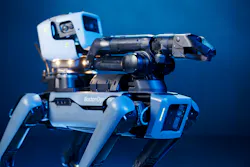
"Operators can get a 360-view of a scene and up to 30 times magnification of any angle from a safe standoff distance, as well as thermal imaging to search for people who are trapped or objects that are radiating heat—even if Spot’s surroundings are obscured by smoke," Blain tells Firehouse.
Even as the largest of the three, Thermite RS3 still has room to grow with modules and attachments, according to Rob Lemons. The unit was designed to clear entryways, move vehicles and assist with extrication.
The 3,600-lb. robot has a 20-hour runtime without refueling and optional attachments, including a foam tank and nozzle, scene lighting, a thermal camera, a positive-pressure ventilation attachment and a plow assembly.
"We've made size accommodations and power unit accommodations for different mission sets," Lemons explains. "We wanted to provide the size and scalability for the departments. We can pull almost 600 feet of charged two-and-a-half behind that unit."
These companies are only scratching the surface of the robotics world with these capabilities, but they still had use cases where robots protect firefighters and make their jobs easier.
Safety in the field
At Naval Weapons Station Seal Beach in California, Fire Chief Matt Rios says that loves the RTE’s capability to operate underwater up to its antenna reach and is even considering purchasing an antenna extender to reach deeper.
"It's flexible because of the size. Even if we don't have a trailer, we do have the ability to load it into the back of a pickup truck and continue to where we need to go," Rios tells Firehouse. "We do like how it's an electric vehicle, so we can use it in certain hazmat situations where there's no ignition sources."
All of Rios’s members are trained in robotic operations and can deploy the RTE within 25–30 minutes if they are called. Even with training and the robot's flexibility, Rios believes its biggest advantage is safety.
"We can now deploy them into emergencies that we would risk lives deploying our firefighters into,” Rios says. “The robots are replaceable, but firefighters aren’t.”
Spot comes in handy for Oswego County, NY, because of its nearby nuclear power plants. The county drone and robotics coordinator, Mark Bender, also speaks to Spot’s capability for keeping first responders safe.
"It definitely keeps guys out of harm's way," Bender states. "That's obviously the biggest thing for it. It's got a pretty good environmental sensor package and has the ability to open doors."
The RS3 has the most deployments, and Los Angeles City Fire Department (LAFD) Capt. Richard Diede speaks to the enhancement in firefighting, given that the robot has been sent out to more than 80 fires.
"It's nearly a tank, and then you put a water delivery device on it," Diede tells Firehouse. "One fire was a 1.2-million-square-foot building that burned to the ground. Firefighting systems are overwhelmed, and nobody goes inside, because they're worried the walls will come down. No one was mad about me going inside the building with the RS3."
Diede stresses that it isn't a replacement for firefighters. That’s a theme that is congruent across the LAFD that Diede emphasizes in “Firefighting Robots: Removing Firefighters From Environments that Might Not Be Survivable."
"It's just a tool in the toolbox," Diede says. It's not a firefighting device that fixes every problem, but it gives you another option when the building is compromised, and firefighter lives are at stake."
Remote simplicity
Moving back to the logistics of robots, a common theme is the ease of use.
The RTE’s remote control was modeled after how drones operate. Caughey explains that, through feedback, Rosenbauer felt the need to adapt its controller to match how a drone feels to fly.
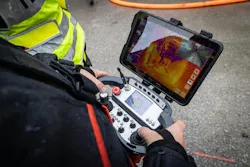
That’s the same idea behind the controller on the RS3. Lemons says “The new controller is more like a drone controller. It's got a much larger screen, better video capability, better communication capability, and distance."
Diede emphasizes that thought when he trains personnel. "I can simply give them the remote, give them a quick down-and-dirty, hand it to them and they'll be running the machine as if they've been fully trained on how to run it.”
Spot’s remote control looks like that of a handheld gaming system, which makes operations and training easier for firefighters.
These fire and rescue robots aren’t meant to replace firefighters, nor are they meant to solve every problem. They are another tool in the firefighter's toolkit and an addition to helping to protect them from high-risk scenarios.
About the Author
 Ryan Baker
Associate Editor
Ryan Baker is a writer and associate editor with prior experiences in online and print production. Ryan is an associate editor for Firehouse with a master's degree in sciences of communication from the University of Wisconsin-Whitewater. He recently completed a year of teaching Intro to Public Speaking at UW-Whitewater, as part of his graduate program. Ryan acquired his bachelor's degree in journalism in 2023 from UW-Whitewater, and operates currently out of Minneapolis, MN. Baker, also writes freelances for the Ultimate Frisbee Association (UFA) in his free time, while also umpiring baseball for various ages across the Twin Cities Metro Area.
Related
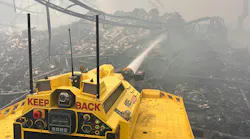 Los Angeles City Fire Department firefighting robot putting out hot spots at industrial fire