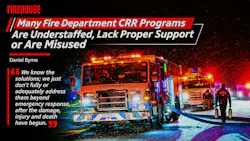
Many Fire Department CRR Programs Are Understaffed, Lack Proper Support or Are Misused
Key Takeaways
- Codes to build the most “fireproof” buildings that modern technology can provide can be created and enhanced, but for those codes to be effective, they must be enforced and adhered to.
- Whether through corruption, negligence, or understaffed and underfunded code enforcement offices, all of the new and enhanced fire codes that came about following the 1903 fire at the Iroquois Theater, the 1942 fire at the Cocoanut Grove nightclub, the 1977 fire at the Beverly Hills Supper Club and others failed to save lives at ensuing fires.
- In many fire departments, community risk reduction either doesn’t exist, is woefully understaffed, is lacking proper support or is misused as an educational tool for public relations purposes more than for purposeful fire protection.
Just as the builders of the Titanic deemed the ship unsinkable, the respective owners of the Iroquois Theater, the Asch Building (which housed the Triangle Shirtwaist Factory) and the Winecoff Hotel boasted that their buildings were fireproof. Yet in the end, fires in these “fireproof” buildings killed at least 867 people and injured 393 others. How could fire claim so many victims in buildings that were advertised as fireproof? The same reason that the Titanic hit the iceberg and sank: humans entered the equation.
In 1903, a fire at Chicago’s Iroquois Theater that was described as being extinguishable by a small stream of water in its incipient stage grew to become the deadliest single-building fire in U.S. history. The fire underscored the importance of fire extinguishers, fire alarms, fire sprinkler systems, emergency lighting, adequate and accessible exits with doors that open outward, the dangers of combustible interior material and the dangers of overcrowding. As a result, new codes were created or existing codes were enhanced to address these issues. However, history repeated itself.
Six years later, a fire broke out at the crowded Triangle Shirtwaist Factory in New York City, killing 146 people and injuring dozens of others. The building, where fires occurred previously, lacked a fire sprinkler system and fire alarm system. The fire began in a rag bin and quickly spread through two months’ worth of fabric scrap buildup. There were insufficient exits: Doors were locked or opened inward. The public outcry and demand for changes resulted in new local laws and gave birth to the Building Exits Code, which we know today as NFPA 101: Life Safety Code.
In 1942, a fire broke out at the overcrowded Cocoanut Grove nightclub in Boston, killing 492 people and injuring at least 160 others. Despite the lessons learned almost four decades earlier, the building had no fire sprinkler system nor fire alarm system. The cause never was determined officially, but the fire quickly spread through the flammable interior decorations as patrons fled for exits that couldn’t be found or were found locked or inadequate for the number of people who tried to egress through them. Once again, public outcry resulted in changes and enhancements to the fire code, including fire sprinkler systems, exits, emergency lighting, flammable interior decorations and stricter occupancy loads.
In 1946, a fire at the Winecoff Hotel in Atlanta killed 119 and injured at least 100 others. As with the Triangle Shirtwaist Factory, the building had previous fires and lacked a fire sprinkler system and an automatic fire alarm system. Because of the lack of fire doors and a combustible interior (e.g., halls of painted burlap), the fire spread quickly, cutting off the only means of escape from upper floors, a single open and unprotected stairwell. Public outcry resulted in even more enhancements to the exit codes, increasing protection of egress stairwells and fire doors, limiting interior combustibles, and requiring emergency lighting and fire sprinkler and alarm systems.
The following year, in part because of the Winecoff Hotel fire, President Harry S. Truman held the Conference on Fire Prevention, which introduced the three E’s of fire prevention: education, engineering and enforcement.
In 1977, a fire broke out at the overcrowded Beverly Hills Supper Club in Kentucky. In spite of the lessons that were taught more than a half a century before, the building lacked a fire sprinkler system and fire alarm system. The fire killed 165 people, and at least 70 others were injured. The flames spread rapidly because of the combustible interior decorations and a single open stairway. Patrons who tried to flee found that many of the exits were hidden or locked. The building was allowed to operate despite being noncompliant to fire code. Public outcry resulted in more enhancements to codes for exits, interior decorations, emergency lighting and occupant loads. Code requirements for fire sprinkler systems were enhanced by requiring them in assembly occupancies that have occupant loads starting at 300 people.
In 2003, a fire in yet another overcrowded nightclub, called The Station, in Rhode Island claimed 100 lives and injured nearly 300 others. The building had a fire alarm system but no fire sprinkler system. The fire was caused by pyrotechnics that ignited highly flammable insulation around the stage, rapidly raising temperatures to flashover. The egress of patrons who were attempting to escape through the front door was restricted because of illegal modifications. Public outcry resulted in even more enhancements to the code for exits and interior finishes and an enhancement for fire sprinkler systems in assembly occupancies, requiring their installation with occupant loads now starting at 100 people.
Knowledge and education
History continues repeating. However, this history also teaches us other lessons: We can create and enhance codes to build the most “fireproof” buildings that modern technology can provide, but for those codes to be effective, they must be enforced and adhered to, and humans must, once again, enter the equation. Whether through corruption, negligence, or understaffed and underfunded code enforcement offices, all of those new and enhanced fire codes failed to save lives in these historical fires. Add into this equation the knowledge and education of employees and patrons to maintain and utilize the fire protection that’s provided, and the risks leading to these tragedies become apparent. Each of the aforementioned fires enhanced or created new codes that sat dormant in the books, because they were either missed or ignored or weren’t enforced. Those that were enforced and available weren’t utilized before or during the tragedy.
A community risk reduction (CRR) program addresses all facets of this issue, from the adoption and application of and education on fire codes, to human actions and reactions in crisis situations, to maximizing the available fire protection: education, engineering and enforcement. Today, we have five E’s, given the addition of economic incentives and emergency response. Nevertheless, the original three E’s remain the pillars of fire protection and the core function of CRR. However, it all starts with humans and their knowledge and education.
That said, in many fire departments today, CRR either doesn’t exist, is woefully understaffed, is lacking proper support or is misused completely as an educational tool for public relations purposes more than for purposeful fire protection. A strong, supported and aggressive CRR program that’s provided with a goal-orientated purpose that’s intertwined within a department’s mission statement and operations is imperative to 21st centure fire protection.
When it comes to fires and fire loss, history continues to repeat itself, including our own line-of-duty deaths. The causes of fire ignition and spread and human response, or lack thereof, that result in injuries and deaths are nothing new.
We know the solutions; we just don’t fully or adequately address them beyond emergency response, after the damage, injury and death have begun. Why Isn’t our ethos to protect life and property? That “Everyone goes home?”
It’s said that those who don’t learn from history are doomed to repeat it. If that is to be believed and applied to the fire service, then your CRR program should be akin to an Ivy League doctorate program and your personnel to professors.
Product Spotlight
Outlet Covers
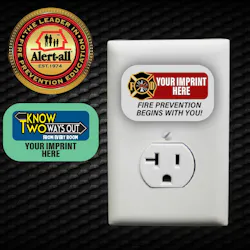
New custom outlet covers from Alert-All help to keep young children safe from electrical shock. Made in the United States, the durable, high-quality plastic outlet covers add a layer of protection by covering unused outlets. They include a full-color imprint and are perfect for homes, offices and childcare centers
Public Education Simulators
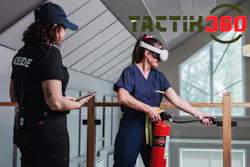
Tactik 360 Public Education Simulators provide immersive virtual-reality experiences that help fire departments to teach essential fire safety skills through realistic and engaging practice. Hero360 teaches smoke alarm awareness. FireKitchen360 demonstrates the correct and incorrect ways to react to a kitchen fire. FireX360 offers hands-on fire extinguisher training that uses a modified real extinguisher. These solutions help departments to deliver consistent, engaging and memorable fire safety education through practical, experience-based learning in a risk-free environment.
Product Spotlight
Public Education Simulators
Tactik 360 Public Education Simulators provide immersive virtual-reality experiences that help fire departments to teach essential fire safety skills through realistic and engaging practice. Hero360 teaches smoke alarm awareness. FireKitchen360 demonstrates the correct and incorrect ways to react to a kitchen fire. FireX360 offers hands-on fire extinguisher training that uses a modified real extinguisher. These solutions help departments to deliver consistent, engaging and memorable fire safety education through practical, experience-based learning in a risk-free environment.
TACTIK360.COM/EN/SHOP
Outlet Covers
New custom outlet covers from Alert-All help to keep young children safe from electrical shock. Made in the United States, the durable, high-quality plastic outlet covers add a layer of protection by covering unused outlets. They include a full-color imprint and are perfect for homes, offices and childcare centers.
ALERTALL.COM
About the Author
 Daniel Byrne
DANIEL BYRNE is a community support officer for the Burton Fire District, Beaufort County, SC, and a retired assistant fire chief of training for the Georgia Air National Guard 165th Fire Department. A third-generation firefighter, he holds an associate degree and a bachelor’s degree in fire science as well as a master’s degree in public administration and disaster management. Byrne is an alumnus of the National Fire Academy. He received state and local awards for public relations and educational programs as well as community partnerships and served as a conference presenter and keynote speaker. Byrne is a recipient of the Thomas Carr Community Service Award from Firehouse.
Related
 A whole-community approach to community risk reduction goes beyond smoke alarms and slips and falls, to involve citizens to reduce a variety of risks before data tell you that action is necessary.