EFO Research Brief: Beyond the Fireground: Measuring Organizational Capacity in the Modern Fire Service
Editor's note: "EFO Research Brief" is a collaboration between Firehouse.com and the National Fire Academy's Executive Fire Officer Program to highlight the research conducted by students. Each month, we will provide a summation brief of the student's final research capstone spanning multiple fire service topics.
The complexity facing the modern fire service is immense. Long gone are the days when departments could focus primarily on waiting for the tones to drop and reacting to emergencies. Communities now expect fire departments to prevent incidents, manage development, analyze risk, coordinate resources, support personnel, and prepare for emerging threats ranging from new technologies to growing wildfire risks, to name only a few of the hats we wear; all while maintaining operational readiness. Meeting these expectations requires the fire service to work smarter, continuously anticipating what is coming next. That begins with understanding who we serve, what our communities need, and which organizational systems are necessary to support the mission.
For decades, the fire service has refined suppression deployment and operational staffing models which have helped departments assess response capabilities, resource deployment, and the number of operational personnel needed to protect a community. However, a significant gap remains: We have not developed comparable methods for determining the personnel needed to support those operational systems.
Fire prevention, community risk reduction (CRR), training, logistics, administration, data analysis, planning, and organizational leadership are essential systems that support the fire service mission. Yet staffing needs for these functions remain largely undefined. This is an organizational, operational, and strategic issue.
Growth creates more than emergency calls
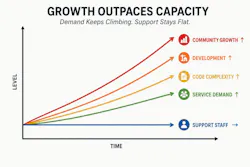
As communities grow, their fire departments must grow with them. Population and development increases create demands beyond emergency response, including inspections, CRR, training, logistics, and strategic coordination.
Despite expanding workload, many fire departments still evaluate staffing primarily through suppression deployment models that measure emergency response capacity without accounting for the organizational infrastructure required to sustain it. As support systems fall behind, chief officers and managers absorb task-level work such as scheduling, data entry, program administration, and routine coordination, diverting time from long-range planning, organizational development, employee support, and community engagement.
Eventually, the department may appear operationally staffed while remaining organizationally under-resourced.
U.S. fire department data suggests a ratio of approximately 1.8 firefighters for every 1,000 residents, although many agencies already struggle to achieve that level. More importantly, population-based firefighter ratios do not fully account for the administrative, technical, analytical, and preventive functions performed by a modern fire department. Decision-makers responsible for allocating limited public resources need tangible measures they can understand. This requires fire service leaders and professionals who can translate operational needs into information that community stakeholders and policymakers can evaluate.
That work increasingly requires professionals who understand fire-service operations, financial constraints, development and construction, regulatory requirements, and fire and life safety standards. No single position can perform all of these functions equally well, and at some point versatility becomes organizational overload. This is especially evident in rapidly growing communities, where workload often increases before staffing models, funding structures, and organizational systems adapt, leaving chief officers to absorb the difference.
Measuring response capacity but not organizational capacity
A central finding of my Executive Fire Officer research was the imbalance between operational and support staffing guidance. The fire service has developed scalable benchmarks for emergency response, while support functions often rely on subjective terms such as “sufficient personnel” or “adequate staffing” without defining how sufficiency should be calculated, which workload indicators should be evaluated, or when organizational capacity has been exceeded.
We have become reasonably effective at measuring response capacity, but we have not developed equivalent methods for measuring organizational capacity.
Without measurable staffing guidance, departments may struggle to justify positions that do not directly place another firefighter on an apparatus. Prevention, administration, logistics, training, analysis, and management may be viewed as secondary expenditures rather than essential components of operational readiness. The absence of measurable guidance does not mean the work is unnecessary; it means the work is often hidden, contributing to inconsistent methods for measuring and justifying support staffing needs across the fire service.
The research question
My research focused on mid-sized, high-growth fire departments that were experiencing workload growth that outpaced organizational staffing capacity, examining relationships among perceived staffing adequacy, workload strain, workforce fatigue and burnout, leadership diversion, organizational effectiveness, and perceived community safety impacts.
The underlying concern was straightforward: Without measurable staffing guidance, departments may struggle to justify support positions until organizational strain is already affecting employee well-being, strategic leadership capacity, internal effectiveness, and the ability to meet community needs.
Parallel research in other high-stakes professions reinforces this concern. One cross-sectional study of emergency department personnel found inadequate staffing to be a leading stressor associated with emotional exhaustion, depersonalization, lower job satisfaction, reduced quality of care, and increased error rates. Although health care and the fire service differ, both operate in complex, high-consequence environments where staffing inadequacy can affect more than employee workload.
What the literature revealed
The literature consistently recognized support functions as operationally important while providing limited guidance for determining appropriate staffing levels. National research from the U.S. Fire Administration and Johns Hopkins has also identified fire prevention and community risk reduction as persistently under-resourced, with inadequate staffing linked to burnout, reduced organizational effectiveness and leadership capacity, inconsistent service delivery, difficulty adapting to growth, and limited ability to implement preventive and data-driven programs.
One of the strongest themes was that organizational complexity increases as communities grow, creating greater demands for coordination, supervision, communication, documentation, quality control, policy development, and strategic oversight. These demands often emerge before staffing and funding structures adjust, leaving departments with organizational workloads that can exceed internal capacity.
Survey finds inadequate understanding of workloads
The study used a quantitative research design focused on mid-sized, high-growth fire departments. Of 107 survey responses, 17 met the final inclusion criteria for the target population. Because the qualifying sample was limited, the findings should be viewed as exploratory rather than nationally representative, although several consistent patterns emerged.

Respondents frequently reported insufficient staffing, growing workload demands, and increasing administrative strain across support functions. Many also lacked formal workload measurement systems, making it difficult to demonstrate how many inspections, plan reviews, investigations, training assignments, logistical requests, administrative processes, or strategic initiatives were being managed by each employee. Where workload measurement did exist, methods varied considerably across departments.
When workload is not measured, organizational strain can be mistaken for an individual performance problem. Without reliable capacity data, leaders may struggle to distinguish between employee performance, inefficient processes, competing priorities, and a workload that has simply exceeded available staffing. Leaders may ask employees to improve time management or become more efficient when the underlying issue is that the volume and complexity of the work exceed available capacity.
The findings also indicated that staffing challenges can divert chief officers and managers from strategic responsibilities. When leaders are routinely required to perform task-level work, the organization loses capacity for planning, mentoring, policy development, workforce development, and long-term risk reduction.
Why focused leadership matters
The implications extend beyond an internal staffing discussion. This is a broader issue of governance, service delivery, and organizational sustainability.
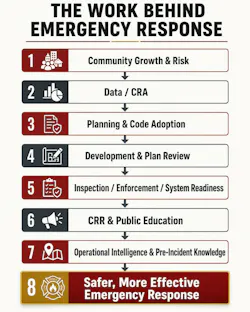
A fire apparatus cannot remain response-ready without maintenance, equipment management, training, scheduling, purchasing, records, and administrative coordination. Community growth cannot be managed safely without development review, inspections, code enforcement, data analysis, and risk reduction. Employees cannot be effectively led when chief officers have no time to plan, mentor, evaluate, or develop the organization.
These functions do not compete with emergency response. They make emergency response possible.
When all of these support systems are inadequately staffed, operational personnel ultimately absorb the consequences. Firefighters may receive less training, operate with delayed equipment replacement, respond to preventable emergencies, or work within systems that are increasingly reactive and strained.
Supporting firefighters therefore requires more than placing personnel on apparatus. It requires building the organizational systems that allow those personnel to operate safely and effectively.
Moving toward measurable support systems
The findings support several strategic recommendations.
First, the fire service should continue developing measurable staffing frameworks for organizational support functions. These frameworks do not need to create a rigid national ratio that applies equally to every department. Community risk, organizational structure, service demand, regulatory responsibility, and development activity vary significantly.
However, departments need a common methodology for evaluating workload and determining capacity.
Second, departments should establish workload measurement systems before requesting additional positions. Revenue generation should not be the primary measure of whether a function is valuable. The first question should be whether the workload exists and whether the department has adequate capacity to perform it safely, effectively, and consistently.
Third, staffing and funding structures should be aligned with community growth. Agencies should identify indicators that trigger an organizational review, such as increases in population, development applications, occupancies, inspections, emergency calls, regulatory responsibilities, or program demands.
Finally, professional standards and accreditation frameworks should provide greater guidance for evaluating organizational capacity.
Supporting the entire mission
The future of the fire service depends on integrated organizational systems.
Community resilience requires more than emergency response; it also depends on prevention, leadership, planning, logistics, training, administration, analysis, and strategic organizational support. These functions are not optional additions to the mission, they are part of it. The findings identified patterns consistent with the hypothesis that inadequate prevention and organizational support staffing in mid-sized, high-growth jurisdictions is associated with increased workload, workforce fatigue, leadership diversion, and perceived impacts on organizational effectiveness and community safety.
The profession has evolved operationally. It has embraced increasingly sophisticated response models, specialized training, new technology, and data-driven deployment practices. Organizational support systems must now evolve with the same level of intention.
As the fire service moves toward a more proactive, data-informed, and community-centered model, organizational capacity must become part of the strategic conversation.
For leaders who genuinely care about supporting their firefighters, the challenge is clear: Are your firefighters and operational systems appropriately supported—and how do you know?
EFO Research Briefs
- EFO Research Brief: Adapting How We Train Gen Z Firefighters
- EFO Research Brief: Identifying Competency Gaps in the Civil Service Promotional Process
- EFO Research Brief: Overcoming Barriers to Collaboration for Fire Protection
- EFO Research Brief: Retirement from the Fire Service and the Loss of Identity
- EFO Research Brief: The Role of Fire Chiefs in Community Risk Reduction Efforts
- EFO Research Brief: Why Vulnerability Is a Leadership Strength in the Fire Service
- EFO Research Brief: Identifying Competency Gaps in the Civil Service Promotional Process
- EFO Research Brief: Removing Barriers to Professional Development in the Fire Service
About the Author
 Lisa J. Richard
Lisa J. Richard is the deputy fire marshal and Battalion Chief of Prevention for the Caldwell, ID, Fire Department. She is a graduate of the National Fire Academy’s Executive Fire Officer Program and is pursuing a Master of Public Administration with a concentration in Emergency Services Management. Richard’s experience spans fire prevention, community risk reduction, code administration, fire investigation, public education, and organizational leadership. She has taught fire prevention and fire investigation topics at local colleges and universities and through a variety of guest teaching and fire service training opportunities. Her professional interests include fire service workload analysis, data-informed decision-making, policy development, and strengthening the integration of prevention, emergency response, and community resilience.