The Five E's of Community Risk Reduction: Why It Requires Every Piece of the System
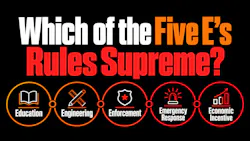
One of the conversations that often surfaces around community risk reduction (CRR) is a deceptively simple question: Which of the five E’s matters most?
Is it education—the ability to teach, inform, and influence safer behaviors before an emergency occurs?
Is it engineering—designing buildings, systems, infrastructure, and environments in ways that reduce risk before people are ever exposed to it?
Is it enforcement—ensuring that established codes, standards, and regulations are followed so known hazards are addressed?
Is it emergency response—when prevention efforts have reached their limit and an emergency actually occurs?
Or, is it economic incentive—using funding, grants, insurance considerations, financial assistance, and other incentives to help individuals and communities make safer choices?
The answer will probably depend on who you ask.
Each player's view is different
A firefighter who has spent a career responding to emergencies may naturally place emergency response near the top because he or she has witnessed firsthand what an effective response can mean when lives and property are at risk. A fire inspector may argue that enforcement is foundational because codes and standards exist specifically to prevent the conditions that contribute to tragedy. A public educator may point to education because changing behavior can prevent an emergency before it begins. An engineer may argue that properly designed systems can remove or minimize hazards without requiring someone to make a conscious decision at all.
Meanwhile, a community leader may recognize that even the best safety solution accomplishes very little if people, businesses, or local governments simply cannot afford to implement it.
The interesting part is that each of them would be right.
Where we get into trouble is when we begin treating those perspectives as competing philosophies rather than pieces of the same strategy. Our opinions about which of the Five E’s is most important will naturally be influenced by our professions, our responsibilities, our experiences, and even our personal life experiences. We tend to place greater value on the tools we understand best and the ones we have personally seen work. That does not necessarily make our perspective wrong, but it can make our perspective incomplete.
What really matters within CRR
Community risk does not exist within professional boundaries. A fire does not care which division of an organization is responsible for prevention. A flood does not distinguish between emergency management, engineering, public education, or response. A vulnerable resident does not care which agency owns a particular responsibility. The risk simply exists, and our responsibility is to determine the most effective combination of strategies available to reduce it.
That is why there will absolutely be situations where one of the Five E’s must move to the forefront. A community experiencing a pattern of cooking fires may initially need a strong educational intervention. A neighborhood repeatedly affected by flooding may require an engineering solution. A commercial property with recurring and uncorrected fire code
violations may require enforcement. A major hurricane, wildfire, or other disaster will inevitably place emergency response at the center of the operation. A community that understands its risks but lacks the financial ability to address them may require economic incentives before meaningful mitigation can occur.
The important distinction is that coming to the forefront does not mean standing alone.
Consider that community experiencing repeated cooking fires. Education may be the initial strategy, but perhaps the data eventually reveals that the problem is occurring primarily among older adults or residents living in certain types of housing. Education may then need to be supported by engineering solutions, partnerships, economic assistance, code enforcement, or changes in how emergency responders interact with residents after an incident. What began as an educational problem may quickly become a much broader CRR effort.
Bringing all pieces to the CRR equation
The same applies across virtually every community risk we encounter. Education without engineering may leave people knowledgeable but still exposed to hazards they cannot control. Engineering without enforcement may establish excellent safeguards that are poorly maintained or ignored. Enforcement without education may achieve temporary compliance without helping people understand why the requirement matters. Emergency response without prevention can leave an organization continually reacting to the same incidents instead of examining and understanding why they continue to occur. Economic incentives without a clearly identified risk and strategy can result in money being spent without producing measurable improvements in community safety.
The Five E’s, therefore, should not be viewed as five competing options. They are five tools available to address risk, and effective CRR requires us to understand when each tool should lead, when it should support, and how they should work together.
That same thought must extend beyond the strategies themselves and into the organizations responsible for carrying them out. In many jurisdictions, the Five E’s do not reside within one division, one agency, or even one level of government. Operations personnel may oversee emergency response while prevention personnel handle enforcement and education. Engineers, planners, building officials, emergency managers, elected officials, nonprofit organizations, healthcare providers, businesses, and community groups may control other pieces of the solution. If those groups operate independently, then our CRR efforts can become just as disjointed as the risks we are attempting to address.
Collaboration of the five E's
This is where collaboration becomes more than a good idea; it becomes a requirement.
The goal should not be to determine whose discipline is most important. The better question is: What does this particular risk require from each of us?
When emergency responders share what they are seeing in the field with prevention personnel, we gain information that can guide education and enforcement. When inspectors communicate recurring problems to educators, public messaging can become more targeted. When engineers and code officials work together, we can identify solutions that are both technically effective and practically enforceable. When economic resources are aligned with identified community risks, residents and organizations may gain the ability to implement the solutions we have been recommending. Each discipline brings a different perspective to the table, and those different perspectives are precisely what makes a comprehensive CRR strategy possible.
Ultimately, CRR is about more than preventing the next emergency. It is about creating communities that are better prepared before an event occurs, better
protected while it is happening, and better positioned to recover afterward. Prevention, preparedness, response, and recovery should not exist as isolated concepts. They should
form a continuum in which the lessons learned from one event help reduce the consequences of the next.
A resilient community is not necessarily a community where emergencies never happen. That is an unrealistic expectation. A resilient community understands its risks, takes reasonable steps to reduce those risks, prepares for the events it cannot completely prevent, responds effectively when those events occur, and possesses the ability to recover, rebuild, and move forward afterward.
Conclusion
So, which of the Five E’s rules supreme? Perhaps the answer is not one of them. Perhaps the greatest strength of the Five E’s is that the right one can lead when the situation demands it, while the others stand ready to support it.
Education, engineering, enforcement, emergency response, and economic incentive were never meant to compete for importance. They represent different ways of attacking the same problem.
When we stop debating which one matters most and begin asking how they can work together, we move closer to what CRR was intended to accomplish in the first place: safer, better prepared, and more resilient communities.
About the Author
 Kory Leo
Kory Leo
Kory Leo serves as the Director of Community Risk Reduction for the Louisiana Office of the State Fire Marshal. Prior to that, he was Assistant Chief of Fire Prevention for the City of Natchitoches, LA, Fire Department (NFD). He began his fire service career with the City of Natchitoches in 1998 and was promoted to engineer before briefly working for an ambulance company. He later returned to the NFD. In 2014, Leo joined the Louisiana Office of State Fire Marshal, where he served as Deputy II, focusing on arson investigation and code enforcement. In 2018, he returned to the NFD to lead its fire prevention efforts. In 2025, he was named one of 10 Rising Stars by the National Fire Protection Association, recognizing emerging leaders in fire safety who demonstrate outstanding commitment in community risk reduction and fire public education.