Police Vehicle Extrication Complexity: Protecting Occupants and Rescuers
Key Takeaways
- Design elements of a patrol car force fire department members who respond to a traffic accident that involves one to think beyond metal and glass and to account for human factors, upfitted hardware, electrical systems and detainee dynamics.
- Reinforced frames, push bumpers, auxiliary batteries and custom consoles on police vehicles change crush behavior and access points for rescuers who must extricate occupants.
- Early establishment of unified command, with clear roles for fire, police and EMS, prevents conflicting priorities from derailing the rescue of trapped or injured occupants who are inside of a police vehicle that was involved in a crash.
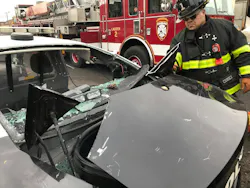
When a police vehicle is the focus of a rescue, the mission looks familiar on paper but is fundamentally different in practice. Yes, the basics of motor vehicle extrication still apply: size up the scene, stabilize the vehicle, gain access, provide medical care, disentangle and remove the patient. Every step is layered with variables that change the calculus for fire and rescue crews. However, a patrol car isn’t just another automobile. It’s a rolling toolbox, a communications hub and an evidence locker that has a weapons cache. That reality forces rescuers to think beyond metal and glass and to account for human factors, upfitted hardware, electrical systems, detainee dynamics and the emotional toll that comes when one of our brothers and sisters in blue is injured.
Pierce Manufacturing, Inc., an Oshkosh Corporation [NYSE:OSK] company, is the leading North American manufacturer of custom fire apparatus. Products include custom and commercial pumpers, aerials, rescue trucks, wildland trucks, mini-pumpers, elliptical tankers, and homeland security apparatus. In addition, Pierce designs its own foam systems and was the first company to introduce frontal airbags and the Side Roll Protection system to fire apparatus.
Training can’t be theoretical
Start with the fundamentals. Don’t skip the 360 size-up. Stabilization isn’t optional. It’s the foundation that lets you work swiftly and safely.
Modern extrication philosophy favors measured, controlled displacement over brute force. Precision work reduces secondary injury to occupants. The tools that you bring and the training that’s behind them define what you can attempt safely. Departments that practice with their actual equipment and run realistic scenarios with the vehicles that they will encounter will be far better prepared than those that don’t.
Capabilities are the limiting factor on scene. Consistent hands-on training and scenario work with the actual vehicles that are in your response area are essential. That might include hybrid and electric vehicle (EV) procedures and the PPE that goes with them, because those systems will change your approach. If you don’t know where the battery disconnects are or how to isolate a hybrid system, you gamble with rescuer and patient safety.
Training shouldn’t be theoretical. It should be tactile and repetitive and include the oddball vehicles and upfits that show up in your jurisdiction. The more familiar that your crews are with the automobiles that they will see, the fewer surprises that you will face when the clock is running.
Purpose-built & upfitted vehicles
Understanding vehicle anatomy is a core skill that becomes more important every year. Modern passenger vehicles use a mix of high-strength steels, boron reinforcements and engineered crush zones that behave uniquely under cutting and spreading. Airbag modules, seat belt pretensioners and battery packs all can be potential hazards if you cut in the wrong place. Police vehicles complicate that picture, because they come in two broad categories: engineered police package vehicles and upfitted civilian units. Each behaves differently in a crash, and each might demand a different mindset from rescuers.
Purpose-built vehicles that are engineered for police work often have heavier cooling systems than civilian automobiles have, reinforced frames and factory provisions for additional electrical loads. Those factory changes give predictable points of failure and known service locations, which can be an advantage during extrication. Upfitted civilian automobiles can be wildly variable depending on the upfitter’s choices. Push bumpers, radios, auxiliary batteries, custom consoles and other items can be installed in ways that change crush behavior and access points. What worked on legacy platforms, such as the Ford Crown Victoria, might not work on modern sedans, SUVs or electric police vehicles. Keep it simple and know what you’re cutting into before you cut.
Legacy body-on-frame cars were simple and predictable. Crews learned their crush behavior and adapted techniques accordingly. Modern sedans and SUVs, such as Dodge Chargers, Ford Explorers and GMC Tahoes, are engineered differently and often have denser electronics and more complex pillar structures than their predecessors had. EV and hybrid patrol vehicles add high-voltage battery packs, thermal runaway potential and unique disconnect procedures. Those batteries are heavy, often are located under the floor or in the rear, and can complicate stabilization and lifting. They also introduce fire behavior that differs from a traditional combustion motor vehicle fire and can reignite hours after the initial incident. Treat EVs with a different checklist and a different respect.
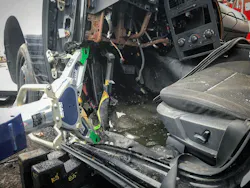
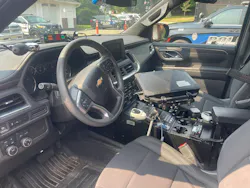
Upfitting elements matter in very practical ways. Push bumpers and winch mounts change front crush characteristics. Cages, prisoner partitions and center consoles reduce cockpit space and create new entrapment points. Weapon mounts, racks for long guns and plate carriers add mass and edges inside of the cabin. Additional batteries, siren amplifiers and lighting controllers increase the electrical load and add wiring harnesses that can short and ignite. Antennas and camera systems route cables through pillars and roofs, sometimes near air bag modules. Ballistic panels and reinforced doors change extrication strategies. The more layers that you find, the more deliberate that your cutting and spreading must be.
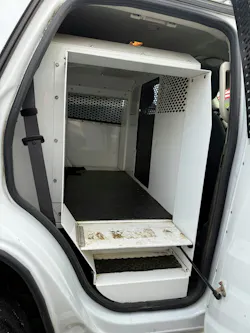
K-9 transport systems introduce unique challenges that are easy to overlook until you’re on scene. A trapped police canine isn’t just an animal welfare concern. An injured, frightened or protective canine can pose a significant safety risk to rescuers. Whenever possible, a canine handler or another officer who’s familiar with the animal should secure or remove the dog before extrication continues. Crews also should be aware of K-9-specific modifications, such as remote door releases, ventilation fans, temperature monitors and auxiliary wiring that add electrical complexity throughout the vehicle. Those systems can be routed in places that you otherwise might cut, and they can complicate both access and patient care.
The trunk on patrol cars and the rear cargo area on SUVs deserve as much attention as the passenger compartment. Patrol cars and SUVs often have custom trunk organization systems, like what you find in fire command vehicles. Drawers, cabinets and slide-out trays keep gear secure during patrol but add weight and change crush characteristics in a crash. Those compartments commonly store pepper spray, tear gas and other gear. Damage to these systems can scatter equipment into the cabin or make it inaccessible, and unsecured items can become projectiles during a collision.
Take a moment to consider everything that was in the vehicle, how it shifted and how it might affect your operation.
Specialized vehicles
Specialized units raise the stakes even higher. Emergency service units and SWAT, tactical and rescue vehicles essentially are mobile arsenals and people movers. These vehicles carry even more equipment than an SUV can handle plus technical police gear. They often have custom storage cabinets, auxiliary power systems, additional batteries and heavy-duty suspension upgrades to support the payload. The sheer amount of equipment affects vehicle stability, alters access points and dictates different extrication tactics. There’s a difference between chocking four points on a Dodge Charger and setting up struts on a BearCat-type vehicle.
Know which specialized units operate in your response district and what they carry, so you can plan stabilization and access accordingly.
Ballistics protection
Ballistic protection packages are another variable that changes the game. Many agencies outfit patrol cars and SUVs with ballistic door panels, reinforced window inserts, ballistic seat backs or other armor that’s designed to protect officers from gunfire. Those additions substantially increase the strength and thickness of elements, which makes conventional cutting and spreading techniques slower. Expect slower progress and the possible need to change cutting locations or to bring heavier equipment.
Knowing which agencies in your jurisdiction and their mutual aid use armored or ballistic-enhanced vehicles can save valuable time and reduce risk during a complex extrication.
Human factor
The human factor inside of a police vehicle is unique. Officers routinely wear plate carriers and duty belts that are loaded with all their respective gear.
These people sometimes carry long guns or additional weapons in the vehicle.
When police officers are injured, their gear can impede extrication and present challenges to rescuers. If a detainee is present, custody and safety considerations are layered on top of medical priorities. Weapons must be secured, and restraints must be considered.
Unified command
Scene control and unified command are critical when emotions run high. Incidents that involve police vehicles often become charged quickly, because police officers are protective of their own, supervisors arrive with urgency, and bystanders or other motorists might escalate the situation. Early establishment of unified command, with clear roles for fire, police and EMS, prevents conflicting priorities from derailing the rescue. A police supervisor can be invaluable in calming officers, securing weapons and managing custody issues, so fire and rescue can focus on patient care and extrication.
Involve public information officers (PIOs) early. In today’s world, any scene that has emergency lights is newsworthy, and uncontrolled information flow can complicate things.
Investigations add another operational constraint. Police vehicles often are evidence hubs. Onboard cameras, radios and consoles might contain critical data. Preserving that evidence while conducting a time-sensitive rescue requires coordination. Expect to remain on scene for the duration of the rescue, the investigation and the cleanup.
The unified command structure should include an investigative lead who can advise on evidence preservation without obstructing lifesaving measures. Document your actions, photograph the scene when possible and communicate decisions so that investigators understand why lifesaving steps were taken.
Anticipate the variables
Training together is the single most effective mitigation for the unknown. Joint police and fire extrication drills build trust, clarify expectations and reveal procedural gaps before they cost lives. Include scenarios that involve K-9s, different vehicle platforms and heavily upfitted units. Run tabletop exercises that include PIOs and investigators, so everyone understands the timeline and information flow. Make sure that your standard operating procedures and standard operating guidelines address who secures weapons, who controls the detainee and how evidence is handled during a rescue.
Command presence and emotional control matter. A calm authoritative incident commander (IC) who enforces scene safety, manages resources and keeps communication channels open will defuse many potential issues. Sometimes, that means a police supervisor stepping in to calm their personnel so fire and rescue can work. Sometimes, it means the fire chief or IC asserting control to protect rescuers and patients. Either way, the goal is the same: Get the injured out, preserve life and protect the integrity of the scene.
Nobody wants to be the crew that faces a police vehicle entrapment for the first time under pressure. If you prepare, know the vehicles that are in your response area, understand common upfits and train with your police partners, you will be a step ahead when it happens. The mission doesn’t change. The variables do. Anticipate them and train for them. Respect the complexity, control the scene, and get your brothers and sisters in blue home.
Thank you to all of my friends and colleagues in law enforcement for their assistance, including Dave Murphy, who is chief of police of the Wyckoff, NJ, Police Department.
About the Author
 Robert Policht
Robert Policht
Robert Policht, who is a Firehouse contributing editor, is lieutenant of Ladder Co. 2 of the Passaic, NJ, Fire Department. He assisted with developing and establishing the department’s response to human vs. machine incidents and is attached to the Fire Investigation Unit. Policht started his career as a volunteer and has served as a chief of department. He taught at the Bergen County, NJ, Fire Academy and is a member of the NJ Division of Fire Safety's Fire Threat Task Force. Policht has a master’s degree in emergency management and homeland security from Arizona State University and has been published in several trade publications. He is a founder of and contributor to Flow and Vent, which is a website that's dedicated to fire and rescue training.